
Privacy by Design Principles: The 7 Rules for Secure Architecture
Privacy by design principles treat data protection as a default setting rather than an afterthought, preventing breaches before code is written.
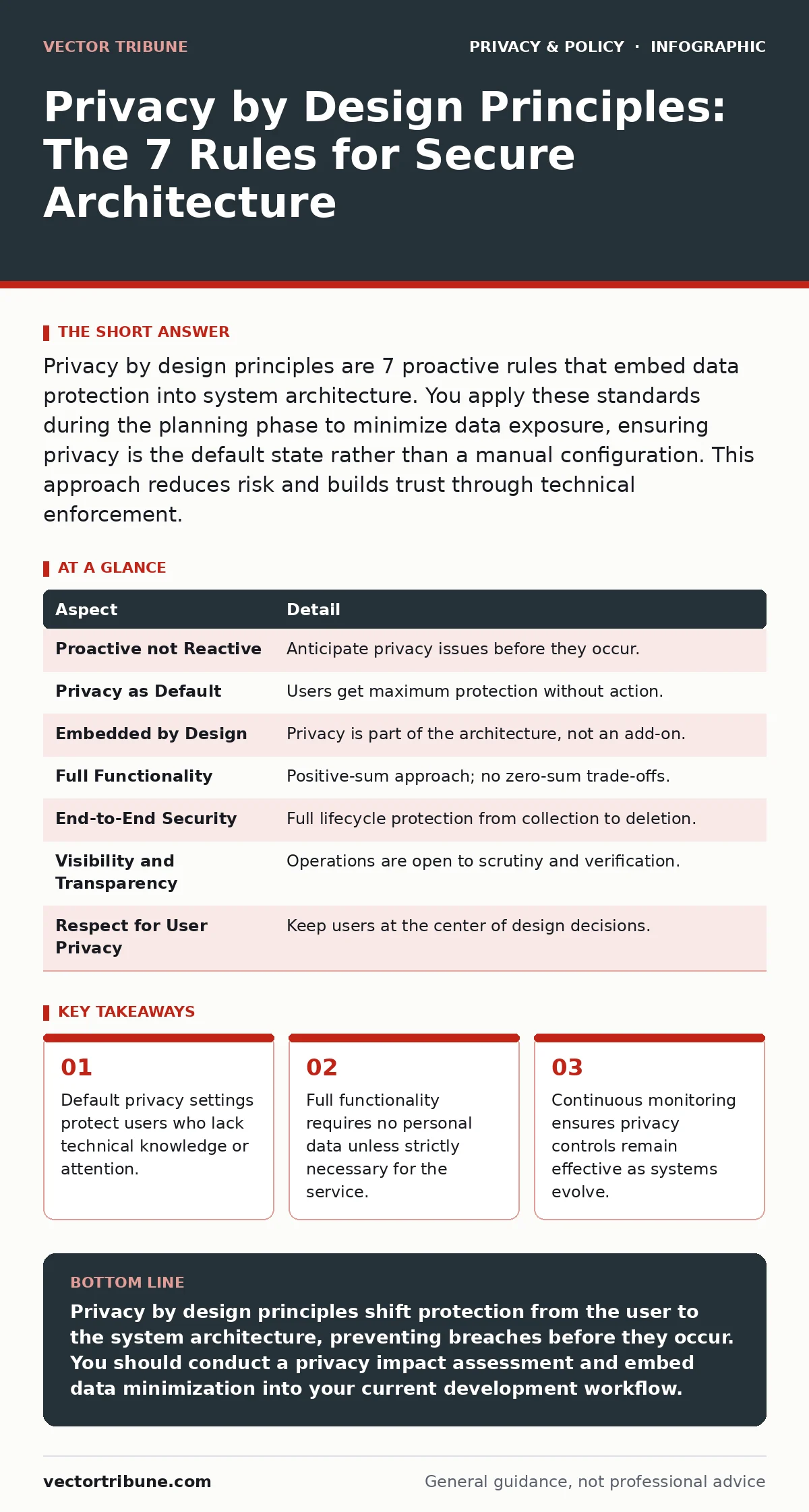
Privacy by design principles are 7 proactive rules that embed data protection into system architecture. You apply these standards during the planning phase to minimize data exposure, ensuring privacy is the default state rather than a manual configuration. This approach reduces risk and builds trust through technical enforcement.
Everyday Analogy: The Vault Door
Imagine designing a home security system. A reactive approach installs a camera that records a break-in and alerts the police afterward. Privacy by design builds a vault door that requires a specific key to open. The structure itself prevents unauthorized access. You do not hope the thief will leave a note. You engineer the entry point so that intrusion is physically difficult. This shifts the burden from user behavior to system architecture.
Privacy by design principles are a framework for embedding data protection into the development lifecycle. You apply these rules before writing code. The goal is to make privacy the default setting. Users do not need to configure complex settings to stay safe. The system protects them automatically.
| Aspect | Detail |
|---|---|
| Proactive not Reactive | Anticipate privacy issues before they occur. |
| Privacy as Default | Users get maximum protection without action. |
| Embedded by Design | Privacy is part of the architecture, not an add-on. |
| Full Functionality | Positive-sum approach; no zero-sum trade-offs. |
| End-to-End Security | Full lifecycle protection from collection to deletion. |
| Visibility and Transparency | Operations are open to scrutiny and verification. |
| Respect for User Privacy | Keep users at the center of design decisions. |
Privacy by Design Principles Explained
The framework consists of 7 foundational principles. You must understand each rule to implement them correctly. The first principle is proactive, not reactive. You anticipate potential privacy breaches and mitigate them before they happen. This requires threat modeling during the design phase. You identify where data flows and where it might leak.
The second principle is privacy as the default. Every product should offer the highest level of privacy automatically. Users should not have to opt-in to protection. This protects individuals who lack technical expertise or time. It also reduces the attack surface by minimizing unnecessary data collection.
The third principle is embedded by design. Privacy is not an add-on feature. It is woven into the core architecture. You cannot patch privacy into a system later. The data model, the database schema, and the API endpoints must reflect privacy constraints from day one.
Who It Affects and What To Do
Developers, product managers, and legal teams all share responsibility for these standards. You must collaborate early in the project. Legal teams define the requirements. Developers implement the technical controls. Product managers ensure the user experience remains smooth.
You start by conducting a privacy impact assessment. This document maps data flows and identifies risks. You then apply the remaining principles. The fourth principle is full functionality. You must achieve both privacy and security goals without compromising utility. This is a positive-sum approach. You do not sacrifice features for privacy. You find ways to protect data while maintaining functionality.
For example, you can use pseudonymization. This technique replaces identifiers with artificial codes. You retain the ability to analyze data trends without exposing individual identities. This satisfies both business needs and privacy requirements.
Technical Implementation Strategies
You implement these principles through specific technical controls. Data minimization is key. You collect only the data you strictly need. If you do not need a user's address, you do not ask for it. This reduces the impact of any future breach.
You also apply purpose limitation. Data collected for one purpose cannot be used for another without explicit consent. This prevents function creep. You enforce this through access controls and data tagging.
Encryption is another critical control. You encrypt data at rest and in transit. This ensures that even if data is stolen, it remains unreadable. You must manage encryption keys securely. Losing keys means losing data. This is a trade-off between security and availability.
You should also consider end-to-end encryption for sensitive communications. This ensures that only the sender and receiver can read the message. The service provider cannot access the content. This aligns with the principle of end-to-end security.
What People Usually Get Wrong
Many teams misunderstand these principles. They treat privacy as a compliance checkbox. They add terms of service and hope users read them. This is not privacy by design. It is privacy by notice. You cannot design your way out of bad architecture with a legal disclaimer.
Another common mistake is assuming that anonymization is sufficient. True anonymization is difficult to achieve. Re-identification attacks can often link anonymous data back to individuals. You must use robust techniques like k-anonymity or differential privacy. These methods add noise or aggregate data to prevent identification.
Teams also often ignore the user experience. They assume privacy controls will slow down users. This is a false dichotomy. Good design makes privacy invisible. Users should not feel the friction of privacy controls. They should simply feel safe.
See also: Cloud Backup Scams: How to Spot Fake Recovery Services · Tracker Blockers: How They Work and What They Break
Common Pitfalls in Execution
You must avoid several pitfalls during implementation. One major pitfall is retrofitting privacy. You cannot add privacy to a legacy system easily. The data model is already fixed. Changing it requires significant refactoring. You must plan for privacy from the start.
Another pitfall is ignoring third-party vendors. Your system may be secure, but your vendors may not be. You must audit your supply chain. Ensure that vendors adhere to similar privacy standards. This extends the protection to the entire ecosystem.
You must also consider the lifespan of data. Data retention policies are critical. You should delete data when it is no longer needed. Storing data indefinitely increases risk. You must automate data deletion processes. Manual deletion is error-prone and inconsistent.
Integration with Related Frameworks
Privacy by design works best when combined with other security practices. You should integrate it with consent management systems. These systems track user permissions and ensure compliance. You must update consent records when policies change.
You should also consider browser cookies and tracking technologies. Many privacy issues arise from third-party cookies. You can implement strict cookie policies to limit tracking. This respects user privacy and reduces data exposure.
For mobile applications, you must review smartphone privacy settings. Users can control app permissions at the OS level. Your app should respect these settings. If a user denies camera access, your app should not crash. It should degrade gracefully.
Final Steps for Implementation
You must establish a continuous improvement process. Privacy threats evolve. New vulnerabilities emerge. You must monitor your systems for changes. You should conduct regular privacy audits. These audits verify that controls are effective.
You must also train your team. Developers need to understand privacy principles. They need to know how to implement them. You should include privacy training in your onboarding process.
Finally, you must be transparent. Users want to know how their data is used. You should provide clear privacy notices. You should allow users to access and delete their data. This builds trust and demonstrates respect for user privacy.
Privacy by Design Principles Checklist
You can use this checklist to verify your implementation.
- Conduct a privacy impact assessment before development.
- Set default settings to the highest privacy level.
- Minimize data collection to only what is necessary.
- Encrypt data at rest and in transit.
- Implement automated data deletion policies.
- Audit third-party vendors for privacy compliance.
- Provide clear and transparent privacy notices.
Key takeaways
- Default privacy settings protect users who lack technical knowledge or attention.
- Full functionality requires no personal data unless strictly necessary for the service.
- Continuous monitoring ensures privacy controls remain effective as systems evolve.
Privacy by design principles shift protection from the user to the system architecture, preventing breaches before they occur. You should conduct a privacy impact assessment and embed data minimization into your current development workflow.
Frequently asked questions
How does privacy by design differ from GDPR compliance?
Privacy by design is a technical framework for building systems. GDPR is a legal regulation. You use privacy by design to achieve GDPR compliance.
Can small startups implement privacy by design?
Yes. You can start with basic data minimization and default privacy settings. You do not need complex tools to begin.
Does privacy by design slow down development?
It may slow initial planning but reduces rework and legal risks later. It streamlines the long-term development process.
How do I handle third-party cookies?
You should limit third-party cookies to essential functions. You must provide users with clear opt-out mechanisms.
How this guide was produced: written by the Vector Tribune editorial team with AI assistance, checked against the public references listed below, and reviewed when the facts change. See our editorial policy or report an error.