
Consent Management Mistakes That Break Your Legal Compliance
Silent data flows and buried opt-outs invalidate consent, turning your privacy program into a liability rather than a shield against regulatory action.
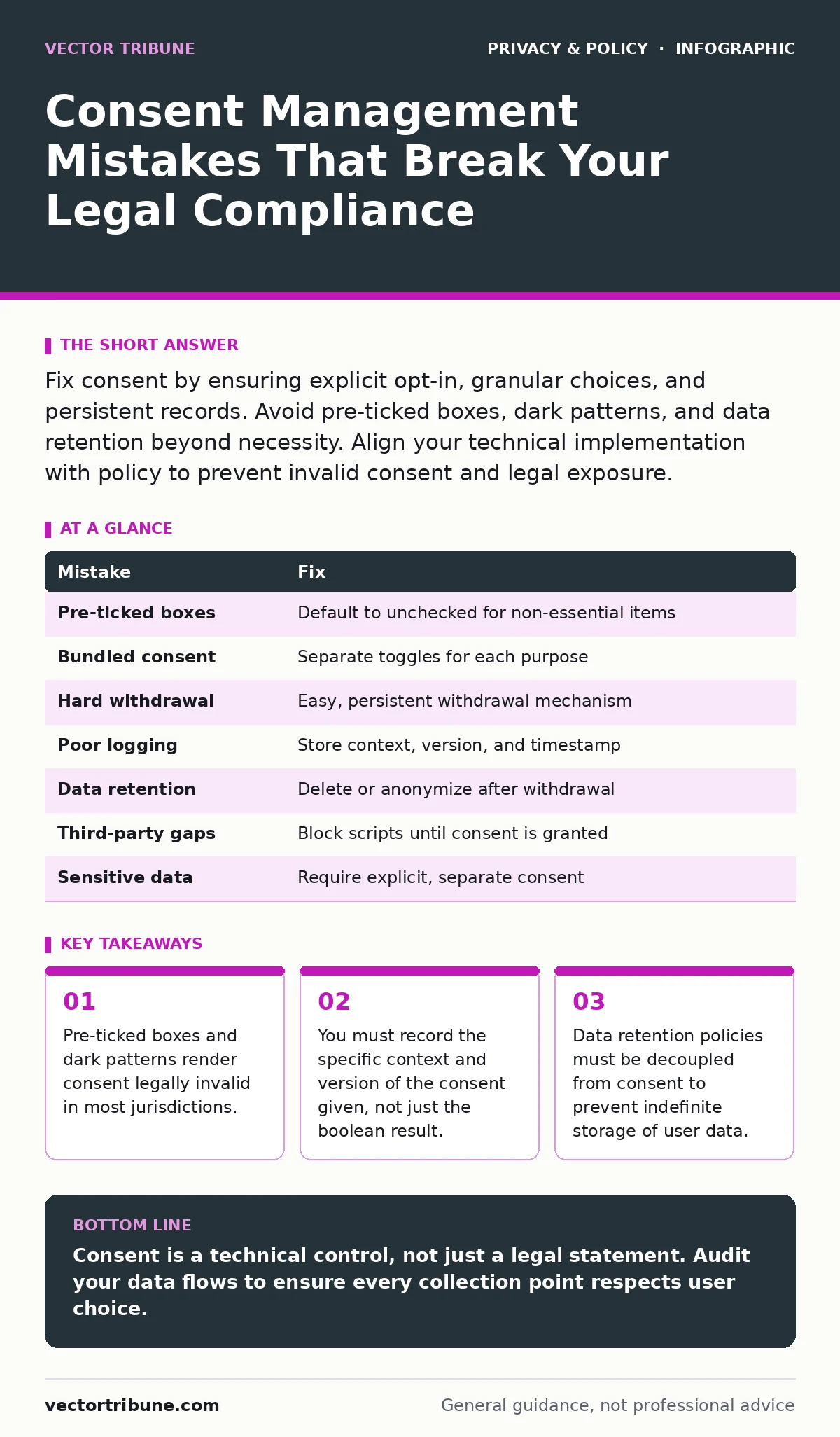
Fix consent by ensuring explicit opt-in, granular choices, and persistent records. Avoid pre-ticked boxes, dark patterns, and data retention beyond necessity. Align your technical implementation with policy to prevent invalid consent and legal exposure.
Consent is not a one-time legal hurdle. It is a continuous operational process that requires technical precision. Many organizations treat consent as a marketing checkbox rather than a data governance control. This mindset leads to systemic failures that expose the organization to regulatory scrutiny and user distrust.
Mistake 1: Using Pre-Ticked Boxes for Non-Essential Data
Organizations often default to pre-ticked checkboxes for analytics or marketing cookies to maximize data collection. This assumes silence equals agreement. Regulatory frameworks generally require active, unambiguous affirmation.
Why it hurts:
Pre-ticked boxes fail the standard for informed consent. If a user does not actively select an option, they have not consented. This invalidates the legal basis for processing that data. You cannot rely on this data for profiling or targeted advertising without risking non-compliance.
The fix:
Implement default unchecked states for all non-essential processing. Essential cookies, such as those required for session management or security, do not require consent. Everything else must start in a denied state. The user must take a deliberate action to enable these services.
Mistake 2: Bundling Consent for Unrelated Purposes
Many interfaces present a single "Accept All" button that covers data processing for multiple unrelated purposes. This bundles operational necessities with optional marketing activities. It forces users to accept broad terms to access basic functionality.
Why it hurts:
Consent must be specific to the purpose of processing. Bundling prevents users from giving granular permission. If a user agrees to a bundle, regulators may view the consent for specific purposes as invalid because it was not separate. This creates a legal gap in your data processing activities.
The fix:
Separate consent requests by purpose. Group related functions, such as first-party analytics, but keep them distinct from third-party advertising. Provide clear, individual toggles for each category. This aligns with the principle of purpose limitation.
Mistake 3: Ignoring the Right to Withdraw
Consent is revocable at any time. Many systems make the withdrawal process difficult or hidden. Users must be able to withdraw consent as easily as they gave it.
Why it hurts:
If withdrawal is harder than consent, the initial consent is considered flawed. Blocking a user’s ability to withdraw quickly can be interpreted as a dark pattern. This undermines the validity of all prior consent records. It also violates the core principle of user control over personal data.
The fix:
Provide a persistent, accessible mechanism for withdrawing consent. This should be available in the user account settings and via a global preference center. The system must immediately stop processing data for the withdrawn purpose. Document the withdrawal timestamp for audit trails.
Mistake 4: Failing to Record Consent Context
Many systems store only a boolean value indicating whether consent was given. They ignore the context, such as the exact wording presented, the version of the policy, and the timestamp.
Why it hurts:
You must prove that consent was freely given, specific, and informed. A boolean value is insufficient evidence during an audit. If the policy changes, you cannot determine which version the user agreed to. This makes it impossible to demonstrate compliance with historical requirements.
The fix:
Store detailed consent logs. Include the timestamp, the IP address, the user agent, the specific text presented, and the policy version. This creates an immutable audit trail. It allows you to reconstruct the exact moment of consent.
Mistake 5: Retaining Data After Consent Withdrawal
When a user withdraws consent, many systems continue to retain the historical data. They assume that past consent allows indefinite storage. This is a common misunderstanding of data retention laws.
Why it hurts:
Withdrawal of consent requires you to stop processing and often to delete the data. Retaining data without a new legal basis is unlawful. It increases your liability in the event of a breach. You are holding data that the user explicitly rejected.
The fix:
Implement automated data deletion or anonymization workflows triggered by consent withdrawal. Ensure your data retention policy aligns with your consent records. If you need to retain data for legal reasons, such as tax compliance, document this separate legal basis clearly.
Mistake 6: Overlooking Third-Party Consent Chains
Organizations often focus on their own consent mechanisms while ignoring third-party vendors. These vendors may inject scripts that collect data before your consent banner loads. This is known as non-compliant data flow.
Why it hurts:
You are responsible for the data collected by your vendors. If a third party collects data without valid consent, you are liable. This is especially prevalent with analytics and advertising partners. It creates a hidden compliance risk that is difficult to detect.
The fix:
Audit all third-party scripts for consent compliance. Use consent management platforms that block third-party tags until consent is granted. Require vendors to provide documentation of their consent handling. This ensures the entire data supply chain is compliant.
Mistake 7: Assuming Consent Covers All Data Types
Some organizations assume that general consent covers sensitive data categories, such as health or political opinions. This is a critical error in data classification.
Why it hurts:
Sensitive data requires higher standards of protection and often explicit, separate consent. General consent is insufficient for special category data. Processing this data without specific consent can lead to severe penalties. It also erodes user trust significantly.
The fix:
Identify and isolate sensitive data processing activities. Require explicit, separate consent for these categories. Do not bundle them with general service terms. Ensure your technical systems can distinguish between general and sensitive data flows.
| Mistake | Fix |
|---|---|
| Pre-ticked boxes | Default to unchecked for non-essential items |
| Bundled consent | Separate toggles for each purpose |
| Hard withdrawal | Easy, persistent withdrawal mechanism |
| Poor logging | Store context, version, and timestamp |
| Data retention | Delete or anonymize after withdrawal |
| Third-party gaps | Block scripts until consent is granted |
| Sensitive data | Require explicit, separate consent |
Key takeaways
- Pre-ticked boxes and dark patterns render consent legally invalid in most jurisdictions.
- You must record the specific context and version of the consent given, not just the boolean result.
- Data retention policies must be decoupled from consent to prevent indefinite storage of user data.
Consent is a technical control, not just a legal statement. Audit your data flows to ensure every collection point respects user choice.
Frequently asked questions
Does consent cover data collected before the user visits the site?
No, consent applies to future processing. Historical data collected without consent must be deleted unless another legal basis applies.
How long should consent records be stored?
Store records for the duration of the data retention period plus any statutory limitation periods for legal claims.
Can I use consent for legitimate interests?
No, consent and legitimate interests are separate legal bases. Do not mix them for the same processing activity.
What if a user changes their mind mid-session?
The system must immediately respect the new preference. Block any further data collection for the withdrawn purposes.
How this guide was produced: written by the Vector Tribune editorial team with AI assistance, checked against the public references listed below, and reviewed when the facts change. See our editorial policy or report an error.