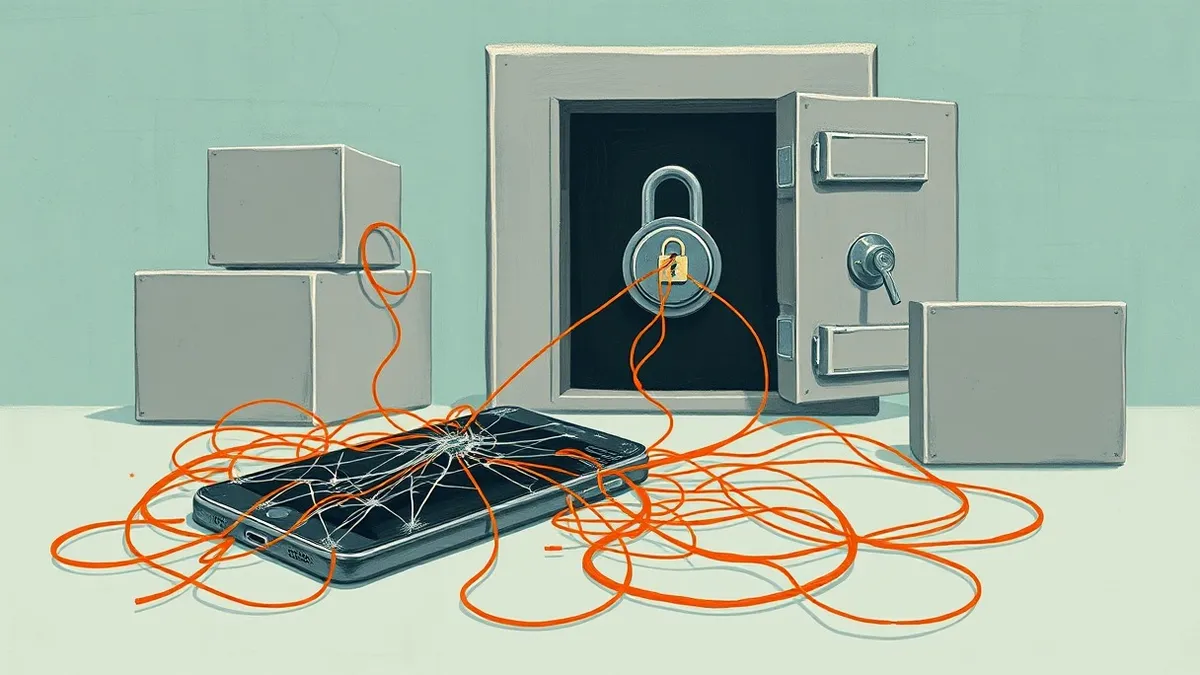
Is End-to-End Encryption Safe? The Real Risks and Limits
Encryption protects data in transit, but compromised devices and weak metadata handling expose your secrets regardless of how strong the cryptographic keys are.
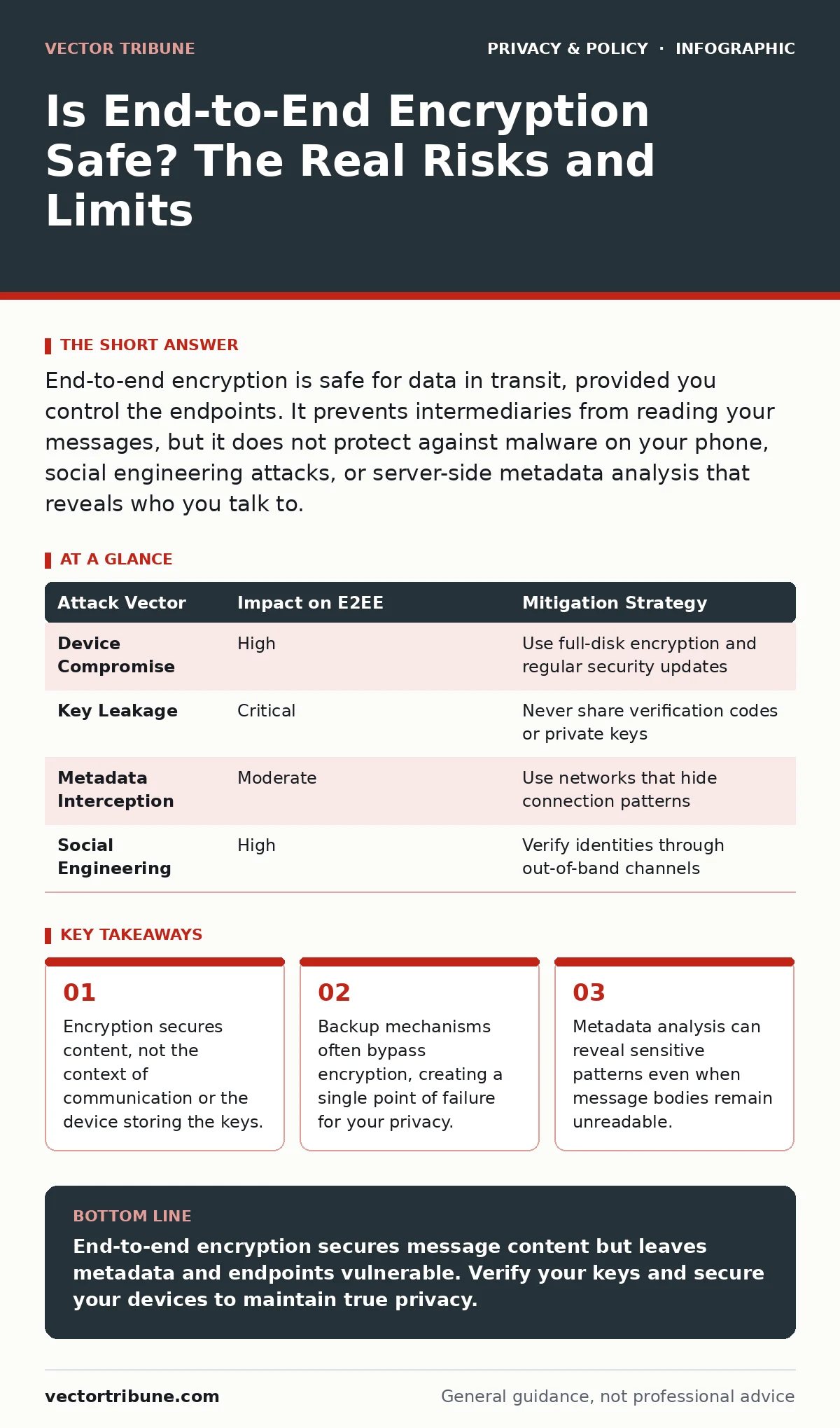
End-to-end encryption is safe for data in transit, provided you control the endpoints. It prevents intermediaries from reading your messages, but it does not protect against malware on your phone, social engineering attacks, or server-side metadata analysis that reveals who you talk to.
Is end to end encryption safe for your private messages?
Yes, end-to-end encryption is safe for preventing unauthorized access to message content during transmission. The cryptographic keys required to decrypt the data exist only on the sender's and receiver's devices. No third party, including the service provider, holds the decryption keys. This architecture ensures that even if an attacker intercepts the data packets, the information remains mathematically unreadable. The safety relies entirely on the secrecy of your private keys and the integrity of your devices.
How does end-to-end encryption actually work under the hood?
The system uses a combination of asymmetric and symmetric cryptography to secure your communications. When you start a conversation, your device generates a unique pair of cryptographic keys: one public and one private. The public key encrypts the message, while only the corresponding private key can decrypt it. Modern protocols often use the Signal Protocol, which implements the Double Ratchet algorithm. This mechanism continuously updates the encryption keys for every message. Key rotation limits the damage of a compromised key, ensuring past and future messages remain secure even if one session is breached.
What are the specific conditions where encryption fails?
Encryption fails when the endpoints are compromised or when the implementation is flawed. If malware infects your smartphone, it can read messages before they are encrypted or after they are decrypted. The encryption layer cannot protect data that is already visible to the operating system. Another failure point is weak key management. If you reuse passwords or store backup keys in insecure cloud storage, attackers can bypass the encryption entirely. Human error remains the largest vulnerability in any cryptographic system.
| Attack Vector | Impact on E2EE | Mitigation Strategy |
|---|---|---|
| Device Compromise | High | Use full-disk encryption and regular security updates |
| Key Leakage | Critical | Never share verification codes or private keys |
| Metadata Interception | Moderate | Use networks that hide connection patterns |
| Social Engineering | High | Verify identities through out-of-band channels |
Does end-to-end encryption protect your metadata?
No, standard end-to-end encryption does not protect metadata. Metadata includes information about the communication, such as who you talk to, when, and how often. Service providers often retain this data for operational purposes. Law enforcement agencies can request metadata without needing decryption keys. While the content of your message is hidden, the pattern of your behavior is visible. This allows analysts to map social networks and predict activities. True privacy requires minimizing metadata exposure, which standard encryption protocols do not address.
What happens if you lose your encryption keys?
You lose access to your data permanently. End-to-end encryption relies on the principle that the service provider cannot recover your data. If you lose your device or forget your backup passphrase, there is no "forgot password" function that bypasses the cryptography. The data remains encrypted on the server, but without the private key, it is mathematically impossible to decrypt. This trade-off is necessary for security. Convenience is sacrificed to ensure that no backdoor exists for attackers or malicious insiders. Plan your key recovery strategy before you encrypt sensitive data.
See also: Post-Quantum Crypto Mistakes and How to Fix Them · Mobile Security Architecture: 8 Practices for Device Integrity
How do cloud backups affect end-to-end security?
Cloud backups often bypass end-to-end encryption, creating a significant security gap. Many services encrypt messages in transit but store backups in a way that the provider can access. This allows for account recovery but exposes your data to server-side attacks. If the backup service is compromised, your entire message history is exposed. You must verify whether your backup is encrypted with a key that only you control. Some applications allow you to encrypt backups locally before uploading them. This adds an extra layer of protection but increases the risk of data loss if you lose the local key.
Can law enforcement bypass end-to-end encryption?
Law enforcement cannot mathematically break strong end-to-end encryption. However, they can bypass it by targeting the endpoints or the metadata. They may seize physical devices to access decrypted messages directly. They can also compel service providers to hand over metadata, which reveals communication patterns. In some cases, legal pressure forces companies to implement weak security features or backdoors. These measures degrade security for all users. The cryptographic strength of the protocol remains intact, but the surrounding ecosystem may be vulnerable to legal and physical coercion.
What advanced threats should you consider?
You must consider side-channel attacks and implementation flaws. Side-channel attacks analyze power consumption, electromagnetic leaks, or timing information to deduce encryption keys. These attacks are rare but possible against poorly implemented systems. Implementation flaws, such as buffer overflows or logic errors in the cryptographic library, can also expose data. Open-source implementations allow for independent security audits, which reduce the risk of hidden backdoors. Closed-source applications rely on trust in the vendor. For maximum security, prefer applications with transparent, audited codebases and established cryptographic standards.
How do you verify the security of your communication?
You verify security by checking the cryptographic keys directly. Most secure applications provide a safety number or QR code that you can compare with your contact. This process, known as key fingerprint verification, ensures that you are talking to the intended person and not an imposter. It protects against man-in-the-middle attacks where an attacker intercepts and relays the connection. Verification is a manual step that many users skip. For high-stakes communications, always verify the key fingerprint through a trusted, out-of-band channel.
Key takeaways
- Encryption secures content, not the context of communication or the device storing the keys.
- Backup mechanisms often bypass encryption, creating a single point of failure for your privacy.
- Metadata analysis can reveal sensitive patterns even when message bodies remain unreadable.
End-to-end encryption secures message content but leaves metadata and endpoints vulnerable. Verify your keys and secure your devices to maintain true privacy.
Frequently asked questions
Does end-to-end encryption protect my photos?
Yes, if the application encrypts media files before upload. Ensure that the service does not store unencrypted thumbnails or previews on its servers.
Is WhatsApp end-to-end encrypted by default?
WhatsApp uses end-to-end encryption for chats by default. However, backups to iCloud or Google Drive may not be encrypted with keys you control.
Can I use end-to-end encryption for email?
Standard email is not end-to-end encrypted. You must use PGP or S/MIME to encrypt emails, which requires both parties to manage keys.
Does turning off encryption improve battery life?
No, modern processors handle encryption efficiently. The battery impact of cryptographic operations is negligible compared to other system processes.
How this guide was produced: written by the Vector Tribune editorial team with AI assistance, checked against the public references listed below, and reviewed when the facts change. See our editorial policy or report an error.