Encryption in a Sentence: How Scrambling Data Protects Your Digital Life
Encryption transforms readable data into unreadable code using mathematical keys, ensuring only authorized parties with the correct decryption key can access the original information.
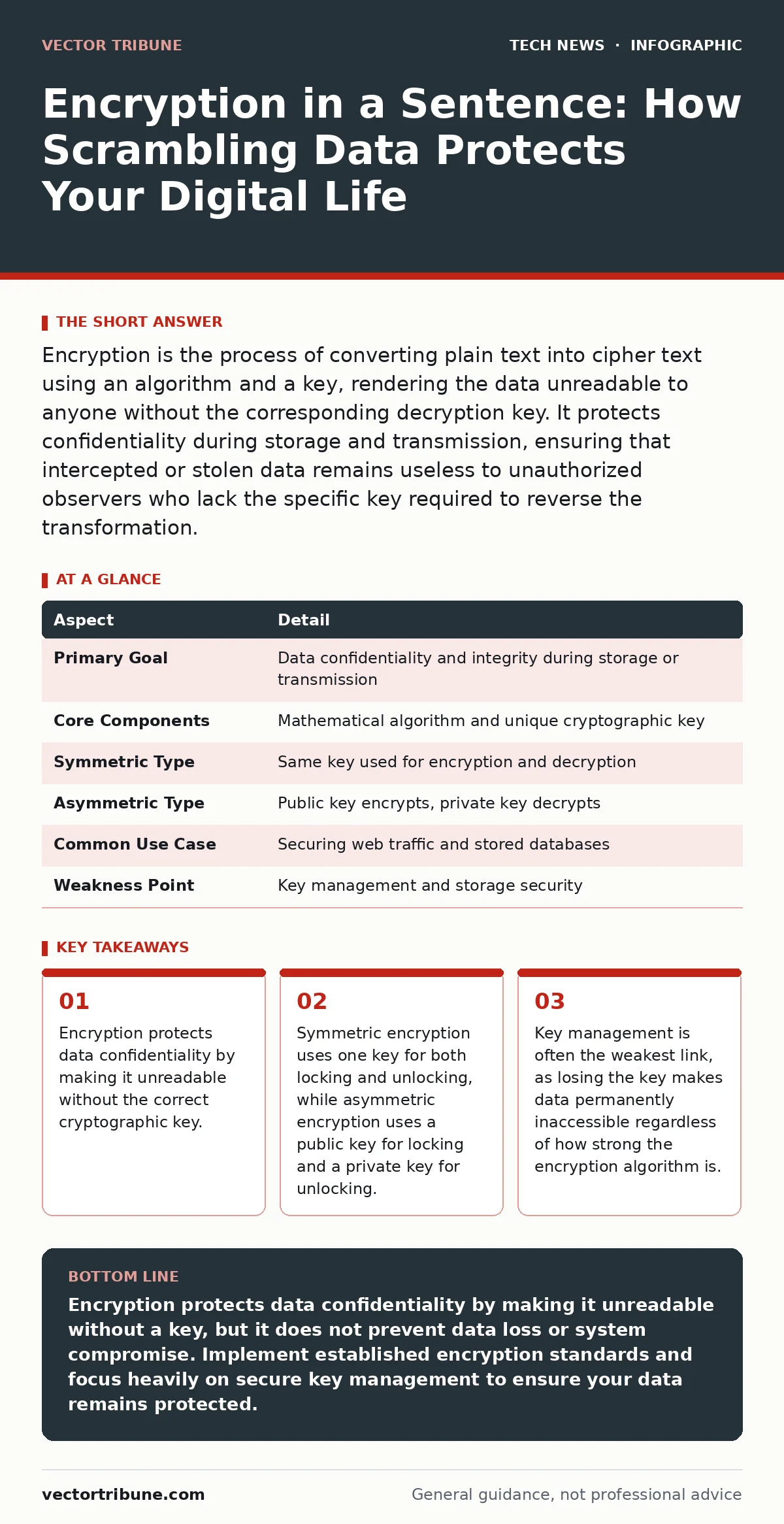
Encryption is the process of converting plain text into cipher text using an algorithm and a key, rendering the data unreadable to anyone without the corresponding decryption key. It protects confidentiality during storage and transmission, ensuring that intercepted or stolen data remains useless to unauthorized observers who lack the specific key required to reverse the transformation.
How Encryption Works in Practice
Imagine sending a sealed letter through a postal system where every post office worker can open the mail. Without protection, anyone handling the letter reads your contents. Encryption acts as a locked box that only the recipient can open. You place your message inside, lock it with a mathematical key, and send the box. Even if someone intercepts the box, they cannot read the message because they lack the specific key required to unlock it.
The mechanism relies on two core components: the algorithm and the key. The algorithm is the set of mathematical rules that scrambles the data. The key is a unique string of bits that determines exactly how the algorithm rearranges the data. Without the key, the algorithm produces random noise. With the correct key, the algorithm reverses the process, restoring the original plain text. This separation allows you to share the algorithm publicly while keeping the key secret.
Encryption in a sentence is the transformation of readable information into a secure, unreadable format using a cryptographic key and algorithm. This definition captures the essence of the technology: it is not merely hiding data, but mathematically altering its structure. The strength of this protection depends on the complexity of the algorithm and the length of the key. Longer keys provide more possible combinations, making brute-force attacks computationally impractical.
| Aspect | Detail |
|---|---|
| Primary Goal | Data confidentiality and integrity during storage or transmission |
| Core Components | Mathematical algorithm and unique cryptographic key |
| Symmetric Type | Same key used for encryption and decryption |
| Asymmetric Type | Public key encrypts, private key decrypts |
| Common Use Case | Securing web traffic and stored databases |
| Weakness Point | Key management and storage security |
Symmetric Versus Asymmetric Methods
You must choose between two main approaches based on your needs. Symmetric encryption uses the same key for both encrypting and decrypting data. This method is fast and efficient, making it ideal for large volumes of data like database backups or file storage. However, you must securely share the key with the recipient before sending any data. If an attacker intercepts the key exchange, the entire system fails.
Asymmetric encryption uses a pair of keys: a public key and a private key. You share the public key openly, allowing anyone to encrypt messages for you. Only your private key, which you keep secret, can decrypt those messages. This solves the key exchange problem but is slower and more computationally expensive. Most modern systems use a hybrid approach. They use asymmetric encryption to securely exchange a symmetric session key, then switch to symmetric encryption for the actual data transfer. This combines the security of key exchange with the speed of bulk encryption.
Who Encryption Affects
Encryption affects everyone who creates, stores, or transmits digital information. Software developers embed encryption libraries into applications to protect user data. System administrators configure servers to enforce encrypted connections. End users benefit from encryption when they use secure messaging apps or online banking. It also affects attackers, who must invest significant resources to bypass these protections.
Organizations face regulatory requirements to encrypt sensitive data. Failure to encrypt personal information can lead to legal penalties and loss of customer trust. Individuals face the risk of device theft. If your laptop is stolen and the drive is not encrypted, the thief can access your files. If the drive is encrypted, the thief only has a brick of data they cannot read. Understanding who holds the keys is critical. If you rely on a third-party service, they may hold the keys, meaning they can access your data if compelled or compromised.
What People Usually Get Wrong
Many assume encryption makes data invulnerable. This is incorrect. Encryption only protects confidentiality. It does not prevent data loss, ransomware encryption, or system crashes. If you lose the decryption key, your data is gone forever. No amount of computing power can recover it. This is the hidden cost of strong encryption: it creates a single point of failure in the key itself.
Another common misconception is that end-to-end encryption protects metadata. End-to-end encryption ensures only the sender and receiver can read the message content. However, it does not hide who you are talking to, when you are talking, or how much data you are sending. Network observers can still analyze traffic patterns. To protect metadata, you must use additional techniques like mixing services or tunneling protocols, which add complexity and latency to your connections.
Key Management Challenges
The security of your encryption depends entirely on how you manage your keys. Generating strong keys is easy; storing them securely is difficult. If you store keys in plain text on a server, an attacker who breaches the server can decrypt everything. If you store keys in a hardware security module, you add a layer of physical protection.
You must also plan for key rotation. Over time, keys may become compromised or algorithms may become obsolete. Rotating keys means generating new ones and re-encrypting old data. This process is resource-intensive and complex. If you do not rotate keys, you increase the window of opportunity for attackers who may have obtained a key through subtle means. You must balance the security benefit of rotation against the operational cost of re-encryption.
See also: Post-Quantum Crypto Mistakes and How to Fix Them · Mobile Security Architecture: 8 Practices for Device Integrity
Implementation Best Practices
Implementing encryption requires a holistic approach. Do not roll your own cryptographic algorithms. Use established, peer-reviewed libraries that have been tested by experts. Custom implementations often contain subtle flaws that attackers can exploit. Ensure you use strong key lengths and secure random number generators for key creation.
Integrate encryption into your development lifecycle. Encrypt data at rest and in transit. Use standard protocols for network communication. Verify that your configuration enforces strong cipher suites. Regularly audit your encryption settings to ensure they meet current security standards. Consider the impact on performance and usability. Strong security should not break your application or frustrate your users.
Related Security Measures
Encryption works best when combined with other security controls. For instance, Secure Boot ensures that the operating system loading on your device has not been tampered with, providing a trusted foundation for your encryption keys. If the boot process is compromised, an attacker could potentially extract keys before they are used.
Network segmentation using VLANs limits the spread of a breach. If an attacker gains access to one part of your network, VLANs prevent them from easily reaching servers that hold encryption keys or sensitive data. This containment reduces the attack surface and protects your cryptographic assets.
Operating system hardening reduces the number of vulnerabilities that an attacker could exploit to steal keys. By disabling unnecessary services and applying strict permissions, you make it harder for malware to access memory where keys might reside. Similarly, domain name security prevents attackers from redirecting your traffic to malicious servers that could intercept unencrypted data or steal credentials.
Mobile device security often relies on hardware-backed encryption. Modern smartphones store encryption keys in secure enclaves, making them resistant to software-based attacks. Understanding these hardware features helps you leverage the full protection available on your devices.
Network monitoring helps detect unusual traffic patterns that might indicate an attacker is attempting to steal keys or decrypt data. While encryption hides content, monitoring can reveal attempts to access key management systems or abnormal data exfiltration rates.
IPv6 security requires careful configuration to ensure that encryption is applied consistently across both IPv4 and IPv6 networks. Misconfigured IPv6 settings can create bypasses that expose unencrypted traffic.
Windows security settings include features like BitLocker for drive encryption. Configuring these settings correctly ensures that your local data is protected even if the physical device is lost or stolen.
Key takeaways
- Encryption protects data confidentiality by making it unreadable without the correct cryptographic key.
- Symmetric encryption uses one key for both locking and unlocking, while asymmetric encryption uses a public key for locking and a private key for unlocking.
- Key management is often the weakest link, as losing the key makes data permanently inaccessible regardless of how strong the encryption algorithm is.
- Encryption does not prevent data loss or system compromise; it only ensures that stolen data remains unintelligible to attackers who do not possess the decryption credentials.
Encryption protects data confidentiality by making it unreadable without a key, but it does not prevent data loss or system compromise. Implement established encryption standards and focus heavily on secure key management to ensure your data remains protected.
Frequently asked questions
Does encryption slow down my computer?
Modern processors have hardware instructions that accelerate encryption tasks, making the performance impact negligible for most users. The overhead is usually minimal compared to the security benefits.
Can hackers break encryption?
Breaking strong encryption through brute force is computationally impractical with current technology. Attackers typically target weak implementations, poor key management, or human error rather than the algorithm itself.
Is end-to-end encryption the same as transport encryption?
No. Transport encryption, like HTTPS, protects data between your device and the server. End-to-end encryption protects data between the sender and receiver, meaning the server cannot read the content.
What happens if I lose my encryption key?
You permanently lose access to the encrypted data. There is no backdoor or recovery method for strong encryption. You must maintain secure backups of your keys to prevent data loss.
How this guide was produced: written by the Vector Tribune editorial team with AI assistance, checked against the public references listed below, and reviewed when the facts change. See our editorial policy or report an error.