Domain Name System Security: Protecting DNS From Cache Poisoning and Hijacking
Domain name system security fails when organizations treat DNS as a passive utility rather than an active attack surface requiring cryptographic validation.
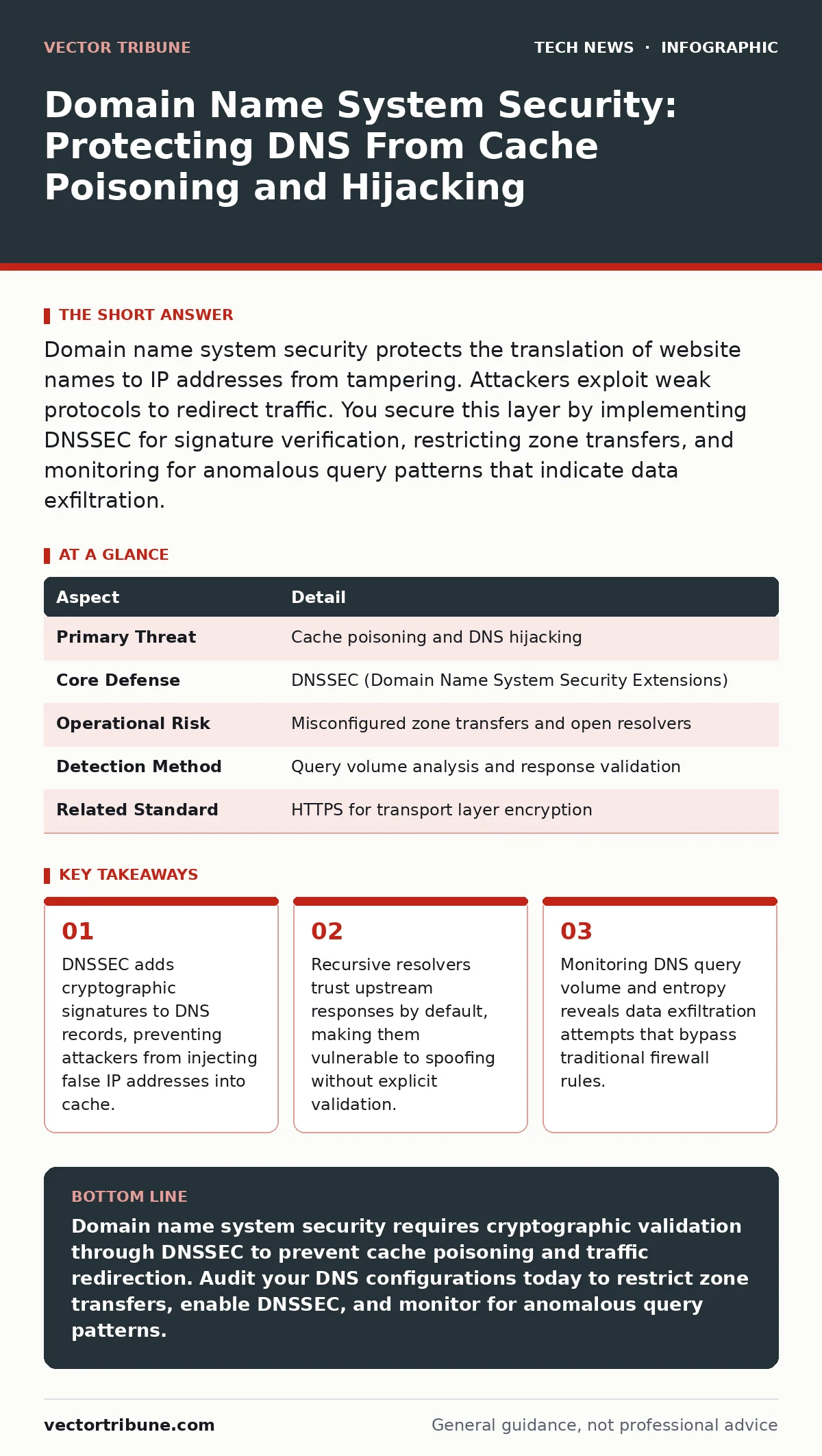
Domain name system security protects the translation of website names to IP addresses from tampering. Attackers exploit weak protocols to redirect traffic. You secure this layer by implementing DNSSEC for signature verification, restricting zone transfers, and monitoring for anomalous query patterns that indicate data exfiltration.
Understanding the Foundation of Domain Name System Security
Imagine walking into a library to find a specific book. You ask the librarian for the location, and they direct you to the wrong aisle. You end up reading a different book entirely, unaware that the initial direction was manipulated. The Domain Name System (DNS) functions as the internet’s librarian. It translates human-readable domain names into numerical IP addresses that computers use to locate each other. Domain name system security ensures that this translation process remains accurate and untampered.
The DNS protocol was designed in an era when trust was implicit. It operates on a hierarchical structure where root servers delegate authority to top-level domains, which then delegate to registrars and finally to authoritative name servers. This chain of delegation creates multiple points of failure. An attacker does not need to compromise the final server to redirect traffic. They only need to intercept or spoof a single response in the chain. This architectural fragility is why domain name system security requires active defense mechanisms rather than passive perimeter controls.
At a Glance: DNS Security Components
| Aspect | Detail |
|---|---|
| Primary Threat | Cache poisoning and DNS hijacking |
| Core Defense | DNSSEC (Domain Name System Security Extensions) |
| Operational Risk | Misconfigured zone transfers and open resolvers |
| Detection Method | Query volume analysis and response validation |
| Related Standard | HTTPS for transport layer encryption |
How DNS Resolution and Vulnerabilities Work
When you type a web address, your device sends a query to a recursive resolver. This resolver checks its local cache for a recent answer. If the record is missing or expired, the resolver traverses the DNS hierarchy. It queries the root servers, then the top-level domain servers, and finally the authoritative name server for the specific domain. Each step returns a referral or an answer. The resolver caches this result for a duration defined by the Time to Live (TTL) value.
The vulnerability lies in the lack of origin authentication. Standard DNS responses use UDP, a connectionless protocol. An attacker can send a forged response that arrives before the legitimate one. If the forged response contains the correct transaction ID and source port, the resolver accepts it as valid. This is known as cache poisoning. The resolver then serves the fake IP address to all subsequent users querying that domain. The victim connects to a malicious server that looks identical to the intended destination. This mechanism bypasses standard network monitoring because the traffic appears to be legitimate DNS resolution.
Who Is Affected by DNS Compromise
Domain name system security failures impact every entity that relies on internet connectivity. End users experience broken links, slow load times, or successful phishing attacks. They often blame the website owner or their internet service provider, unaware that the address translation layer was compromised. Organizations face broader risks. A compromised DNS record can redirect employees to malicious command-and-control servers. This facilitates lateral movement within corporate networks.
Developers face specific challenges. They often assume that if a browser shows a secure connection, the destination is legitimate. This assumption fails when DNS hijacking occurs before the TLS handshake. The browser connects to the attacker’s server, which presents a valid certificate for a different domain or uses a self-signed certificate that the user ignores. This interplay between DNS and encryption highlights why HTTPS alone is insufficient. You must secure the name resolution process to ensure you are talking to the correct server before encryption begins.
Implementing DNSSEC for Cryptographic Validation
DNSSEC adds a layer of digital signatures to DNS records. It does not encrypt the data. Instead, it allows resolvers to verify that the data originated from the authoritative source and has not been altered. Each zone in the DNS hierarchy generates a public-private key pair. The private key signs the DNS records. The public key is published in the parent zone. This creates a chain of trust from the root zone down to the specific domain.
Implementing DNSSEC requires careful key management. You must generate Key Signing Keys (KSK) and Zone Signing Keys (ZSK). The KSK signs the Delegation Signer (DS) record, which is published in the parent zone. The ZSK signs the actual resource records. Rotating these keys is critical. If a private key is compromised, attackers can sign arbitrary records. DNSSEC introduces complexity and slight latency due to cryptographic verification. However, it eliminates the possibility of cache poisoning for signed domains. Resolvers that support DNSSEC validation will reject unsigned or improperly signed responses. This forces the ecosystem toward a more secure baseline.
See also: VLANs in Networking: How Virtual Segments Control Traffic Flow · Operating System Hardening Techniques for Secure Infrastructure
What People Usually Get Wrong About DNS Defense
Many organizations believe that configuring firewalls is sufficient for domain name system security. Firewalls filter traffic based on IP addresses and ports. They do not inspect the content of DNS queries or responses for validity. An open resolver, which answers queries from any source, is a common misconfiguration. Attackers abuse these resolvers for amplification attacks or to bypass censorship. You must restrict recursive queries to trusted internal clients only.
Another misconception is that DNSSEC is optional for small organizations. Even a single domain can be used to redirect users to malicious content. The cost of implementation is low, but the cost of a breach is high. Organizations also neglect monitoring. DNS traffic is often excluded from security information and event management (SIEM) systems because it is considered low risk. This leaves a blind spot. Data exfiltration via DNS tunneling hides within standard query patterns. Without baseline monitoring, these anomalies go unnoticed. This relates closely to network monitoring practices, where visibility into all protocol layers is required.
Operational Hygiene and Advanced Protections
Beyond DNSSEC, operational hygiene reduces the attack surface. Restrict zone transfers to specific IP addresses. Zone transfers expose the entire DNS database to anyone who can request them. This information aids attackers in mapping your infrastructure. Use short TTL values for critical records. This limits the window of exposure if a record is compromised. However, short TTLs increase query volume, which can strain resolvers. You must balance security with performance.
Consider the future threat of post-quantum cryptography. Current DNSSEC algorithms rely on elliptic curve cryptography. Quantum computers could eventually break these signatures. While this threat is not immediate, planning for algorithm agility is prudent. Select DNSSEC implementations that support easy algorithm rotation.
This ensures you can transition to quantum-resistant signatures when they become standardized. Additionally, integrate DNS security with secure software development practices. Ensure that applications validate hostnames and certificates rigorously. Do not rely solely on the operating system’s DNS resolver. Some applications allow custom resolvers, which can be targeted for interception.
Detecting Anomalies in DNS Traffic
Effective domain name system security requires continuous monitoring. Look for spikes in query volume. A sudden increase in DNS requests often indicates malware communication or data exfiltration. Analyze query entropy. Normal queries have predictable patterns. High entropy in subdomain names suggests encoded data being sent via DNS tunneling. This technique bypasses firewalls because DNS traffic is allowed outbound.
Compare internal queries against threat intelligence feeds. If your devices are querying domains associated with known malicious infrastructure, isolate them immediately. Implement DNS filtering at the network edge. This blocks known bad domains before they reach endpoints. However, DNS filtering is reactive. It relies on prior knowledge of malicious domains. DNSSEC and validation are proactive measures that prevent the initial redirection. Combining both approaches provides layered defense. This complements encryption strategies by ensuring that the endpoint you are encrypting traffic to is actually the intended destination.
Key takeaways
- DNSSEC adds cryptographic signatures to DNS records, preventing attackers from injecting false IP addresses into cache.
- Recursive resolvers trust upstream responses by default, making them vulnerable to spoofing without explicit validation.
- Monitoring DNS query volume and entropy reveals data exfiltration attempts that bypass traditional firewall rules.
Domain name system security requires cryptographic validation through DNSSEC to prevent cache poisoning and traffic redirection. Audit your DNS configurations today to restrict zone transfers, enable DNSSEC, and monitor for anomalous query patterns.
Frequently asked questions
Does DNSSEC encrypt my DNS queries?
No, DNSSEC only signs records to verify their authenticity and integrity. It does not hide the contents of your queries from observers on the network.
Can I use DNSSEC with a content delivery network?
Yes, most major content delivery networks support DNSSEC delegation. You must coordinate with your provider to ensure the chain of trust is correctly established.
How do I know if my resolver supports DNSSEC?
You can test your resolver using online validation tools or by querying a known signed domain and checking the response code for an authoritative answer.
Is DNSSEC compatible with all operating systems?
Most modern operating systems and recursive resolvers support DNSSEC validation. You may need to update your software or enable the feature in settings.
How this guide was produced: written by the Vector Tribune editorial team with AI assistance, checked against the public references listed below, and reviewed when the facts change. See our editorial policy or report an error.