IPv6 and Security: Addressing the Hidden Risks of Dual-Stack Networks
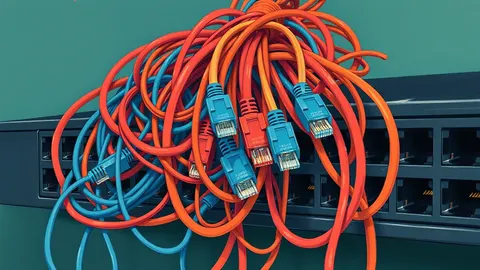
Dual-stack configurations often bypass traditional firewall rules, allowing traffic to flow through unmonitored IPv6 tunnels even when IPv4 protections are strictly enforced.
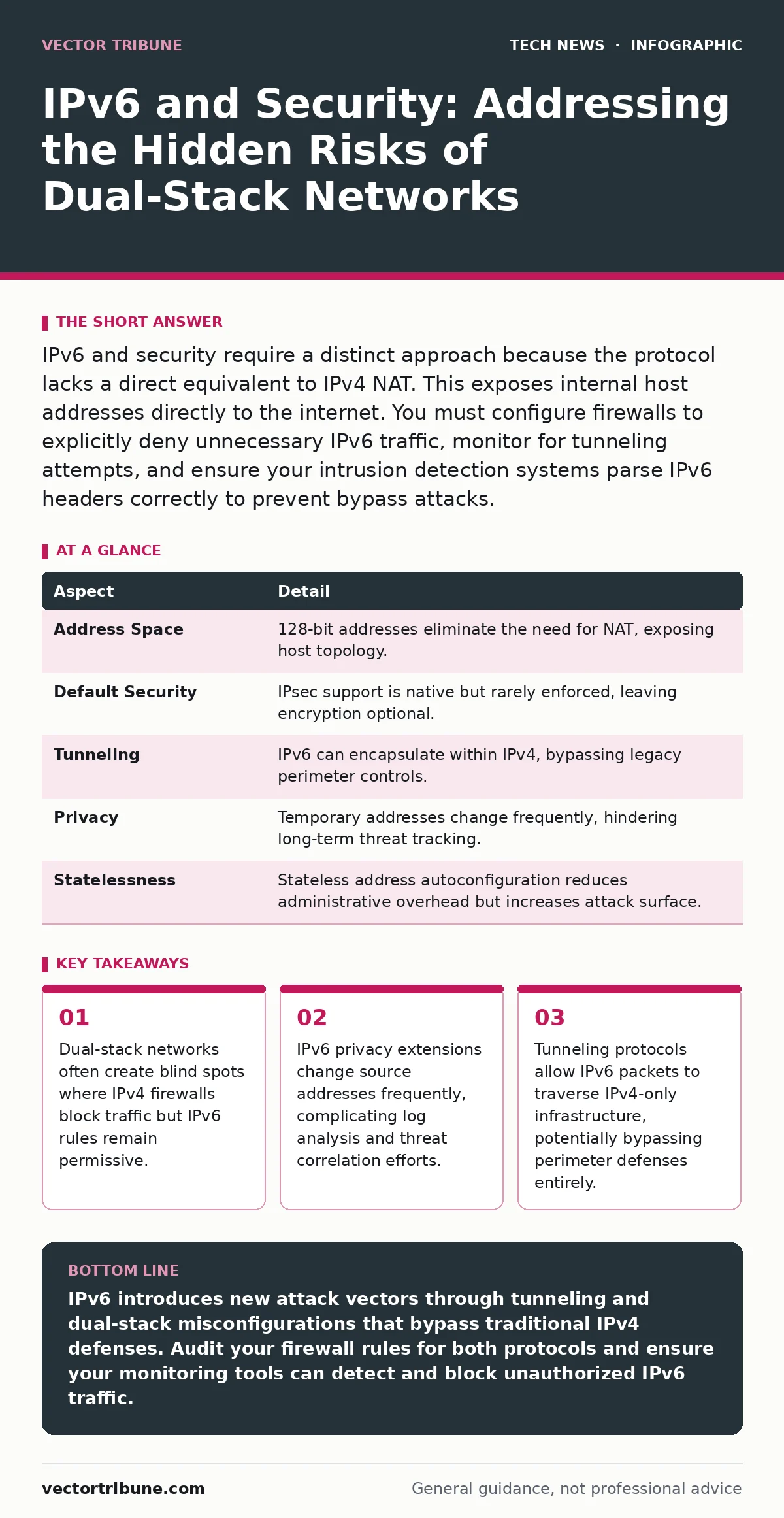
IPv6 and security require a distinct approach because the protocol lacks a direct equivalent to IPv4 NAT. This exposes internal host addresses directly to the internet. You must configure firewalls to explicitly deny unnecessary IPv6 traffic, monitor for tunneling attempts, and ensure your intrusion detection systems parse IPv6 headers correctly to prevent bypass attacks.
Understanding the Protocol Shift
IPv6 is the next-generation internet protocol designed to replace IPv4 by providing a vastly larger address space. Unlike IPv4, which relies on Network Address Translation to hide internal structures, IPv6 assigns globally unique addresses to every device on the network.
This architectural shift changes how security perimeters function. With IPv4, the concept of "inside" versus "outside" was reinforced by the translation layer. In IPv6, every host has a public-facing identity by default. This does not mean every device is reachable, but it means the default assumption of obscurity no longer applies. You must treat every IPv6 address as if it were directly exposed to the public internet.
The transition creates a dual-stack environment where both protocols operate simultaneously. This coexistence introduces complexity. Security tools that understand IPv4 may ignore or mishandle IPv6 traffic, creating gaps in visibility. You need to verify that your security stack processes both protocols with equal rigor.
| Aspect | Detail |
|---|---|
| Address Space | 128-bit addresses eliminate the need for NAT, exposing host topology. |
| Default Security | IPsec support is native but rarely enforced, leaving encryption optional. |
| Tunneling | IPv6 can encapsulate within IPv4, bypassing legacy perimeter controls. |
| Privacy | Temporary addresses change frequently, hindering long-term threat tracking. |
| Statelessness | Stateless address autoconfiguration reduces administrative overhead but increases attack surface. |
How IPv6 and Security Intersect
The primary security challenge with IPv6 is the assumption that existing IPv4 controls will automatically apply. They do not. Firewalls operate on state tables and rule sets specific to each protocol. A rule that blocks incoming IPv4 connections to port 80 does not block incoming IPv6 connections to the same port.
Imagine a corporate network with a strict IPv4 firewall policy. An attacker scans the network and finds that IPv4 traffic is blocked. However, the same firewall has a default "allow" rule for IPv6 outbound traffic to support DNS resolution. The attacker uses an IPv6 tunnel to send data out and receive responses, effectively bypassing the IPv4 restrictions. This scenario highlights the danger of asymmetric configurations.
You must audit your firewall rules for both protocols separately. Many administrators configure IPv6 rules to "allow all" to prevent connectivity issues during migration. This is a critical error. You should apply the principle of least privilege to IPv6 traffic just as you do for IPv4. Explicitly deny inbound traffic that is not required for business functions.
The Tunneling Threat
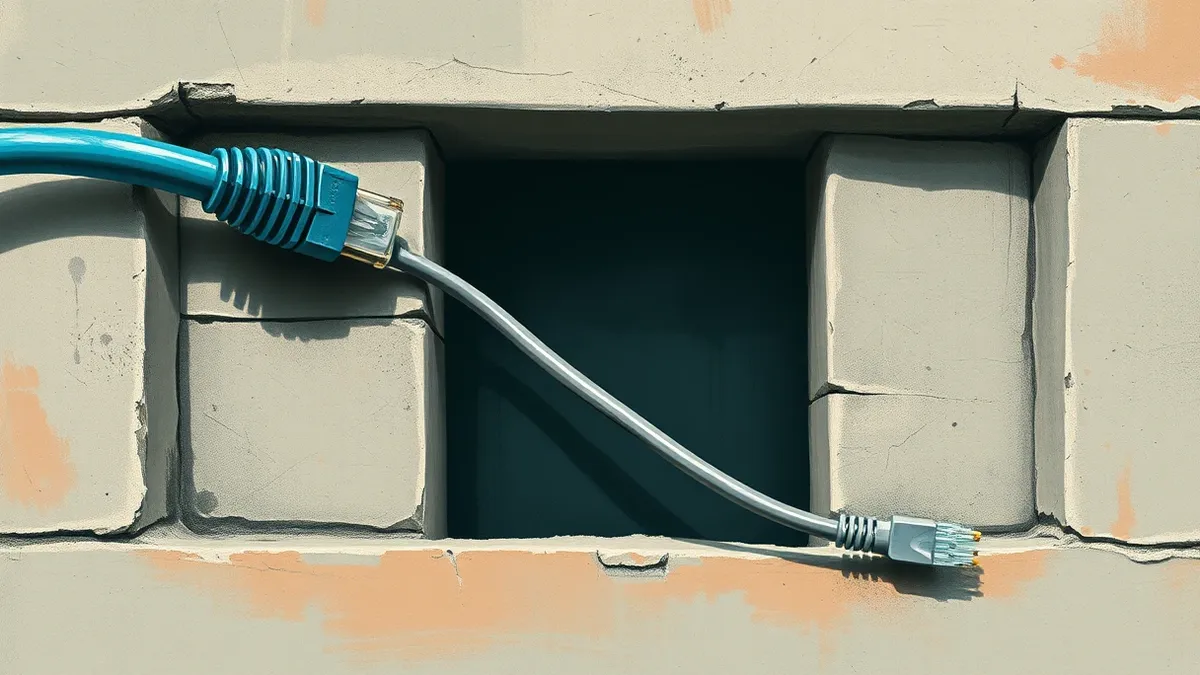
Tunneling allows IPv6 packets to travel through networks that only support IPv4. This is useful for connectivity but dangerous for security. Protocols like 6to4, Teredo, and ISATAP encapsulate IPv6 data inside IPv4 packets. If your perimeter firewall inspects only the outer IPv4 header, it sees harmless IPv4 traffic. It ignores the inner IPv6 payload, which may contain malicious commands or exfiltrated data.
These tunnels can be initiated by endpoints without administrative approval. A user’s laptop might automatically establish a Teredo tunnel to access IPv6 resources. This tunnel becomes a backdoor. Your security tools must detect and block unauthorized tunneling protocols. You should configure your network to drop IPv4 packets with specific protocol numbers associated with IPv6 tunneling unless explicitly permitted.
Monitoring for tunneling requires deep packet inspection. Standard firewalls may not decode the inner payload. You need specialized sensors or next-generation firewalls that can unwrap these packets. Without this capability, you are blind to traffic moving through these covert channels.
Common Misconfigurations
Many organizations fail to secure IPv6 because they assume it is not in use. They disable IPv6 on servers to reduce complexity. However, if a single device on the network supports IPv6, it can route traffic for others. This is known as neighbor discovery abuse. An attacker can send false Router Advertisement messages, convincing other devices to send their IPv6 traffic through the attacker’s machine.
Another common mistake is relying on IPsec for security. IPsec is built into the IPv6 specification, leading some to believe it is always enabled. It is not. IPsec provides encryption and authentication, but it must be explicitly configured and managed. Without a key management infrastructure, IPsec is rarely used in practice. Do not assume your traffic is encrypted just because you are using IPv6.
You also need to address privacy extensions. These features generate temporary IPv6 addresses to prevent tracking. While this protects user privacy, it complicates security monitoring. Logs show different source addresses for the same device over time. This makes it difficult to correlate events or identify compromised hosts. You must implement logging strategies that map temporary addresses to persistent identifiers, such as MAC addresses or user accounts.
What People Usually Get Wrong
A frequent misconception is that IPv6 is inherently more secure than IPv4 because it includes IPsec. This is false. The presence of a feature does not imply its use. Most deployments do not enforce IPsec, leaving traffic unencrypted. Another error is assuming that because IPv4 is secured, IPv6 is safe. Dual-stack networks require parallel security policies. Ignoring one protocol creates a bypass path for attackers.
See also: Domain Name System Security: Protecting DNS From Cache Poisoning and Hijacking
Operational Best Practices
Start by mapping your IPv6 deployment. Identify all devices that support IPv6 and understand how they communicate. Check your firewall rules. Ensure that inbound IPv6 traffic is restricted to only necessary services. Block unauthorized tunneling protocols at the perimeter.
Enable logging for IPv6 traffic. Ensure your intrusion detection systems can parse IPv6 headers. Many older IDS signatures only check IPv4, leaving IPv6 attacks undetected. Update your detection rules to include IPv6-specific threats.
Review your operating system hardening policies. Ensure that systems do not automatically accept Router Advertisements from untrusted sources. Configure devices to use stateless address autoconfiguration only when necessary. Prefer stateful DHCPv6 for better control over address assignment.
Integrate IPv6 monitoring into your network monitoring stack. Look for anomalies in traffic volume or unusual source addresses. Correlate IPv6 logs with IPv4 logs to get a complete picture of network activity.
Integration with Existing Controls
IPv6 security does not exist in isolation. It interacts with other security layers. For instance, HTTPS provides application-layer encryption, which mitigates the risk of unencrypted IPv6 traffic. However, it does not protect against network-layer attacks like neighbor discovery spoofing. You need both transport-layer encryption and network-layer filtering.
Mobile devices often handle IPv6 differently than desktops. They may use cellular networks that support IPv6 natively. Your mobile device security policies must account for this. Ensure that mobile apps do not bypass corporate proxies by using direct IPv6 connections.
Finally, consider secure software development. Applications should handle IPv6 addresses correctly. Buffer overflow vulnerabilities in IPv6 parsing code can lead to remote code execution. Test your applications with IPv6 traffic to ensure they do not crash or behave unexpectedly.
Key takeaways
- Dual-stack networks often create blind spots where IPv4 firewalls block traffic but IPv6 rules remain permissive.
- IPv6 privacy extensions change source addresses frequently, complicating log analysis and threat correlation efforts.
- Tunneling protocols allow IPv6 packets to traverse IPv4-only infrastructure, potentially bypassing perimeter defenses entirely.
IPv6 introduces new attack vectors through tunneling and dual-stack misconfigurations that bypass traditional IPv4 defenses. Audit your firewall rules for both protocols and ensure your monitoring tools can detect and block unauthorized IPv6 traffic.
Frequently asked questions
Does IPv6 make NAT obsolete?
Yes, IPv6 eliminates the need for Network Address Translation by providing enough addresses for every device. This removes the accidental security benefit of NAT but requires explicit firewall rules.
Should I disable IPv6 on my servers?
Disabling IPv6 is not recommended as it can break functionality and force fallback to less secure protocols. Instead, secure IPv6 by configuring strict firewall rules and monitoring for anomalies
How this guide was produced: written by the Vector Tribune editorial team with AI assistance, checked against the public references listed below, and reviewed when the facts change. See our editorial policy or report an error.