Remote Code Execution Risks and Protection for Small Businesses
Remote code execution allows attackers to run commands on your servers, turning a single vulnerability into full system control without user interaction.
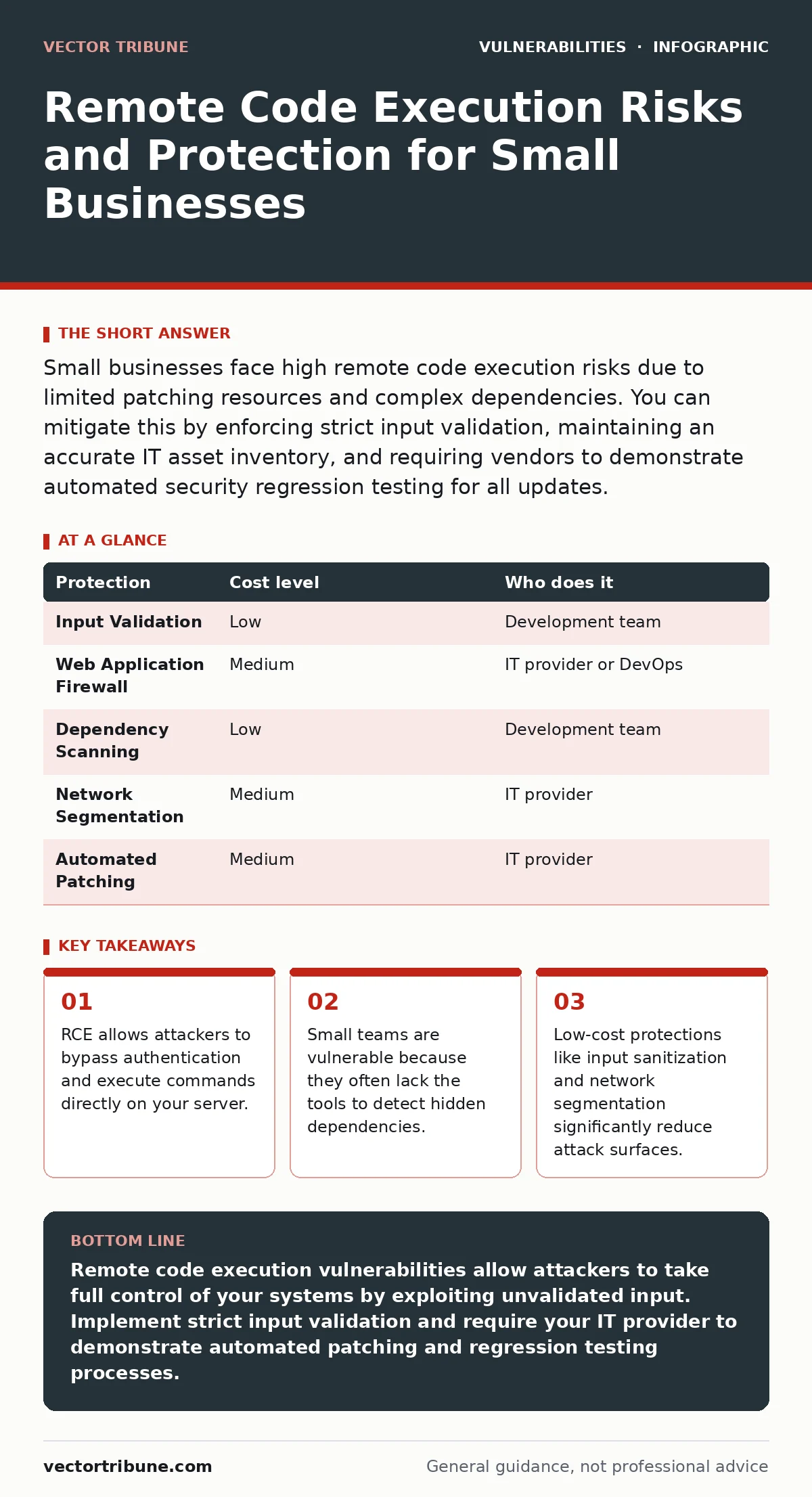
Small businesses face high remote code execution risks due to limited patching resources and complex dependencies. You can mitigate this by enforcing strict input validation, maintaining an accurate IT asset inventory, and requiring vendors to demonstrate automated security regression testing for all updates.
The Mechanics of Unchecked Execution
Remote code execution, often abbreviated as RCE, occurs when an application processes untrusted input as executable code. This differs from simple data injection because the server actually runs the attacker’s commands. The attacker does not need to log in or guess passwords. They simply send a crafted request that the application interprets as an instruction.
This mechanism is dangerous because it grants the attacker the same privileges as the application itself. If your web server runs with administrative rights, the attacker gains administrative access to the entire machine. They can read files, install additional malware, or pivot to other systems on your network. The speed of exploitation is often automatic, driven by bots scanning the internet for known vulnerable software versions.
Why Small Organizations Face Disproportionate Risk
Small organizations often assume that limited visibility protects them from large-scale attacks. This assumption fails because modern attacks are automated and indiscriminate. Bots scan for specific software signatures regardless of the company size. A small business running outdated software is just as visible as a large enterprise.
The real exposure comes from resource constraints. Small teams rarely have dedicated security staff to monitor security bulletins or test patches before deployment. They often rely on third-party IT providers who may prioritize uptime over security hardening. When a critical vulnerability is disclosed, the window to patch is narrow. Without automated testing, small teams risk breaking their applications if they update too quickly, leaving them exposed.
The Hidden Cost of Dependencies
Your application is only as secure as its weakest dependency. Most modern software relies on dozens of open-source libraries. A vulnerability in a minor logging library can provide an entry point for RCE. This is why server-side template injection remains a persistent threat. Developers often trust that third-party code is secure, but supply chain attacks target these exact trust assumptions.
You must treat external libraries as untrusted code. This means verifying that your dependencies are actively maintained. If a library has not been updated in years, it is likely vulnerable to newly discovered exploits. The hidden cost here is the time required to audit and update these dependencies regularly. Neglecting this leads to technical debt that manifests as security breaches.
| Protection | Cost level | Who does it |
|---|---|---|
| Input Validation | Low | Development team |
| Web Application Firewall | Medium | IT provider or DevOps |
| Dependency Scanning | Low | Development team |
| Network Segmentation | Medium | IT provider |
| Automated Patching | Medium | IT provider |
Low-Cost Protections You Can Implement
Input validation is the first line of defense against RCE. You must ensure that all user input is treated as data, not code. This involves defining strict rules for what characters are allowed and rejecting anything that does not fit. For example, if a field expects a number, reject any alphabetic characters. This prevents attackers from injecting command syntax into your application.
Network segmentation reduces the impact of a successful breach. By separating your public-facing web servers from your internal database servers, you limit what an attacker can access. If an attacker gains control of the web server through an RCE vulnerability, they cannot directly query your database. This containment strategy buys you time to detect and respond to the incident.
Regular dependency scanning helps you identify vulnerable libraries before attackers do. Many free tools can analyze your codebase and flag outdated components. Integrating these tools into your development workflow ensures that new vulnerabilities are caught early. This is far cheaper than responding to a breach after it occurs.
What to Ask Your IT Provider
Your IT provider plays a critical role in maintaining your security posture. You need to verify that they have processes in place to handle RCE vulnerabilities effectively. Do not assume that standard maintenance includes security hardening. You must ask specific questions to ensure they are addressing these risks.
- How do you monitor for new security bulletins related to our software stack?
- Do you perform security regression testing to ensure patches do not break functionality?
- What is your process for updating third-party libraries and dependencies?
- How do you isolate public-facing services from internal data stores?
- Can you demonstrate how you detect unauthorized code execution attempts?
The Role of Automated Testing
Manual patching is error-prone and slow. Automated security regression testing ensures that updates do not introduce new vulnerabilities or break existing features. This allows you to patch quickly when a critical RCE vulnerability is disclosed. Without automation, small teams often delay patches, leaving them exposed for weeks.
You should also be aware of API vulnerabilities, as many modern applications rely on APIs for functionality. APIs can be exploited similarly to web forms, allowing attackers to inject malicious code. Ensuring that your APIs enforce strict authentication and input validation is crucial. Your IT provider should have specific tests for API endpoints, not just traditional web forms.
Beyond Immediate Patching
Patching is reactive. You need proactive measures to detect anomalies. Memory forensics can help you understand what happened after a breach, but it does not prevent it. Instead, focus on monitoring for unusual process creation or network connections. If a web server process suddenly tries to connect to an external command and control server, that is a strong indicator of RCE exploitation.
Cloud cryptojacking is a common outcome of successful RCE attacks. Attackers use your server’s resources to mine cryptocurrency, which can lead to significant performance degradation and costs. Monitoring for high CPU usage or unexpected outbound traffic can help you detect this early. While this does not stop the initial compromise, it limits the damage and allows for faster remediation.
Building a Resilient Security Culture
Security is not a one-time fix. It requires continuous effort and vigilance. Small businesses must integrate security into their development and operations processes. This means training developers to write secure code and ensuring IT providers follow best practices. By understanding the mechanics of RCE and implementing layered defenses, you can significantly reduce your risk.
Remember that no single measure provides complete protection. You need a combination of input validation, network segmentation, and regular patching. By asking the right questions and demanding transparency from your IT provider, you can build a more resilient environment. The goal is not to eliminate risk entirely, but to make it difficult enough for attackers to move on to easier targets.
Key takeaways
- RCE allows attackers to bypass authentication and execute commands directly on your server.
- Small teams are vulnerable because they often lack the tools to detect hidden dependencies.
- Low-cost protections like input sanitization and network segmentation significantly reduce attack surfaces.
Remote code execution vulnerabilities allow attackers to take full control of your systems by exploiting unvalidated input. Implement strict input validation and require your IT provider to demonstrate automated patching and regression testing processes.
Frequently asked questions
How do I know if my application has an RCE vulnerability?
You typically do not know until an attacker exploits it or a scanner identifies it. Regular code reviews and dependency scanning are the best ways to find these flaws before they are abused.
Can a Web Application Firewall prevent RCE attacks?
A WAF can block many common RCE patterns, but it is not foolproof. Attackers can often bypass WAF rules by obfuscating their payloads. Input validation within your code is the only reliable defense.
How often should I update my third-party libraries?
You should update libraries as soon as security patches are released. For non-critical updates, a regular schedule is fine, but critical security fixes must be applied immediately to avoid exploitation.
What is the difference between RCE and SQL injection?
SQL injection allows attackers to manipulate your database queries, while RCE allows them to execute operating system commands. RCE is generally more severe because it grants direct control over the server.
How this guide was produced: written by the Vector Tribune editorial team with AI assistance, checked against the public references listed below, and reviewed when the facts change. See our editorial policy or report an error.