
Unauthenticated Remote Code Execution: How the Attack Works
Attackers bypass authentication checks by exploiting logic flaws or memory errors in network-facing services that accept input without verifying user identity.
Unauthenticated remote code execution allows an attacker to run commands on a server without login credentials. The process begins with network access, moves to input manipulation, triggers a software flaw, and ends with arbitrary command execution. Defenses require strict input validation, minimal service exposure, and runtime protection mechanisms that isolate memory and restrict system calls.
The Mechanics of Unauthenticated Access
Unauthenticated remote code execution relies on a service accepting input from an untrusted source without verifying the sender's identity. Most network services require authentication before processing sensitive requests. When a service skips this step, it treats all incoming data as potentially valid. This design choice expands the attack surface significantly. An attacker does not need stolen credentials or a compromised account. The attacker only needs network reachability to the vulnerable port. The flaw exists in how the software handles untrusted data before any identity check occurs.
Imagine a web server that parses request headers before checking for a session token. If the parser contains a flaw, the server crashes or executes code during the parsing phase. The authentication check never runs because the program has already deviated from its intended path. This timing difference is the core vulnerability. The system assumes the request is safe enough to process structurally, but the structure itself contains the weapon.
Stage 1: Network Reconnaissance and Target Selection
The attacker first identifies systems that expose services to the internet or internal networks. They scan for open ports that correspond to known vulnerable services. This stage relies on the principle of least exposure failing. Services that should be internal often leak to public networks due to misconfigured firewalls or cloud security groups. The attacker looks for default configurations that lack network segmentation.
They also fingerprint the software version running on those ports. Version numbers often correlate with known security bulletins. If a service runs an outdated version, the attacker knows specific flaws may exist. This step requires no interaction with the application logic. It relies entirely on network responses and banner grabbing. The attacker builds a list of potential targets that are reachable and likely vulnerable.
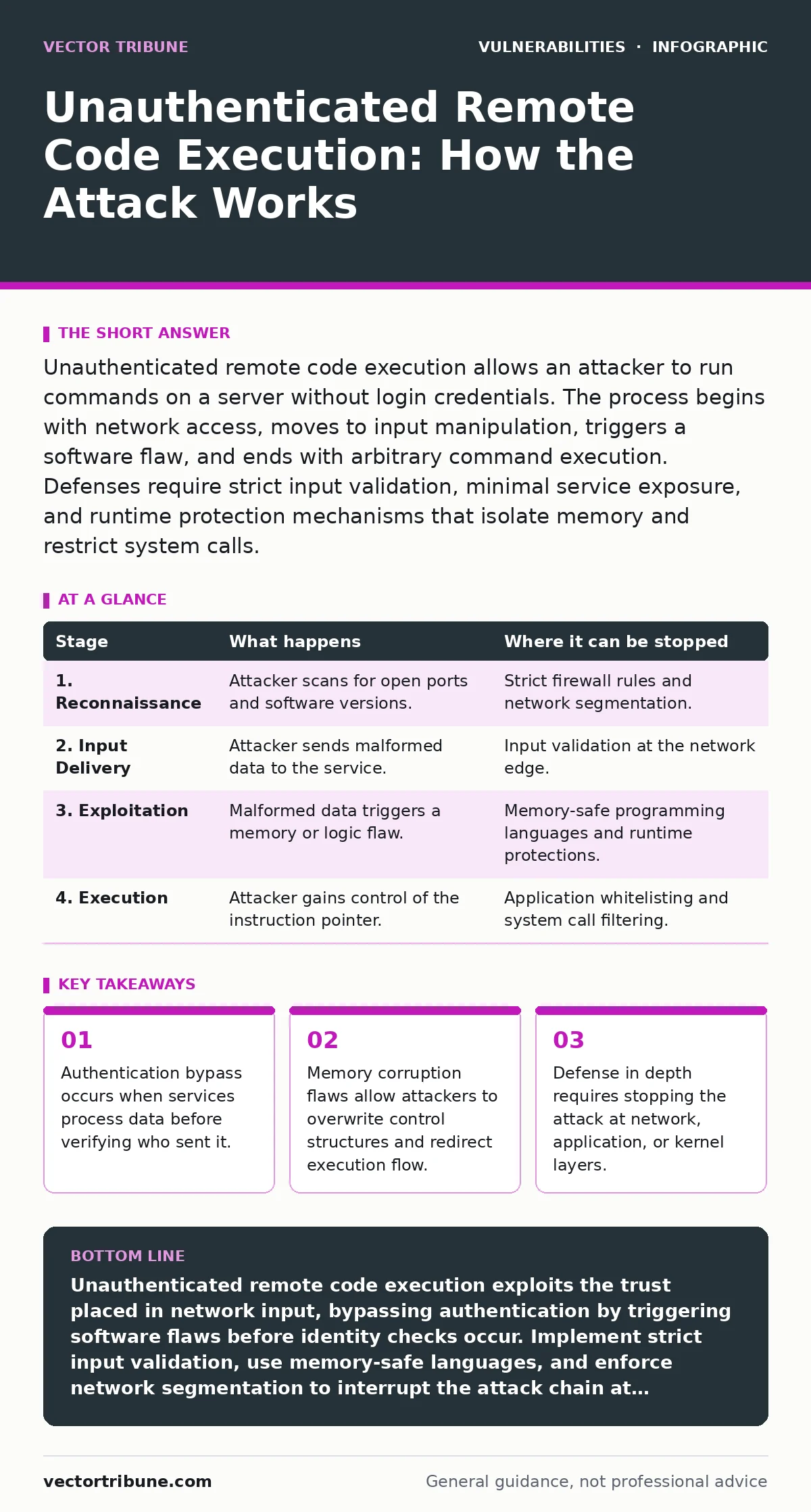
| Stage | What happens | Where it can be stopped |
|---|---|---|
| 1. Reconnaissance | Attacker scans for open ports and software versions. | Strict firewall rules and network segmentation. |
| 2. Input Delivery | Attacker sends malformed data to the service. | Input validation at the network edge. |
| 3. Exploitation | Malformed data triggers a memory or logic flaw. | Memory-safe programming languages and runtime protections. |
| 4. Execution | Attacker gains control of the instruction pointer. | Application whitelisting and system call filtering. |
Stage 2: Crafting and Delivering the Payload
Once a target is selected, the attacker crafts a specific input designed to trigger a flaw. This input often contains binary data that overwrites memory structures. In the case of buffer overflow vulnerabilities, the input exceeds the allocated space, overwriting adjacent memory. In logic flaws, the input might be a specially formatted command or file that the parser misinterprets. The payload includes shellcode, which is machine code that performs the desired action.
The attacker delivers this payload via the standard protocol of the service. If it is an HTTP service, the payload goes into headers or the body. If it is a database service, it goes into query parameters. The key is that the delivery method is legitimate. The firewall sees normal traffic patterns. The intrusion detection system might miss it if it only looks for known signatures. The payload relies on the application processing it as valid data.
Stage 3: Triggering the Software Flaw
The service receives the payload and begins processing it. This is where the flaw activates. The software fails to validate the size, type, or content of the input. It assumes the data conforms to the specification. When the data violates this assumption, the software behaves unpredictably. In memory corruption cases, the program writes data to unauthorized memory locations. This can overwrite function pointers, return addresses, or virtual table entries.
Logic flaws occur when the application state changes unexpectedly. The parser might interpret a sequence of characters as a command instead of data. This confusion between data and code is the root cause. The application continues running, but its control flow is now determined by the attacker's input. The authentication check is bypassed because the program is no longer executing the standard authentication routine. It is executing the attacker's instructions.
Stage 4: Gaining Code Execution
The final stage involves the system executing the attacker's code. The program jumps to the memory address specified by the payload. This address points to the shellcode embedded in the input. The shellcode runs with the privileges of the service account. If the service runs as root or administrator, the attacker gains full control. The shellcode typically opens a reverse shell, allowing the attacker to send commands remotely.
This stage completes the chain. The attacker has moved from network access to arbitrary command execution. No credentials were used. The attacker exploited the trust the service placed in the network input. The system treats the shellcode as legitimate instructions. This bypasses application-level security controls. The attacker can now read files, modify data, or install additional malware. The breach is complete.
See also: Dependency Confusion Attacks: How Private Packages Hijack Public Registries
Interrupting the Attack Chain
You can interrupt this chain at multiple points. Network segmentation prevents the initial reconnaissance. Firewalls that block unnecessary ports reduce the attack surface. Input validation at the application layer rejects malformed data before it reaches the parser. Using memory-safe programming languages prevents buffer overflows by design. These languages manage memory automatically, removing the ability to overwrite critical structures.
Runtime application self-protection tools can detect abnormal behavior. They monitor system calls and memory access patterns. If a program attempts to execute code in a non-executable memory region, the tool blocks it. This stops the shellcode from running. Even if the flaw is triggered, the execution fails. Defense in depth ensures that one layer failing does not lead to compromise. Attack surface management helps identify which services are exposed and whether they need to be.
Related Security Considerations
Understanding this attack helps contextualize other security topics. Zero-day vulnerabilities are flaws unknown to the vendor, making patching impossible. Attackers often use these for unauthenticated access because no defenses are in place. Vulnerability disclosure policies encourage researchers to report flaws before attackers exploit them. This reduces the window of opportunity for unauthenticated attacks.
Remote code execution vulnerabilities are a subset of all software flaws. They are particularly dangerous because they allow full control. Memory-safe programming languages address the root cause of many of these flaws. By eliminating manual memory management, they remove the possibility of buffer overflows. Dependency confusion attacks exploit software supply chains, but they often require authentication. Unauthenticated attacks bypass this requirement entirely.
Security bulletins provide details on new flaws and patches. Monitoring these helps you patch systems before attackers exploit them. Attack surface management identifies exposed services that could be targeted. By reducing the number of exposed services, you reduce the likelihood of an unauthenticated attack succeeding. These practices work together to protect against the stages described above.
Practical Mitigation Strategies
Implement strict input validation at every entry point. Validate data type, length, and format. Reject any input that does not match the expected schema. Use allowlists rather than blocklists. Allowlists specify what is valid, making it harder for attackers to find bypasses. Blocklists specify what is invalid, and attackers can often find new invalid inputs that are not on the list.
Deploy services in isolated environments. Use containers or virtual machines to limit the impact of a breach. If an attacker gains code execution, they are confined to the isolated environment. This prevents lateral movement. Apply the principle of least privilege. Services should run with the minimum permissions required. This limits the damage if an attacker gains execution. They cannot access sensitive data or modify system settings.
Regularly update software to patch known flaws. Follow security bulletins to stay informed. Conduct code reviews to identify logic flaws. Use static analysis tools to find potential memory errors. Test applications with automated security scanners. These scanners can identify common flaws before deployment. Combine these technical measures with organizational policies. Enforce secure coding standards and require security training for developers.
Key takeaways
- Authentication bypass occurs when services process data before verifying who sent it.
- Memory corruption flaws allow attackers to overwrite control structures and redirect execution flow.
- Defense in depth requires stopping the attack at network, application, or kernel layers.
Unauthenticated remote code execution exploits the trust placed in network input, bypassing authentication by triggering software flaws before identity checks occur. Implement strict input validation, use memory-safe languages, and enforce network segmentation to interrupt the attack chain at multiple stages.
Frequently asked questions
How do I know if my service is vulnerable to unauthenticated remote code execution?
Review your code for input processing that occurs before authentication. Test your service with fuzzing tools to identify memory corruption or logic flaws. Check if your service runs with elevated privileges.
Does using an API gateway prevent unauthenticated remote code execution?
An API gateway can enforce authentication, but it does not fix flaws in the backend service. If the backend processes data before checking the gateway's validation, the flaw remains. Ensure the backend validates input independently.
Can web application firewalls stop these attacks?
Web application firewalls can block known attack patterns, but they may miss new or customized payloads. They are a defense layer, not a complete solution. Combine WAFs with secure coding practices and runtime protection.
What is the difference between authenticated and unauthenticated remote code execution?
Authenticated RCE requires valid credentials to trigger the flaw. Unauthenticated RCE allows the attack without any credentials. Unauthenticated attacks are more severe because they require less initial access.
How this guide was produced: written by the Vector Tribune editorial team with AI assistance, checked against the public references listed below, and reviewed when the facts change. See our editorial policy or report an error.