
Zero-Day Vulnerabilities Meaning: How Unpatched Flaws Bypass Your Defenses
A zero-day flaw exists in software before the vendor knows it exists, leaving you defenseless against exploitation until a patch is built and deployed.
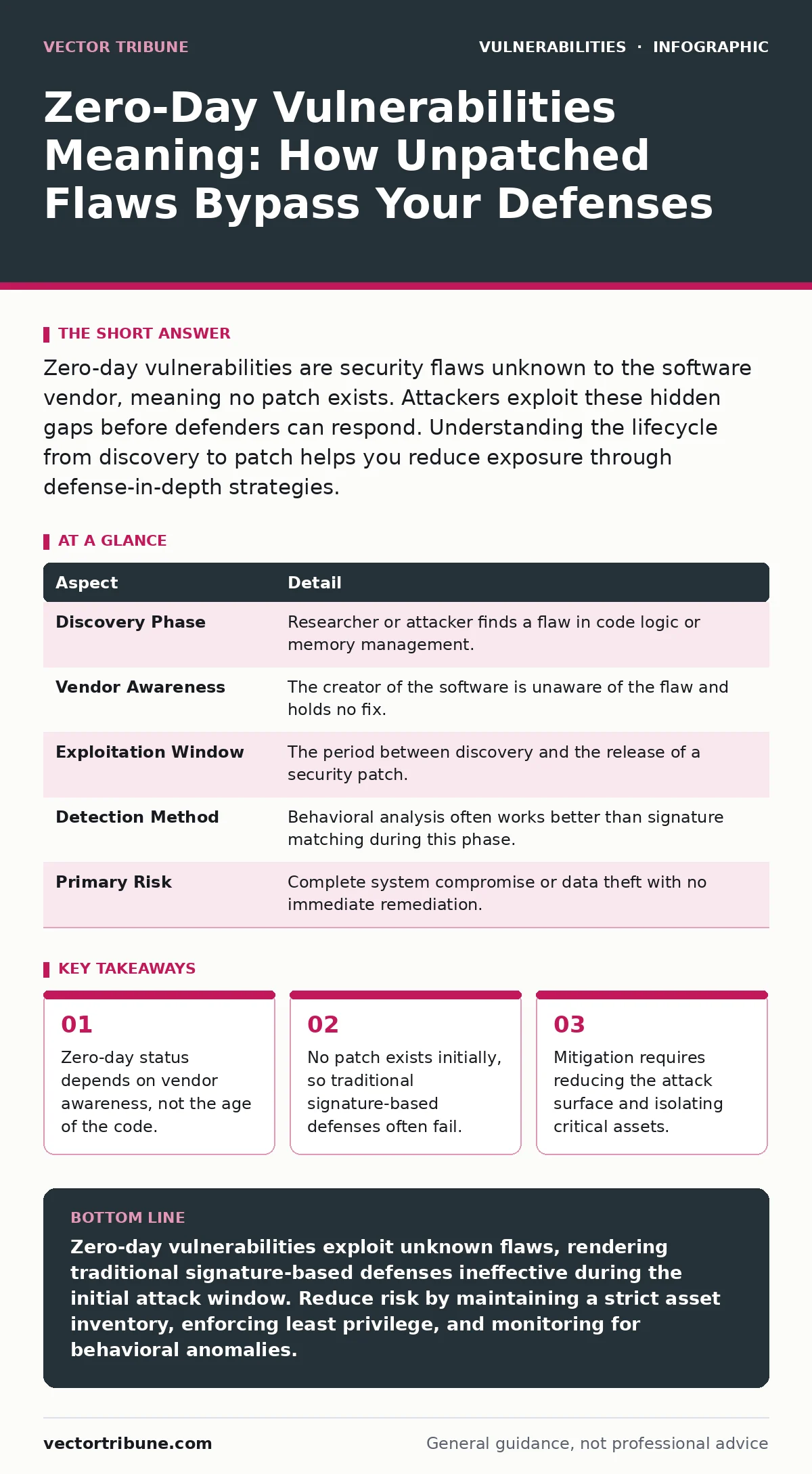
Zero-day vulnerabilities are security flaws unknown to the software vendor, meaning no patch exists. Attackers exploit these hidden gaps before defenders can respond. Understanding the lifecycle from discovery to patch helps you reduce exposure through defense-in-depth strategies.
The Meaning of Zero-Day Vulnerabilities
Imagine finding a loose floorboard in a house you just bought. The builder never knew it was there, so they cannot fix it yet. You must walk around it until you install a temporary support. A zero-day vulnerability operates on this same principle of unknown structural weakness.
Zero-day vulnerabilities are software flaws that the vendor does not know about and therefore cannot patch. The term "zero-day" refers to the zero days you have to fix the problem before an attacker exploits it. This definition focuses on the vendor's state of knowledge, not the age of the code. Old code can contain new zero-days if the flaw was always present but never detected.
How Zero-Day Exploitation Works
The lifecycle begins when a researcher or malicious actor discovers a flaw in the logic or memory handling of a program. They analyze how input data can be manipulated to crash the application or execute arbitrary commands. This process is called exploitation.
The attacker then builds a payload, a small piece of code designed to run on the target system. They send this payload through the vulnerable interface, such as a web browser or email client. Because the vendor has not issued a fix, the software processes the malicious input as valid data. The system executes the attacker's code, granting them control.
| Aspect | Detail |
|---|---|
| Discovery Phase | Researcher or attacker finds a flaw in code logic or memory management. |
| Vendor Awareness | The creator of the software is unaware of the flaw and holds no fix. |
| Exploitation Window | The period between discovery and the release of a security patch. |
| Detection Method | Behavioral analysis often works better than signature matching during this phase. |
| Primary Risk | Complete system compromise or data theft with no immediate remediation. |
Who Is Affected by Zero-Days
Every system running the affected software is at risk, regardless of its security configuration. Standard firewalls and antivirus programs rely on known patterns of malicious behavior. Since a zero-day attack is new, it lacks a known pattern. The defenses do not recognize the traffic as hostile.
High-value targets such as government agencies and large corporations face coordinated attacks using expensive, custom-built zero-days. These attackers invest significant resources to create exploits that remain hidden for years. Smaller organizations face opportunistic attacks using widely circulated exploits found on underground forums. The severity of the impact depends on the role of the compromised system. A web server hosting public content poses a different risk than an internal database holding personal records.
Common Misconceptions About Zero-Days
Many organizations believe that being "hidden" makes them safe from zero-day attacks. This is a dangerous assumption. Attackers scan the entire internet for running services. They do not need to know who you are to exploit a public-facing service. Obscurity provides no protection against automated scanning tools.
Another common error is assuming that internal networks are isolated from zero-days. Many zero-day exploits travel laterally through internal networks once a single endpoint is compromised. If one user opens a malicious attachment, the attacker can move to servers with higher privileges. You must treat every connection as potentially hostile, even those within your own infrastructure.
A third misconception involves the belief that zero-days are rare. While truly unique, custom exploits are rare, the same zero-day can be reused by multiple attackers. Once a flaw is disclosed, copies of the exploit code often circulate widely. This creates a surge of automated attacks targeting the vulnerability until patches are applied.
Immediate Mitigation Strategies
You cannot patch a flaw that has no fix, but you can make it harder to exploit. The first step is to verify your IT asset inventory. You cannot protect what you do not know exists. Untracked devices often run outdated software that is easier to exploit.
Next, apply the principle of least privilege. Users and services should only have the permissions necessary for their specific tasks. If a web service is compromised with limited privileges, the attacker cannot easily access the entire system. This containment strategy limits the blast radius of a successful exploit.
Isolate critical systems using network segmentation. Place sensitive data on separate network zones with strict access controls. If an attacker breaches the outer perimeter, they face additional barriers to reach the core data. This adds friction to the attack path, increasing the time and effort required for the attacker to succeed.
See also: Tactics Techniques and Procedures: How to Map Adversary Behavior · Tactics vs Techniques vs Procedures: The Difference in Cybersecurity
Long-Term Defense Architecture
Relying solely on perimeter defenses is insufficient. You must implement behavioral monitoring that looks for anomalies rather than known signatures. If a process attempts to inject code into another process, or if a script connects to an unknown server, these are suspicious behaviors. Security operations teams can investigate these alerts even if the specific exploit is unknown.
Adopting memory-safe programming languages for new development reduces the likelihood of introducing certain classes of vulnerabilities. Languages that manage memory automatically prevent buffer overflow errors, which are a common source of zero-days. While this does not eliminate logic flaws, it removes a large category of exploitable bugs.
Maintain strict vulnerability disclosure policies to encourage responsible reporting. Researchers who find flaws need a clear, secure channel to report them. If they cannot report safely, they may sell the flaw to the highest bidder on the black market. A clear policy ensures you are the first to know about new issues in your custom software.
Understanding Exploit Chains
Attackers rarely use a single zero-day to achieve their goals. They often chain multiple vulnerabilities together. One flaw might allow them to execute code, while another allows them to escalate privileges. This technique increases the reliability of the attack. If one step fails, the attacker can try another path.
This chaining behavior explains why simple patching is not enough. You must monitor for unusual sequences of events. A successful login followed immediately by a privilege escalation attempt is a red flag. Understanding how remote code execution vulnerabilities often serve as the initial entry point helps you prioritize monitoring for execution anomalies.
The Role of Disclosure
When a vendor learns of a zero-day, they begin working on a patch. The time between discovery and patch release is the most dangerous period for users. Vendors often coordinate with security researchers to disclose the flaw publicly only after a patch is available. This is known as coordinated disclosure.
Until then, the vendor may issue security bulletins advising users on temporary mitigation steps. These steps might include disabling specific features or changing configuration settings. You must monitor these channels closely. Acting on mitigation advice can stop an attack before the patch is ready.
Why Signatures Fail
Traditional antivirus and intrusion detection systems rely on signatures. A signature is a unique string of bytes or a pattern of network traffic associated with a known threat. Zero-day attacks, by definition, are new. They do not match any existing signature in the database.
This is why heuristic analysis and machine learning models are becoming standard. These tools look for the intent of the action rather than the specific code. They can flag a file that behaves like malware, even if the file itself has never been seen before. You must configure these tools carefully to avoid false positives that disrupt normal operations.
The Economics of Exploits
Zero-day exploits are valuable commodities. In the underground market, they are sold to the highest bidder. This economic incentive drives the development of sophisticated attacks. Attackers invest time and money to create reliable exploits that can bypass modern defenses.
This market dynamic means that zero-days will continue to exist. You cannot eliminate the supply side. Your strategy must focus on resilience. Assume that some zero-days will bypass your defenses. Design your systems to recover quickly from compromise. Regular backups, isolated recovery environments, and clear incident response plans are your final line of defense.
Key takeaways
- Zero-day status depends on vendor awareness, not the age of the code.
- No patch exists initially, so traditional signature-based defenses often fail.
- Mitigation requires reducing the attack surface and isolating critical assets.
Zero-day vulnerabilities exploit unknown flaws, rendering traditional signature-based defenses ineffective during the initial attack window. Reduce risk by maintaining a strict asset inventory, enforcing least privilege, and monitoring for behavioral anomalies.
Frequently asked questions
Can antivirus software detect a zero-day attack?
Traditional signature-based antivirus usually cannot detect a zero-day because it lacks a known pattern. However, modern security tools using behavioral analysis and machine learning may identify suspicious activity associated with the exploit.
How long does a zero-day vulnerability remain unpatched?
The duration varies widely. Some patches are released within days of disclosure, while others take months. The length of the exposure window depends on the complexity of the fix and the vendor's response time.
Are zero-day attacks only used by state-sponsored hackers?
No, while state actors use custom zero-days, criminal groups also exploit widely circulated zero-days. Opportunistic attackers use automated tools to scan for and exploit known-but-unpatched vulnerabilities.
What is the difference between a zero-day and an N-day vulnerability?
A zero-day is unknown to the vendor with no patch available. An N-day vulnerability is one where a patch exists, but users have not yet applied it. The risk shifts from unknown exploit to delayed remediation.
How this guide was produced: written by the Vector Tribune editorial team with AI assistance, checked against the public references listed below, and reviewed when the facts change. See our editorial policy or report an error.