
Tactics Techniques and Procedures: How to Map Adversary Behavior
TTPs reveal the stable habits of attackers, allowing defenders to block future intrusions even when specific malware signatures change completely.
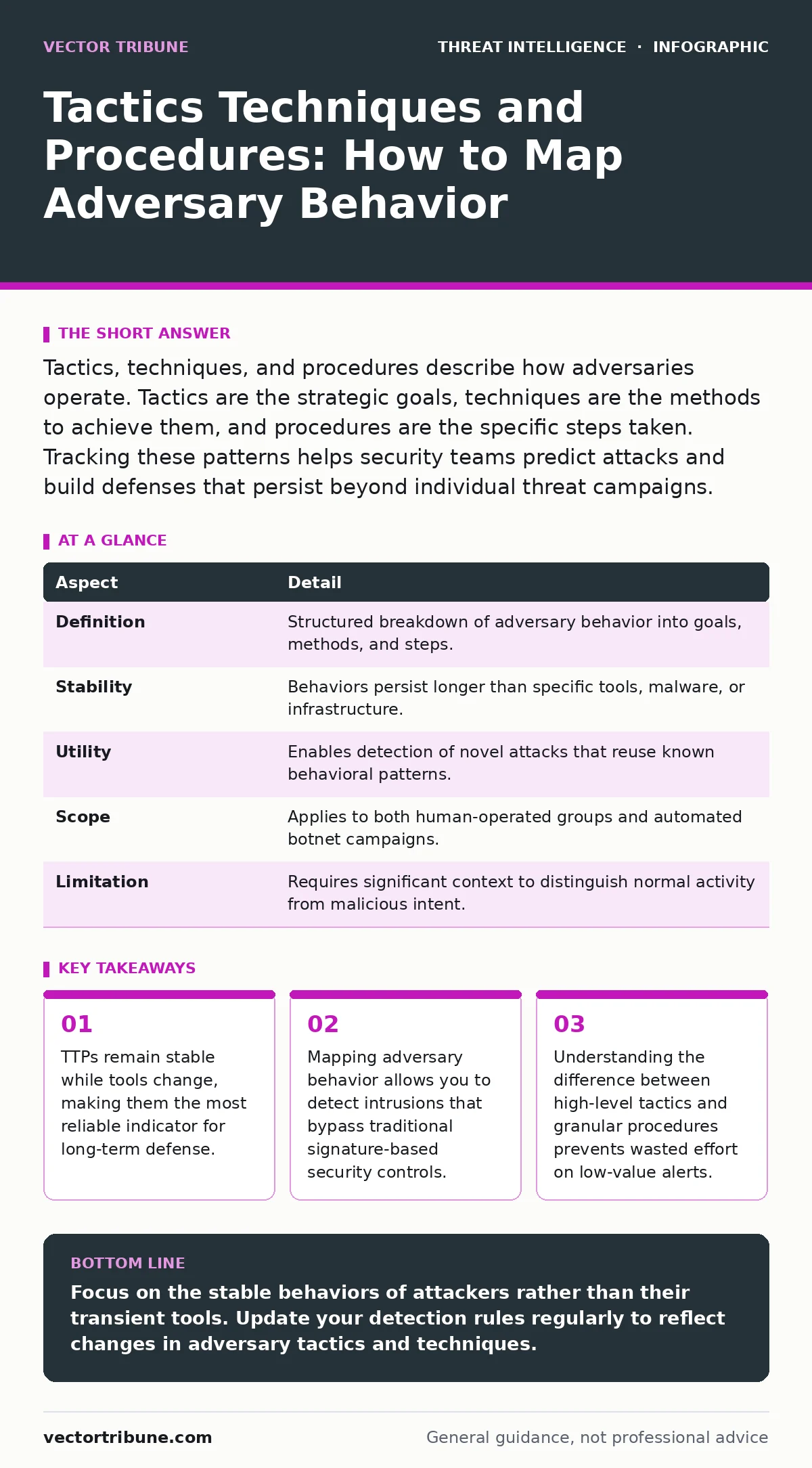
Tactics, techniques, and procedures describe how adversaries operate. Tactics are the strategic goals, techniques are the methods to achieve them, and procedures are the specific steps taken. Tracking these patterns helps security teams predict attacks and build defenses that persist beyond individual threat campaigns.
What Are Tactics Techniques and Procedures
Tactics, techniques, and procedures define the structured behavior of cyber adversaries. This framework breaks down an attack into strategic goals, methods, and specific actions. You use this model to understand not just what happened, but why it happened and how it will happen again.
The concept moves beyond simple indicators of compromise. A file hash or IP address disappears when an attacker changes their tools. The underlying behavior remains consistent. You track these behaviors to build defenses that resist evolution in attack methods. This approach shifts security from reactive cleanup to proactive prediction.
Imagine a burglar who always picks the same type of lock. The key they use might change, but the method of entry stays the same. You secure the lock mechanism, not just block that specific key. This is the core logic behind tracking adversary behavior.
| Aspect | Detail |
|---|---|
| Definition | Structured breakdown of adversary behavior into goals, methods, and steps. |
| Stability | Behaviors persist longer than specific tools, malware, or infrastructure. |
| Utility | Enables detection of novel attacks that reuse known behavioral patterns. |
| Scope | Applies to both human-operated groups and automated botnet campaigns. |
| Limitation | Requires significant context to distinguish normal activity from malicious intent. |
How The Framework Works
The framework operates on three distinct levels of abstraction. Understanding the difference between these levels is critical for accurate detection engineering.
Tactics represent the "why." They describe the high-level objective the attacker wants to achieve. Examples include gaining initial access, escalating privileges, or exfiltrating data. Tactics are broad and apply to almost all attack scenarios.
Techniques represent the "how." They describe the general method used to accomplish the tactic. For example, to gain initial access, an attacker might use spear-phishing or exploit a remote service. Techniques are reusable across different campaigns and threat groups.
Procedures represent the "what." They are the specific, granular steps taken to execute the technique. This includes the exact command-line arguments, the specific configuration of a tool, or the precise sequence of API calls. Procedures are the most detailed and often the most unique to a specific group.
Why Behavior Matters More Than Tools
Attackers frequently discard their tools to evade detection. They generate new malware variants, rotate IP addresses, and change domain names. Traditional security tools often rely on these transient indicators. When the indicator changes, the detection fails.
Behavioral patterns are harder to change. An attacker may write a new script, but the sequence of actions required to move laterally across a network remains largely the same. By focusing on the procedure, you catch the attacker even when they use custom, unsigned code.
This is why tactical threat intelligence focuses on the narrative of an attack rather than a list of bad files. You map the adversary's preferred path through your environment. This allows you to set traps at choke points where the attacker must perform specific actions to proceed.
Who Is Affected By This Approach
This framework affects every organization with a digital footprint. The impact varies based on the sophistication of the defender and the attacker.
Small organizations often rely on perimeter defenses. They assume that if they block known bad traffic, they are safe. This approach fails against attackers who use legitimate services to bypass filters. Understanding TTPs helps these organizations realize that internal monitoring is necessary.
Large enterprises face complex environments with many users and systems. The noise from normal activity can hide malicious behavior. Mapping specific adversary procedures helps reduce false positives. You learn to distinguish between a developer running a script and an attacker using the same script for reconnaissance.
What People Usually Get Wrong
Many security teams confuse indicators of compromise with tactics, techniques, and procedures. An IP address is an indicator, not a technique. Tracking IPs alone leads to a game of whack-a-mole. You block one address, and the attacker uses another. The behavior continues unchanged.
Another common error is over-investigating low-level procedures without understanding the tactic. You might block a specific command, but the attacker simply uses a different command to achieve the same goal. Without understanding the broader tactic, you miss the strategic intent.
You may also assume that all groups use the same procedures. Different threat actors have different cultures and capabilities. Some prefer manual exploitation, while others rely on automated frameworks. Tailoring your detection to the specific procedures of likely adversaries yields better results than generic rules.
See also: Zero-Day Vulnerabilities Meaning: How Unpatched Flaws Bypass Your Defenses · Alert Triage: How to Cut Noise and Find Real Threats
How To Implement Behavioral Defense
Start by identifying the most likely adversaries for your industry. Not all groups target everyone equally. Focus on those who have demonstrated an interest in your sector.
Map their known tactics, techniques, and procedures to your environment. Identify where these behaviors would leave evidence. Look for logs, network traffic, or system changes that align with their preferred methods.
Build detection rules around these behaviors. Instead of looking for a specific file, look for the sequence of actions. For example, detect when a user account creates a new scheduled task and then runs a PowerShell script. This combination is more indicative of compromise than either action alone.
Integrating With Existing Processes
Behavioral detection requires integration with your existing security operations. It does not replace other controls; it enhances them.
Use alert triage to prioritize events based on their alignment with known adversary behaviors. An alert that matches a high-value procedure gets immediate attention. An alert that matches common noise gets lower priority.
Incorporate findings into your digital forensics and incident response plans. When an incident occurs, use the TTP framework to understand the scope. Did the attacker only gain initial access, or did they move laterally? This understanding guides your containment and eradication efforts.
Regularly update your mappings. Adversaries adapt when they detect defenses. You must track changes in their behavior and adjust your detections accordingly. This is an ongoing cycle of observation and adaptation.
Beyond Signature-Based Security
Traditional security relies on knowing what bad things look like. Behavioral security relies on knowing what bad things do. This shift is fundamental to modern defense.
You cannot wait for a signature to be created for every new variant of malware. The volume of new threats is too high. You must detect the underlying intent. This requires a deeper understanding of your own environment and the adversaries who target it.
Consider how command and control traffic behaves. It often mimics legitimate web traffic. Signature-based tools may miss it. Behavioral analysis looks for the timing, frequency, and structure of the communication. This reveals the hidden channel even if the content appears normal.
Similarly, packet capture analysis can reveal anomalies in protocol usage. An attacker might use a standard protocol in an unusual way. By understanding the expected behavior of your network, you can spot these deviations.
The Long-Term Value Of TTP Tracking
Building a library of adversary behaviors takes time. It requires patience and consistent effort. The payoff is a defense that improves over time.
As you track more attacks, you identify patterns that span multiple groups. You may find that different groups are using similar techniques. This allows you to build broader, more effective detections.
You also gain insight into your own vulnerabilities. If an attacker can easily execute a specific procedure, it indicates a gap in your controls. You can then strengthen those controls to raise the cost of attack.
This approach aligns with red teaming exercises. Red teams simulate attacks using realistic TTPs. You test your defenses against these simulations. This reveals gaps before real adversaries exploit them.
Key takeaways
- TTPs remain stable while tools change, making them the most reliable indicator for long-term defense.
- Mapping adversary behavior allows you to detect intrusions that bypass traditional signature-based security controls.
- Understanding the difference between high-level tactics and granular procedures prevents wasted effort on low-value alerts.
Focus on the stable behaviors of attackers rather than their transient tools. Update your detection rules regularly to reflect changes in adversary tactics and techniques.
Frequently asked questions
How is a TTP different from an IOCs?
An IOC is a specific artifact like a file hash or IP address. A TTP describes the behavior or method used. IOCs change quickly; TTPs remain stable over time.
Can I automate TTP detection?
Yes, you can use **SOAR** platforms to automate responses to detected behaviors. However, initial rule creation and tuning require human expertise to avoid false positives.
Do all attackers follow the same TTPs?
No, different groups have different preferences and capabilities. Some focus on initial access, while others specialize in data exfiltration. Tailor your defenses to your likely adversaries.
How do I start tracking TTPs?
Begin by researching common attack frameworks. Map these frameworks to your environment. Identify which behaviors are most relevant to your industry and build detections around those specific actions.
How this guide was produced: written by the Vector Tribune editorial team with AI assistance, checked against the public references listed below, and reviewed when the facts change. See our editorial policy or report an error.