Digital Forensics and Incident Response: The Technical Reality
Forensic integrity often fails not during the breach, but during the initial collection when volatile memory is overwritten by standard restart procedures.
Digital forensics and incident response follows a strict lifecycle from preparation to lessons learned. It relies on preserving evidence chain of custody while containing threats. Success depends on capturing volatile state before persistence mechanisms erase traces, balancing speed against legal admissibility.
Preparation and Baseline Establishment
You cannot detect deviation without a known standard. Preparation involves defining what normal behavior looks for your specific infrastructure. This includes documenting approved software versions, typical network traffic patterns, and authorized user activities. Without this baseline, anomalous activity blends into noise.
Many organizations skip this step, assuming security tools provide sufficient context. They do not. Security tools alert on known bad signatures. They do not explain why a legitimate process is behaving unusually. You must establish this baseline before an incident occurs.
Detection and Initial Triage
Detection begins when an anomaly crosses a threshold. This could be a signature match, a behavioral heuristic, or a manual report. The immediate goal is verification. You must determine if the alert is a true positive or a false positive.
This stage requires careful handling of indicators of attack. These are artifacts like file hashes, IP addresses, or domain names that suggest malicious activity. You collect these indicators to scope the incident. If you act too quickly, you may destroy volatile evidence. If you act too slowly, the attacker expands their footprint.
Suppose you see a suspicious process launching. Do not kill it immediately. Killing the process terminates the memory space. That memory may contain encryption keys, stolen data, or network connections that are no longer visible on disk. You must capture the state first.
Containment and Preservation
Containment stops the spread of the threat. This is a trade-off between speed and preservation. Isolating a host from the network stops lateral movement but may prevent you from communicating with it for analysis. Shutting down a host preserves disk data but destroys all memory state.
You must choose the least destructive method. For malware that relies on network callbacks, network isolation is usually preferred. For ransomware that is actively encrypting files, power loss may be necessary to stop data destruction. Each choice has consequences for your ability to reconstruct the event.
Eradication and Recovery
Once the scope is known, you remove the threat. This involves deleting malicious files, removing unauthorized accounts, and patching vulnerabilities. You must verify that the eradication was complete. Simple deletion is rarely enough. Attackers often create persistence mechanisms that survive file deletion.
Check for scheduled tasks, service installations, and registry modifications. In environments using Active Directory attacks, attackers may have created hidden users or modified group policies. You must audit these areas thoroughly. Kerberoasting attacks, for example, exploit service account tickets. Removing the malware does not reset the compromised service accounts. You must rotate credentials.
Recovery involves restoring systems from clean backups. You must ensure the backups are not infected. If the attacker had access to the backup system, restoring from those images reintroduces the threat. You may need to rebuild systems from scratch.
Post-Incident Analysis and Lessons Learned
The incident is not over when the threat is removed. You must analyze what happened, why it happened, and how to prevent it. This involves reviewing logs, timelines, and actions taken. You identify gaps in detection and response.
This stage feeds back into preparation. You update your baseline. You improve your monitoring rules. You refine your procedures. Without this step, you are likely to face the same incident again. You must document the entire process for legal and compliance purposes.
See also: Tactics vs Techniques vs Procedures: The Difference in Cybersecurity · Red Teaming Definition: How Adversarial Simulation Works
The Limits of Forensic Reconstruction
Forensics is not perfect. Many actions leave no trace. If an attacker uses command and control traffic over encrypted channels, you may see the connection but not the content. If they use DNS tunneling, data exfiltration can look like normal DNS queries. You can detect the volume of traffic, but not the payload.
Volatility is the greatest enemy. Memory is overwritten constantly. If you do not capture it immediately, it is gone. Disk encryption can hinder analysis if you do not have the keys. Air-gapped systems may be clean, but they are not immune to physical attacks.
Evidence Handling and Chain of Custody
Every piece of evidence must be tracked. Chain of custody documents who handled the evidence, when, and why. Any break in this chain can render evidence inadmissible in legal proceedings. It can also undermine internal trust.
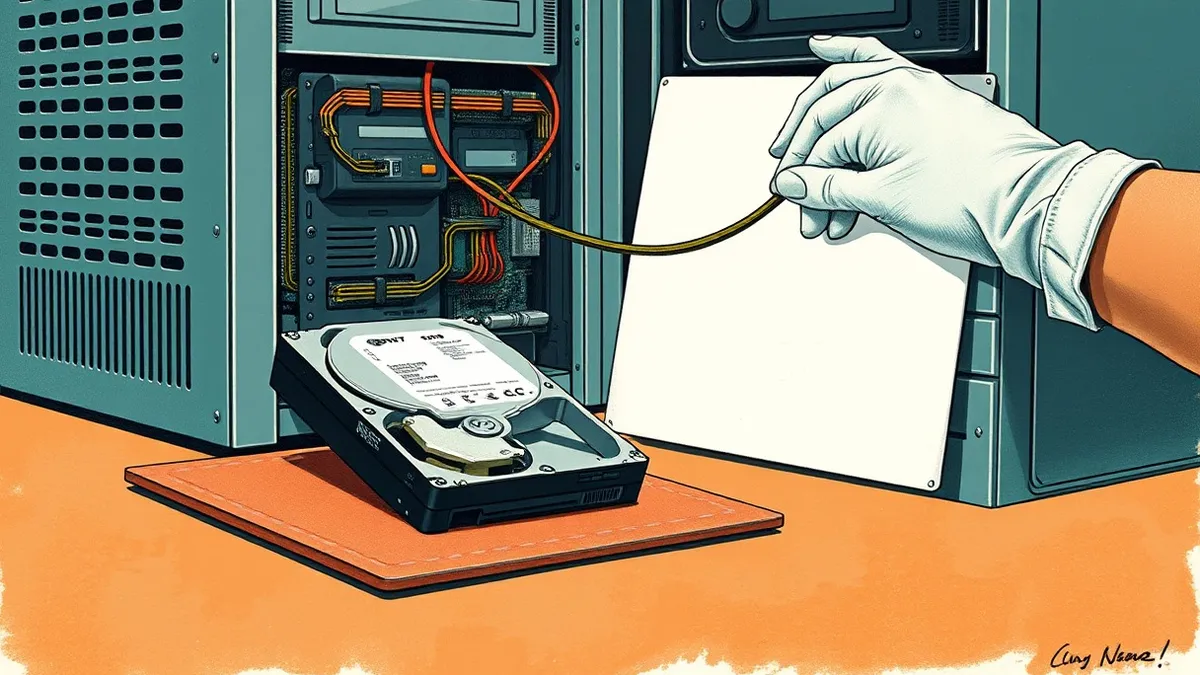
You must use write-blockers when imaging disks. This ensures you do not alter the data during collection. You must hash every file you collect. This allows you to verify integrity later. If the hash changes, the evidence is compromised.
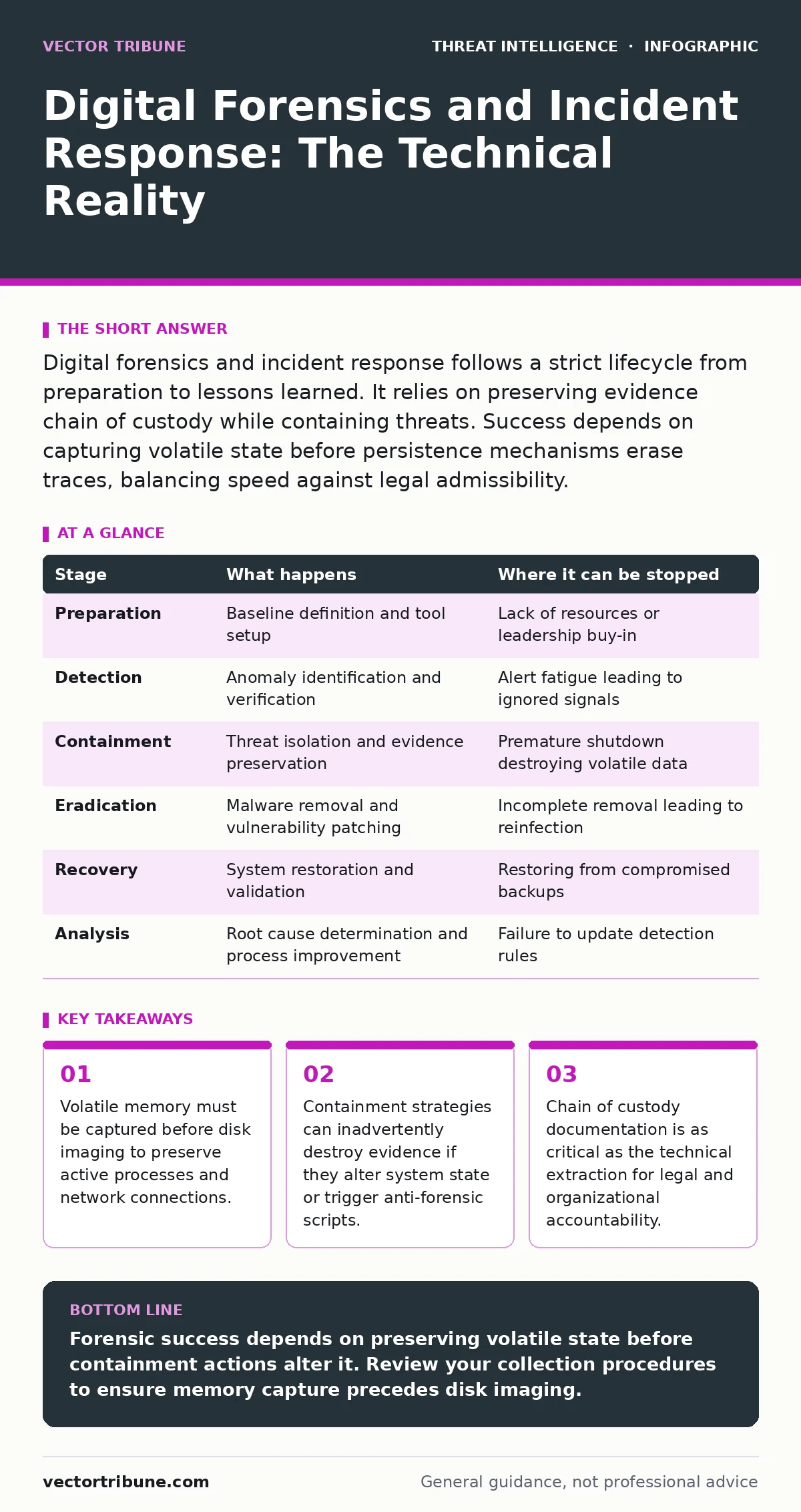
| Stage | What happens | Where it can be stopped |
|---|---|---|
| Preparation | Baseline definition and tool setup | Lack of resources or leadership buy-in |
| Detection | Anomaly identification and verification | Alert fatigue leading to ignored signals |
| Containment | Threat isolation and evidence preservation | Premature shutdown destroying volatile data |
| Eradication | Malware removal and vulnerability patching | Incomplete removal leading to reinfection |
| Recovery | System restoration and validation | Restoring from compromised backups |
| Analysis | Root cause determination and process improvement | Failure to update detection rules |
Integrating with Security Operations
Forensics does not happen in isolation. It relies on alert triage to prioritize incidents. It feeds into threat intelligence to improve future detection. It often involves analyzing pass-the-ticket attacks where stolen authentication tokens are used to move laterally.
You must integrate forensic capabilities into your daily operations. This means having the tools ready and the staff trained. It means understanding how Microsoft Defender Antivirus or other endpoint solutions log their activities. You need to know where to look for evidence.
Key takeaways
- Volatile memory must be captured before disk imaging to preserve active processes and network connections.
- Containment strategies can inadvertently destroy evidence if they alter system state or trigger anti-forensic scripts.
- Chain of custody documentation is as critical as the technical extraction for legal and organizational accountability.
Forensic success depends on preserving volatile state before containment actions alter it. Review your collection procedures to ensure memory capture precedes disk imaging.
Frequently asked questions
How long should I keep forensic data?
Retention periods vary by jurisdiction and industry. Keep data long enough to meet legal requirements and support future investigations.
Can I perform forensics on a live system?
Yes, but it alters the state. Use read-only tools where possible and document all changes. Live forensics is necessary for volatile data.
How this guide was produced: written by the Vector Tribune editorial team with AI assistance, checked against the public references listed below, and reviewed when the facts change. See our editorial policy or report an error.