
Command and Control Traffic: Definition, Detection, and Risk Reduction
Command and control traffic often hides inside standard web protocols, making it nearly invisible to basic perimeter defenses that only inspect known ports.
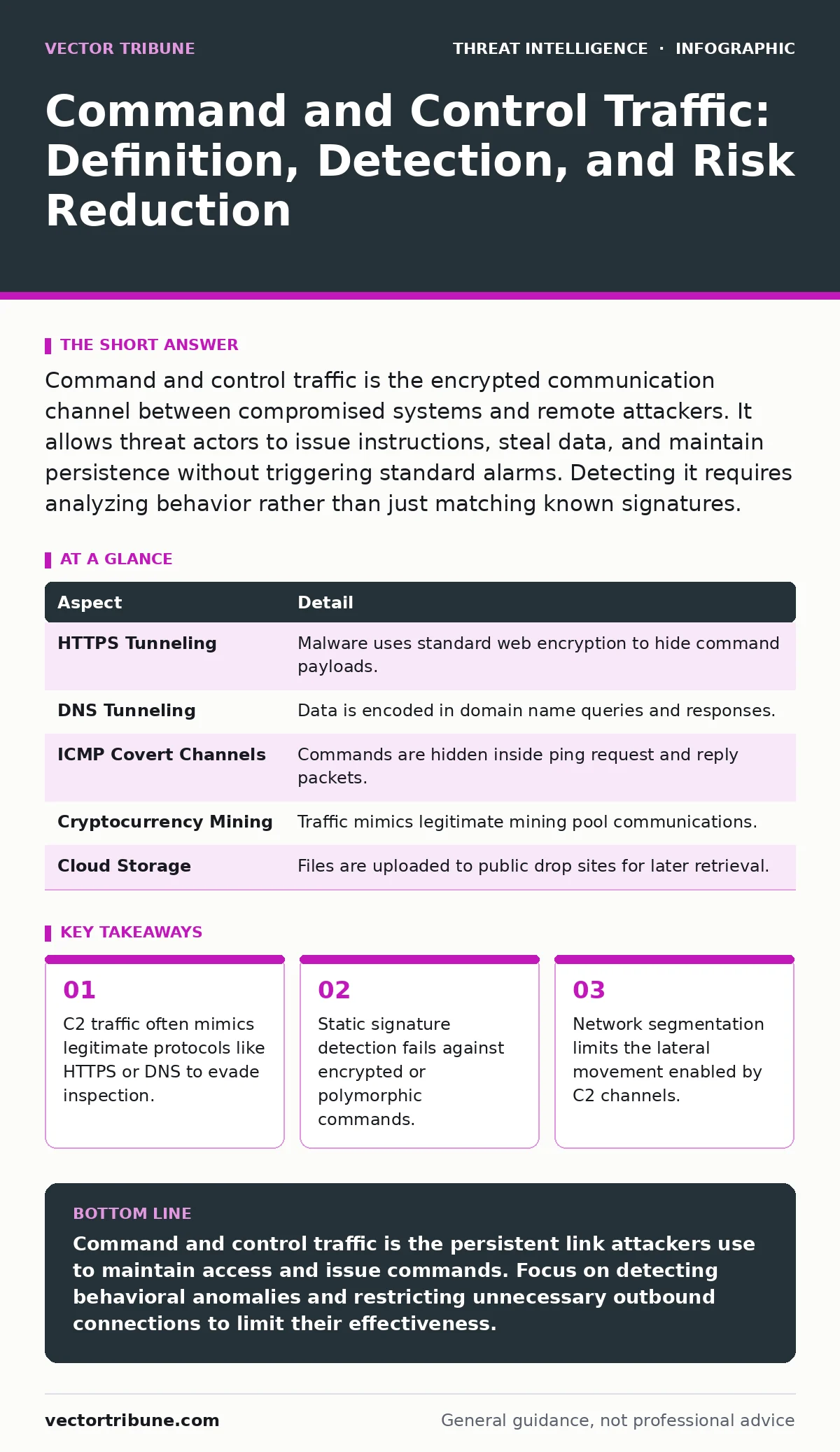
Command and control traffic is the encrypted communication channel between compromised systems and remote attackers. It allows threat actors to issue instructions, steal data, and maintain persistence without triggering standard alarms. Detecting it requires analyzing behavior rather than just matching known signatures.
The Invisible Remote Control
Imagine a smart thermostat in your home. You use an app to adjust the temperature from work. The device sends small packets of data to a cloud server, which then forwards your command. Now imagine an attacker has replaced that app. They are no longer adjusting the temperature; they are telling the device to record audio, disable security cameras, and exfiltrate your local network map.
This mechanism is the core of command and control (C2) traffic. It is the bi-directional communication channel established between a compromised host and an external server controlled by an adversary. The infected system is the beacon; the external server is the controller. The traffic itself carries the instructions, the stolen data, and the updates needed to keep the malware alive.
Unlike a simple file download, C2 is persistent. It is a long-term relationship. The attacker does not just drop a payload and leave. They maintain access to pivot deeper into the environment, escalate privileges, and wait for the right moment to strike. This persistence is what makes C2 traffic so dangerous and difficult to detect.
How the Channel Opens
The establishment of a C2 channel usually follows an initial compromise. The attacker gains a foothold through a phishing email, a vulnerable web application, or a supply chain issue. Once code executes on the victim’s machine, the malware establishes contact with its controller.
This contact often happens via a beacon. The beacon is a periodic signal sent by the malware to check for new instructions. The interval between beacons can vary. It might be every few seconds, or it might be every few hours. This variability is a deliberate design choice to avoid detection by systems looking for regular, rhythmic network activity.
The controller responds only when it has a task. If the attacker is idle, the channel may appear silent. This asymmetry makes the traffic look like background noise. The malware waits for a response, processes the command, and sends back the result. This loop continues until the attacker decides to terminate the session or the system is isolated.
Common Disguises and Protocols
Attackers rarely use raw, unencrypted connections for C2. Doing so leaves a clear trail of plaintext commands. Instead, they wrap their traffic in legitimate protocols. This technique is known as protocol tunneling. By hiding malicious data inside standard traffic, the C2 channel blends in with the noise of normal business operations.
| Aspect | Detail |
|---|---|
| HTTPS Tunneling | Malware uses standard web encryption to hide command payloads. |
| DNS Tunneling | Data is encoded in domain name queries and responses. |
| ICMP Covert Channels | Commands are hidden inside ping request and reply packets. |
| Cryptocurrency Mining | Traffic mimics legitimate mining pool communications. |
| Cloud Storage | Files are uploaded to public drop sites for later retrieval. |
HTTPS is the most common disguise. Because most corporate firewalls allow HTTPS traffic to pass without deep inspection, it provides a perfect cover. The attacker uses a valid SSL certificate, often stolen from a legitimate site, to establish trust. The content inside the encrypted tunnel is unreadable to standard network monitors.
DNS tunneling is another favored method. Domain Name System queries are small and ubiquitous. Attackers encode data in the subdomain labels of DNS requests. For example, a query to data.badsite.com might contain encoded instructions. Since DNS is essential for internet connectivity, blocking it is not an option. This makes detecting DNS-based C2 a complex challenge. See our guide on DNS tunneling for more on how this encoding works.
What People Usually Get Wrong
Many security teams assume that if traffic is encrypted, it is safe. This is a fundamental error. Encryption protects privacy, but it also protects criminals. A standard web browser uses HTTPS to protect your banking details. A trojan uses HTTPS to protect its commands. The protocol is identical. The difference lies in the behavior, not the encryption.
Another common mistake is relying solely on indicators of compromise (IOCs). IOCs are specific artifacts, such as file hashes or IP addresses, that signal malicious activity. While useful, they are reactive. An attacker can change their domain name or IP address overnight. If your defense relies on matching known bad IPs, you are always one step behind. You must look for indicators of attack (IOAs), which describe the behavior of the attack, such as a process attempting to connect to an unknown external host.
The Hidden Cost of Encrypted Channels
The rise of default encryption has shifted the burden of detection. You can no longer simply read the packets. You must infer intent from metadata. This includes the timing of connections, the size of data transfers, and the destination reputation. This inference is imperfect. It leads to false positives, where legitimate software is flagged as malicious, and false negatives, where sophisticated malware slips through.
This trade-off creates a hidden cost: operational noise. Security analysts spend hours investigating alerts that turn out to be benign. This fatigue reduces the effectiveness of your alert triage process. When every alert looks the same, the real threat gets lost in the pile. You must tune your detection logic to focus on anomalies, not just volume.
See also: Stop SYN Flood Attacks: Architectural Defenses for Modern Infrastructure · Red Teaming Definition: How Adversarial Simulation Works
Reducing the Attack Surface
You cannot eliminate C2 traffic entirely. As long as devices connect to the internet, a channel can be established. However, you can make it difficult, expensive, and short-lived. The goal is to limit the impact, not just prevent the initial connection.
- Implement Egress Filtering: Most organizations focus on incoming traffic. You must also control outgoing connections. Block unnecessary protocols and restrict outbound connections to known, trusted destinations.
- Use Network Segmentation: Divide your network into smaller zones. If a workstation is compromised, segmentation prevents the malware from easily reaching critical servers or other workstations.
- Deploy Endpoint Detection and Response: These tools monitor processes on the device itself. They can detect when a legitimate process, like a web browser, attempts to execute a script or connect to an unusual port.
- Monitor for Anomalies: Look for devices that communicate with external hosts during off-hours. Check for large data transfers to unknown cloud storage providers.
The Role of Forensics
When C2 traffic is detected, the immediate response is containment. You isolate the affected system to cut off the channel. But the work is not done. You must understand how the attacker got in and what they did while connected. This is where digital forensics and incident response becomes critical.
You need to analyze the memory of the compromised host. Malware often resides in memory to avoid detection on disk. You need to review logs from firewalls, proxies, and endpoints. You need to determine if the attacker moved laterally to other systems. If they did, you must check for Active Directory attacks or pass-the-ticket attacks that may have given them broader access.
Beyond the Network Perimeter
Modern attacks often move beyond traditional network boundaries. Attackers may use legitimate cloud services to host their C2 infrastructure. These services have high uptime and are trusted by many security tools. Detecting C2 hosted on major cloud platforms requires a different approach. You must focus on the behavior of the client, not just the reputation of the server.
This shift means that your defense must be layered. Network controls are necessary but insufficient. Endpoint controls are vital. User awareness is important. But the most effective defense is a culture of scrutiny. Question every new connection. Verify every unusual request. Assume that the perimeter has already been breached.
The Long Game
Command and control traffic is the lifeline of a persistent threat. It allows attackers to operate with stealth and precision. Defending against it requires a shift from static blocking to dynamic monitoring. You must accept that some C2 traffic will get through. Your goal is to detect it quickly, contain it effectively, and learn from it to improve your defenses.
This is not a one-time fix. It is a continuous process. As attackers evolve their techniques, your detection methods must evolve with them. Stay curious. Stay skeptical. And always look for the anomaly in the noise.
Key takeaways
- C2 traffic often mimics legitimate protocols like HTTPS or DNS to evade inspection.
- Static signature detection fails against encrypted or polymorphic commands.
- Network segmentation limits the lateral movement enabled by C2 channels.
Command and control traffic is the persistent link attackers use to maintain access and issue commands. Focus on detecting behavioral anomalies and restricting unnecessary outbound connections to limit their effectiveness.
Frequently asked questions
Can antivirus software detect command and control traffic?
Traditional antivirus may miss C2 if it relies on known signatures. Modern endpoint protection with behavioral analysis is more effective at identifying suspicious network activity.
How do I know if my DNS traffic is being used for C2?
Look for unusually long domain names, high volumes of DNS queries to a single domain, or DNS traffic containing large amounts of encoded data.
Is blocking all outbound internet traffic a good solution?
No. It is impractical for most organizations. Instead, filter outbound traffic to allow only necessary protocols and destinations.
What is the difference between C2 and data exfiltration?
C2 is the channel for commands and control. Data exfiltration is the act of stealing data. C2 is often used to facilitate exfiltration.
How this guide was produced: written by the Vector Tribune editorial team with AI assistance, checked against the public references listed below, and reviewed when the facts change. See our editorial policy or report an error.