
Stop SYN Flood Attacks: Architectural Defenses for Modern Infrastructure
Rate limiting alone fails against amplified traffic; you must shift the handshake burden to an upstream proxy to preserve application availability.
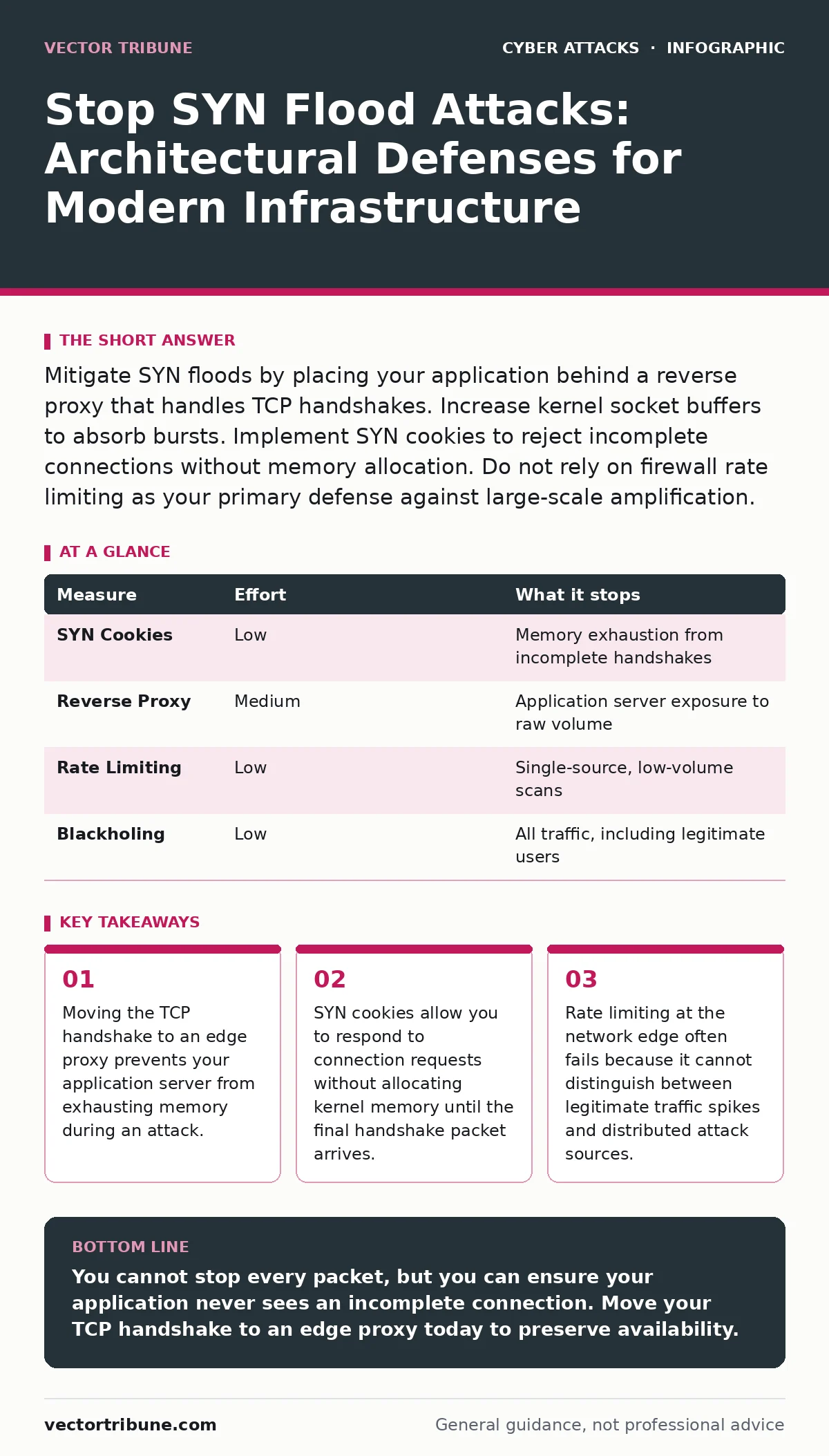
Mitigate SYN floods by placing your application behind a reverse proxy that handles TCP handshakes. Increase kernel socket buffers to absorb bursts. Implement SYN cookies to reject incomplete connections without memory allocation. Do not rely on firewall rate limiting as your primary defense against large-scale amplification.
The Mechanics of Connection Exhaustion
A SYN flood exploits the stateful nature of the Transmission Control Protocol. When a client initiates a connection, it sends a SYN packet. Your server responds with a SYN-ACK and allocates memory for a half-open connection. It waits for the final ACK packet to complete the handshake. The attacker sends millions of SYNs with spoofed source addresses. Your server fills its backlog queue with these half-open connections. It stops accepting legitimate traffic because it has no memory left for new sessions. This is not a resource leak in your code. It is a fundamental limitation of how TCP manages state.
Why Rate Limiting Fails
Many administrators reach for rate limiting as their first line of defense. This approach counts packets per second from a single IP address and blocks those exceeding a threshold. This works poorly against distributed attacks. The attacker uses a botnet with thousands of unique IP addresses. Each IP sends only a few packets per second. The total volume overwhelms your server, but no single IP triggers the limit. Furthermore, legitimate users on shared IP networks, such as mobile carriers, often trigger false positives. You block real users while the attack continues.
| Measure | Effort | What it stops |
|---|---|---|
| SYN Cookies | Low | Memory exhaustion from incomplete handshakes |
| Reverse Proxy | Medium | Application server exposure to raw volume |
| Rate Limiting | Low | Single-source, low-volume scans |
| Blackholing | Low | All traffic, including legitimate users |
Implementing SYN Cookies
SYN cookies are a kernel-level feature that changes how your server handles the initial SYN packet. Instead of allocating memory for the connection, the server generates a cryptographic hash based on the connection parameters. It sends this hash back in the SYN-ACK sequence number. The server stores nothing. If the client responds with the correct ACK, the server verifies the hash and allocates memory. If the packet is forged or the client never responds, the server discards the request with no cost. This mechanism prevents memory exhaustion. It does add a small computational overhead for the hash calculation. On high-throughput servers, this CPU cost can become a bottleneck.
Shifting the Handshake to a Proxy
The most effective architectural change is to remove your application server from the direct path of the internet. Place a reverse proxy or load balancer in front of your application. This device accepts the SYN packets from the internet. It completes the TCP handshake with the client. It then establishes a separate connection to your application server. Your application server only sees completed connections. It never manages half-open states. If the proxy is overwhelmed, it can drop connections before they reach your application. This preserves your application’s ability to serve users who did reach the proxy. This pattern is standard for handling API abuse and other volumetric threats.
Tuning Kernel Parameters
Even with a proxy, your edge devices need tuning to handle traffic bursts. The kernel maintains a backlog queue for connections waiting to be accepted by the application. If this queue fills, the kernel drops new SYN packets. You must increase the size of this queue. You must also increase the maximum number of sockets the kernel can create. These settings prevent the OS from dropping connections during short, intense spikes. These changes do not stop an attack. They buy time for your mitigation systems to activate. Without these buffers, your server will fail under normal traffic growth, not just during attacks.
See also: Public Wi-Fi Risks: How Open Networks Expose Your Data · Watering Hole Attacks in Cyber Security: How Compromise Happens
The Cost of Stateful Inspection
Deep packet inspection tools can identify malformed packets. They add a layer of filtering before traffic reaches your server. This process is computationally expensive. Every packet must be parsed and analyzed. As traffic volume increases, the inspection engine becomes the bottleneck. You trade application performance for security visibility. During a massive flood, the inspection device may fail, taking your entire network down with it. Use this only for low-to-medium traffic environments. For high-scale services, simple stateless filtering is more reliable.
What Does Not Work
Blackholing traffic is a common last resort. You configure your router to drop all traffic destined for your IP address. This stops the attack. It also stops all legitimate users. You are offline. This is not a prevention strategy. It is a surrender. Similarly, blocking IP ranges from known malicious countries does not work. Attackers use compromised servers in any country. You will block legitimate users and miss the attack. These measures create a false sense of security. They do not add resilience to your architecture.
Integrating with Identity Protection
While network defenses handle the volume, you must ensure that your application does not amplify the problem. If your login endpoint is expensive to process, an attacker can use it to exhaust resources faster. Combine your network defenses with application-level limits. This aligns with best practices for privileged access management, ensuring that even if a connection is established, the actions taken are strictly controlled. You should also consider how these limits interact with passkeys, which rely on multiple round-trips for authentication. Ensure your timeout values allow these protocols to complete without dropping legitimate users.
Checklist for Immediate Action
- Enable SYN cookies on all public-facing operating systems to prevent memory exhaustion.
- Increase the TCP backlog queue size in your kernel settings to absorb traffic spikes.
- Verify that your application sits behind a reverse proxy that handles the initial TCP handshake.
Key takeaways
- Moving the TCP handshake to an edge proxy prevents your application server from exhausting memory during an attack.
- SYN cookies allow you to respond to connection requests without allocating kernel memory until the final handshake packet arrives.
- Rate limiting at the network edge often fails because it cannot distinguish between legitimate traffic spikes and distributed attack sources.
You cannot stop every packet, but you can ensure your application never sees an incomplete connection. Move your TCP handshake to an edge proxy today to preserve availability.
Frequently asked questions
How do I know if my server is under a SYN flood attack?
Check your server logs for a high number of half-open connections. If you see many TCP connections in the SYN_RECV state that never transition to ESTABLISHED, you are likely being flooded.
Do SYN cookies affect the performance of legitimate users?
They add minimal CPU overhead for cryptographic hashing. Most users will not notice a difference. High-frequency trading systems or ultra-low-latency applications may see slight delays.
Can a CDN prevent SYN floods?
Yes, most CDNs absorb volumetric attacks at their edge. They handle the TCP handshakes and only forward completed requests to your origin server. This is similar to using a dedicated reverse proxy.
Should I disable SYN cookies if I am using a load balancer?
You should enable them on both the load balancer and the backend servers. The load balancer handles the bulk of the traffic, but backend servers may still receive direct traffic or internal scans. Defense in depth is always safer.
How this guide was produced: written by the Vector Tribune editorial team with AI assistance, checked against the public references listed below, and reviewed when the facts change. See our editorial policy or report an error.