Watering Hole Attacks in Cyber Security: How Compromise Happens
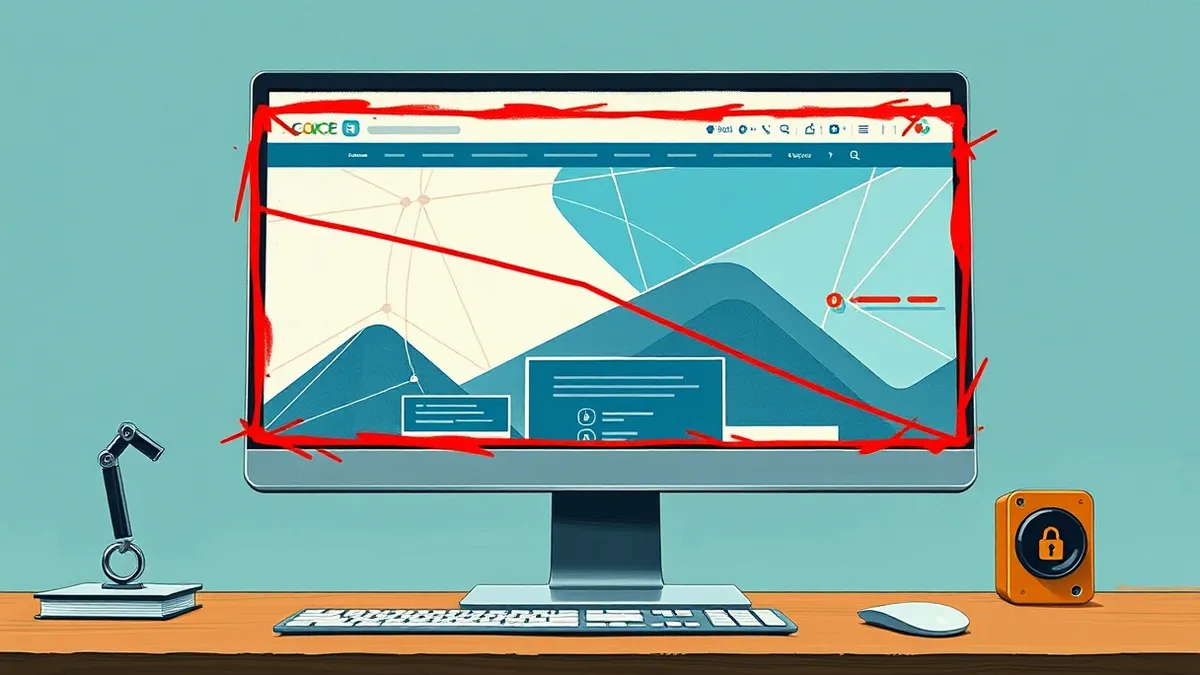
Watering hole attacks bypass user suspicion by compromising sites that victims already trust and visit regularly for legitimate professional tasks.
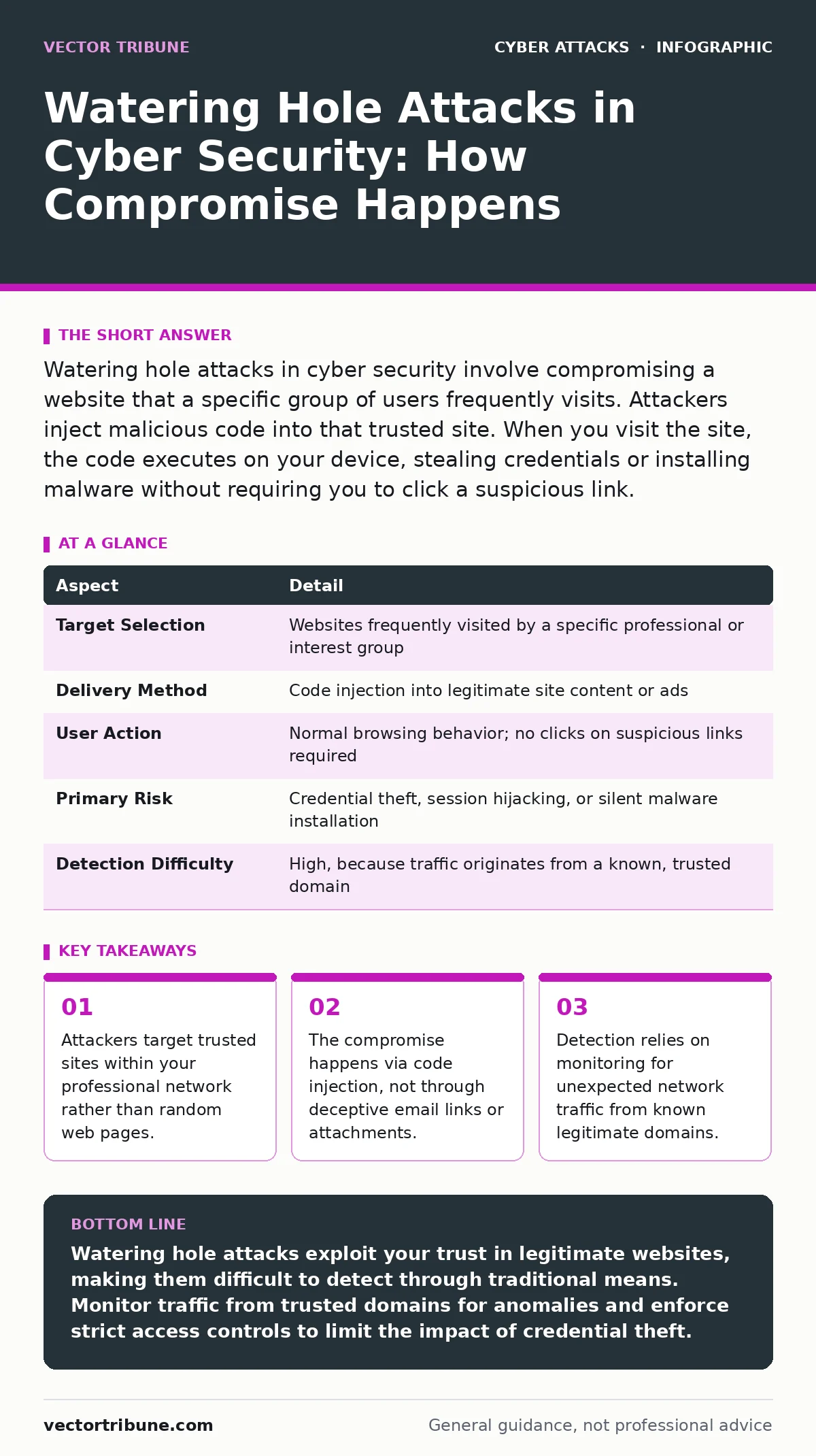
Watering hole attacks in cyber security involve compromising a website that a specific group of users frequently visits. Attackers inject malicious code into that trusted site. When you visit the site, the code executes on your device, stealing credentials or installing malware without requiring you to click a suspicious link.
Understanding the Watering Hole Mechanism
Imagine you drive to a specific gas station every morning because it is on your commute and you trust the pumps. If someone tampers with that specific pump, you do not suspect foul play because you expect the service. Watering hole attacks in cyber security operate on this exact principle. An attacker identifies websites that a specific target group, such as employees of a financial firm or members of a professional association, visits regularly. The attacker then compromises that legitimate website.
The attacker does not send an email to you. You go to the site because you need to. This removes the psychological trigger of urgency or curiosity that makes phishing effective. You expect the site to be safe. The attack succeeds because the trust relationship is between you and the site owner, not between you and the attacker. The attacker hijacks that existing trust.
| Aspect | Detail |
|---|---|
| Target Selection | Websites frequently visited by a specific professional or interest group |
| Delivery Method | Code injection into legitimate site content or ads |
| User Action | Normal browsing behavior; no clicks on suspicious links required |
| Primary Risk | Credential theft, session hijacking, or silent malware installation |
| Detection Difficulty | High, because traffic originates from a known, trusted domain |
How the Compromise Executes
The attacker performs reconnaissance to find the watering hole. They look for sites with high traffic from the target demographic but poor security hygiene. Once identified, the attacker exploits a vulnerability in the website. This might be an outdated plugin, a misconfigured server, or a weak administrative password. The goal is to gain write access to the site's code.
The attacker then injects malicious code. This is often a cross-site scripting payload. Cross-site scripting allows the attacker to run scripts in the context of the victim's browser. When you load the page, your browser treats the malicious script as part of the legitimate site. The script can perform several actions. It can redirect you to a malicious site hosted by the attacker. It can capture your login tokens. It can silently download a tool that establishes a backdoor on your machine.
This method bypasses many traditional security controls. Firewalls often allow traffic to known business partners or industry forums. Email filters do not inspect web traffic. Your browser may not flag the site because it has a valid SSL certificate and a high reputation. The attack exploits the assumption that traffic from a known good domain is safe.
Who Faces the Greatest Risk
Any individual who consumes information online is at risk, but specific groups face higher exposure. Professional communities are prime targets. Industry forums, technical blogs, and association websites attract users who are knowledgeable about security but may not suspect their trusted resources. These users often have valuable data or access to internal systems.
Organizations with supply chains are also vulnerable. If your company relies on a third-party vendor for software updates or documentation, that vendor's website is a potential watering hole. Compromising the vendor's site allows the attacker to reach your employees who visit the site for support or updates. This expands the attack surface beyond your own perimeter.
Individuals in specialized fields, such as healthcare, finance, or legal services, visit niche sites that may lack the security resources of major platforms. These sites are easier to compromise. The attacker gains access to a concentrated group of high-value targets with minimal effort. This efficiency makes watering hole attacks attractive for sophisticated adversaries who want to avoid detection while maximizing impact.
What People Usually Get Wrong
Many defenders assume that watering hole attacks are rare or require advanced persistent threat groups. This is incorrect. The barrier to entry is lowering as website vulnerabilities become more common and exploitation kits are widely available. Another common mistake is focusing solely on the victim's behavior. You cannot train users to stop visiting legitimate sites. The control must be on the infrastructure side.
Another error is assuming that patching the user's device is sufficient. If the attack is a credential harvester on the website, patching your browser does not stop the theft if you log in. The vulnerability lies in the website's integrity, not your local configuration. You must monitor for changes in the behavior of trusted sites.
Defending Against the Attack
Defense requires a shift in perspective. You cannot prevent the attacker from compromising a third-party site. You can, however, limit the damage if your users visit it. Privileged access management is a critical control. If an attacker steals credentials from a watering hole attack, those credentials should have limited scope. Multi-factor authentication adds a layer of protection. Even if the attacker captures your password or session token, they may not be able to authenticate without the second factor.
Monitor network traffic for anomalies. Look for connections from trusted domains to unexpected external servers. If a news site suddenly starts sending data to a server in a different country, that is a red flag. Implement strict domain allowlists for sensitive operations. Use passkeys where possible. Passkeys eliminate the need for passwords, reducing the value of credentials stolen via cross-site scripting.
Review the security posture of the sites you rely on. Check for security headers like Content Security Policy. These headers restrict where scripts can load from, mitigating the impact of injection attacks. If a critical site lacks these protections, report the issue to the site administrator. Collective security improves when site owners patch vulnerabilities quickly.
See also: Cloud Metadata Service Attack Myths vs Reality · How Third-Party Data Breaches Work: The Hidden Attack Chain
Interconnected Threat Vectors
Watering hole attacks do not exist in isolation. They are often part of a broader campaign. An attacker might use a watering hole to deliver an initial payload, then use vendor email compromise to expand their reach. The initial access via the website provides the attacker with enough information to craft convincing emails that appear to come from trusted partners.
Similarly, attackers may combine watering hole techniques with typosquatting. They might register a domain that looks like the trusted site and use it to host the malicious payload. If the watering hole site redirects users to this lookalike domain, the attack becomes harder to trace. Understanding these connections helps you build a defense that addresses multiple entry points.
Long-Term Resilience Strategies
Building resilience against watering hole attacks requires continuous monitoring and adaptation. Static defenses fail because the attack vector changes. The attacker moves from one compromised site to another. You must maintain visibility into the behavior of all external sites your organization interacts with.
Implement a robust incident response plan that accounts for third-party compromises. When a trusted site is breached, your users may be exposed even if your internal systems are secure. Your response should include forced password resets, session invalidation, and enhanced monitoring for compromised accounts.
Stay informed about emerging vulnerabilities in common web technologies. When a new exploit is disclosed, assess whether any of your trusted sites use the affected software. Coordinate with site administrators to apply patches quickly. This collaborative approach strengthens the entire ecosystem, making it harder for attackers to find easy targets.
Key takeaways
- Attackers target trusted sites within your professional network rather than random web pages.
- The compromise happens via code injection, not through deceptive email links or attachments.
- Detection relies on monitoring for unexpected network traffic from known legitimate domains.
Watering hole attacks exploit your trust in legitimate websites, making them difficult to detect through traditional means. Monitor traffic from trusted domains for anomalies and enforce strict access controls to limit the impact of credential theft.
Frequently asked questions
How do I know if I have been targeted by a watering hole attack?
You may not know immediately. Look for unexpected login alerts, strange browser behavior, or unauthorized transactions. Security tools may flag connections from trusted sites to suspicious external servers.
Can antivirus software stop a watering hole attack?
Antivirus software can detect and remove malware if the attack installs a payload. However, it may not prevent the initial credential theft or session hijacking if the attack relies on script injection rather than file download.
Are watering hole attacks only used by state-sponsored groups?
No. While sophisticated groups use them, criminal organizations also employ watering hole techniques. The method is effective for targeting specific professional groups with valuable data or financial assets.
How is this different from a phishing attack?
Phishing relies on tricking you into clicking a link or opening an attachment sent via email or message. Watering hole attacks compromise a site you already visit, requiring no deceptive communication from the attacker.
How this guide was produced: written by the Vector Tribune editorial team with AI assistance, checked against the public references listed below, and reviewed when the facts change. See our editorial policy or report an error.