Vendor Email Compromise: How Identity Theft Bypasses Security
Attackers rewrite invoice details to route funds to accounts they control, exploiting the trust you place in established business relationships.
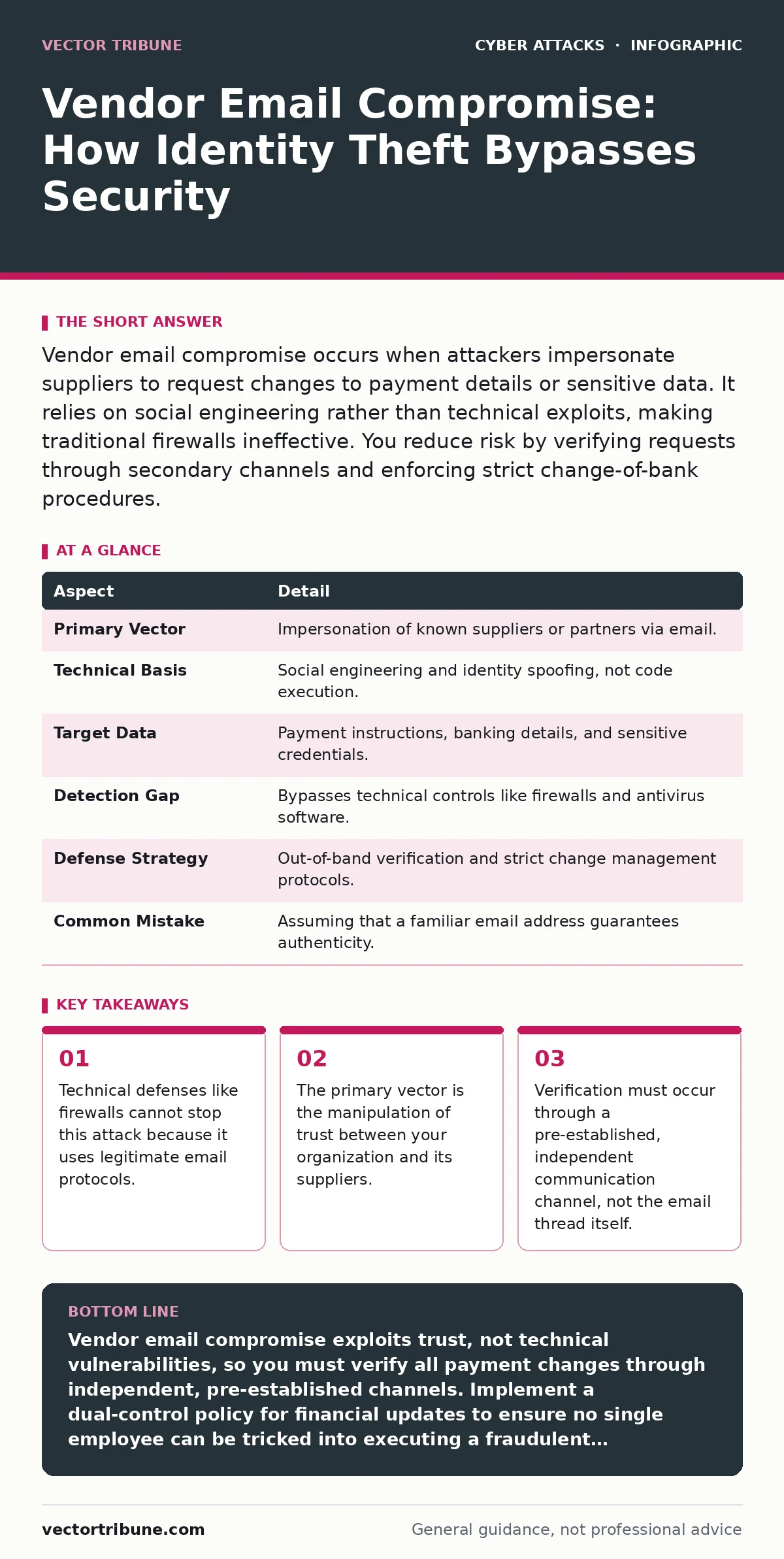
Vendor email compromise occurs when attackers impersonate suppliers to request changes to payment details or sensitive data. It relies on social engineering rather than technical exploits, making traditional firewalls ineffective. You reduce risk by verifying requests through secondary channels and enforcing strict change-of-bank procedures.
The Broken Supply Chain Link
Imagine you receive a package from a trusted courier. The label looks correct, the packaging is standard, and the signature matches your records. You accept it without question. Now imagine the courier was intercepted, and the package contents were swapped while the label remained authentic. You still accepted the delivery, but the value inside is no longer what you expected.
This is the core mechanic of vendor email compromise. It is not a breach of your network perimeter. It is a breach of the relationship between you and your suppliers. The attacker does not need to hack your server. They only need to convince you that a request coming from a known entity is legitimate.
The attack exploits the natural efficiency of business operations. You expect invoices. You expect updates to banking details. You expect timely communication. The attacker mimics these expectations so closely that your standard review process fails to flag the anomaly.
| Aspect | Detail |
|---|---|
| Primary Vector | Impersonation of known suppliers or partners via email. |
| Technical Basis | Social engineering and identity spoofing, not code execution. |
| Target Data | Payment instructions, banking details, and sensitive credentials. |
| Detection Gap | Bypasses technical controls like firewalls and antivirus software. |
| Defense Strategy | Out-of-band verification and strict change management protocols. |
| Common Mistake | Assuming that a familiar email address guarantees authenticity. |
The Mechanics of Impersonation
Attackers begin by researching your supply chain. They identify vendors who send you regular invoices or updates. They then craft an email that appears to come from that vendor. This is not always a simple typo in the sender address. Attackers often register domains that look nearly identical to the real vendor’s domain, a technique known as typosquatting.
Suppose you buy software from "SecureSoft". An attacker registers "Secure-Soft.com" or "SecureSoft-Support.net". When you receive an email from this address, your brain fills in the gap. You assume it is the real vendor. The email body is copied from legitimate correspondence. The tone is professional. The logo is stolen from the web.
The request is usually urgent. The vendor claims their banking details have changed due to a merger, a security incident, or a new accounting system. They ask you to update your records immediately to avoid service interruption. The urgency is designed to bypass your critical thinking. It pushes you to act before you can verify the claim.
Why Traditional Defenses Fail
Most organizations invest heavily in technical security. You likely have firewalls, intrusion detection systems, and endpoint protection. These tools are excellent at stopping malware and blocking unauthorized network access. They are useless against vendor email compromise.
The email arrives through legitimate channels. It travels through standard mail servers. It does not contain malicious code. It is just text. Your security software sees a harmless message from a known contact. It marks it as safe. The attack succeeds because it operates above the technical layer. It operates on the human layer.
This is why phishing filters often miss these attacks. Standard phishing looks for malicious links or attachments. Vendor compromise looks for a change in process. The email is benign. The danger is in the action you take after reading it. You must understand that technical hygiene does not equal operational security.
The Hidden Cost of Trust
The damage is not just financial. It is reputational. When you pay the wrong account, you are not just losing money. You are potentially laundering funds for criminals. Your organization becomes a conduit for illicit activity. This can lead to regulatory scrutiny and legal liability.
Furthermore, the breach erodes trust with your actual suppliers. They may suspect you of negligence. They may tighten their own security around you. The relationship, which was once efficient, becomes fraught with suspicion. You will likely be required to jump through additional hoops for future transactions.
The attacker benefits from this chaos. While you are investigating the loss and repairing the relationship, they are moving the funds. Money moved quickly through multiple accounts is difficult to trace. By the time you realize the error, the trail is cold.
What People Usually Get Wrong
Many organizations believe that verifying the sender’s email address is sufficient. They check that the email comes from the vendor’s domain. This is a critical error. Attackers can compromise the vendor’s email account entirely. If the attacker controls the vendor’s inbox, they can send a legitimate-looking email from the real address.
This is where the advice to "check the sender" fails. If the sender is real, but the actor is not, you are still compromised. You must verify the content of the message, not just the origin. You need to confirm that the vendor actually intends to change their banking details.
Another common mistake is relying on reply-to chains. If you reply to the suspicious email, you are still talking to the attacker. You are not talking to the vendor. The attacker controls the conversation. You must initiate a new conversation through a different channel.
See also: 7 Deepfake Mistakes That Leave Your Organization Vulnerable · Watering Hole Attacks in Cyber Security: How Compromise Happens
Building a Verification Protocol
To reduce risk, you must implement a process that is independent of the email channel. This is often called out-of-band verification. When you receive a request to change payment details, you must contact the vendor using a method you already have on file.
Call the phone number listed on your original contract. Do not call the number in the email. The email may contain a fake support number that leads to the attacker. Send a secure message through your existing procurement platform. Do not reply to the email.
This adds friction to your workflow. It slows down processing times. This is the trade-off. You accept slower operations to prevent catastrophic loss. The cost of a few extra minutes of verification is far less than the cost of a compromised payment.
Integrating with Access Controls
This attack often targets individuals with privileged access management rights. These are users who can change financial records or system configurations. You must restrict who can update vendor banking details. One person should not be able to request and approve the change.
Implement a dual-control policy. One person receives the request. A second, independent person verifies it with the vendor. The system only processes the change after both parties confirm. This removes the single point of failure. It ensures that no single employee can be tricked into executing the attack.
This approach aligns with broader security principles. It limits the blast radius of a social engineering attack. Even if an attacker tricks one employee, they cannot complete the transaction without compromising a second, unrelated person.
The Human Element in Security
You cannot automate this defense. No software can read your mind to determine if a request is genuine. You must train your staff to recognize the psychological pressure tactics. Attackers use urgency, authority, and familiarity to bypass your defenses.
Your staff must feel empowered to delay transactions. They must know that questioning a vendor is not a failure of service. It is a requirement of security. Create a culture where verification is praised, not penalized. If employees fear slowing down business, they will skip verification.
This connects to broader issues of social engineering. The attack is not against your computer. It is against your judgment. You must defend your judgment as rigorously as you defend your network.
Key takeaways
- Technical defenses like firewalls cannot stop this attack because it uses legitimate email protocols.
- The primary vector is the manipulation of trust between your organization and its suppliers.
- Verification must occur through a pre-established, independent communication channel, not the email thread itself.
Vendor email compromise exploits trust, not technical vulnerabilities, so you must verify all payment changes through independent, pre-established channels. Implement a dual-control policy for financial updates to ensure no single employee can be tricked into executing a fraudulent transaction.
Frequently asked questions
Can email authentication protocols prevent vendor email compromise?
Protocols like SPF and DKIM verify that an email comes from a specific domain, but they cannot verify that the person sending it is authorized to make changes. If the attacker compromises the vendor's account, these protocols will still pass.
Should I block emails from new domains that look like my vendors?
Blocking typosquatting domains is helpful, but attackers can register new domains daily. A better approach is to whitelist known vendor domains and require manual review for any request that does not match the whitelist.
How do I handle urgent requests from vendors?
Urgency is a primary tactic used by attackers. You should have a pre-agreed protocol with your vendors that states no financial changes can be processed via email alone, regardless of urgency.
Is this different from a standard phishing attack?
Yes. Standard phishing often attempts to steal credentials or install malware. Vendor email compromise attempts to manipulate business processes and financial data. It targets the workflow, not just the login screen.
How this guide was produced: written by the Vector Tribune editorial team with AI assistance, checked against the public references listed below, and reviewed when the facts change. See our editorial policy or report an error.