7 Deepfake Mistakes That Leave Your Organization Vulnerable
Synthetic media exploits human trust shortcuts. You remain vulnerable when processes rely on single-channel verification. Multi-factor identity checks stop impersonation at the source.
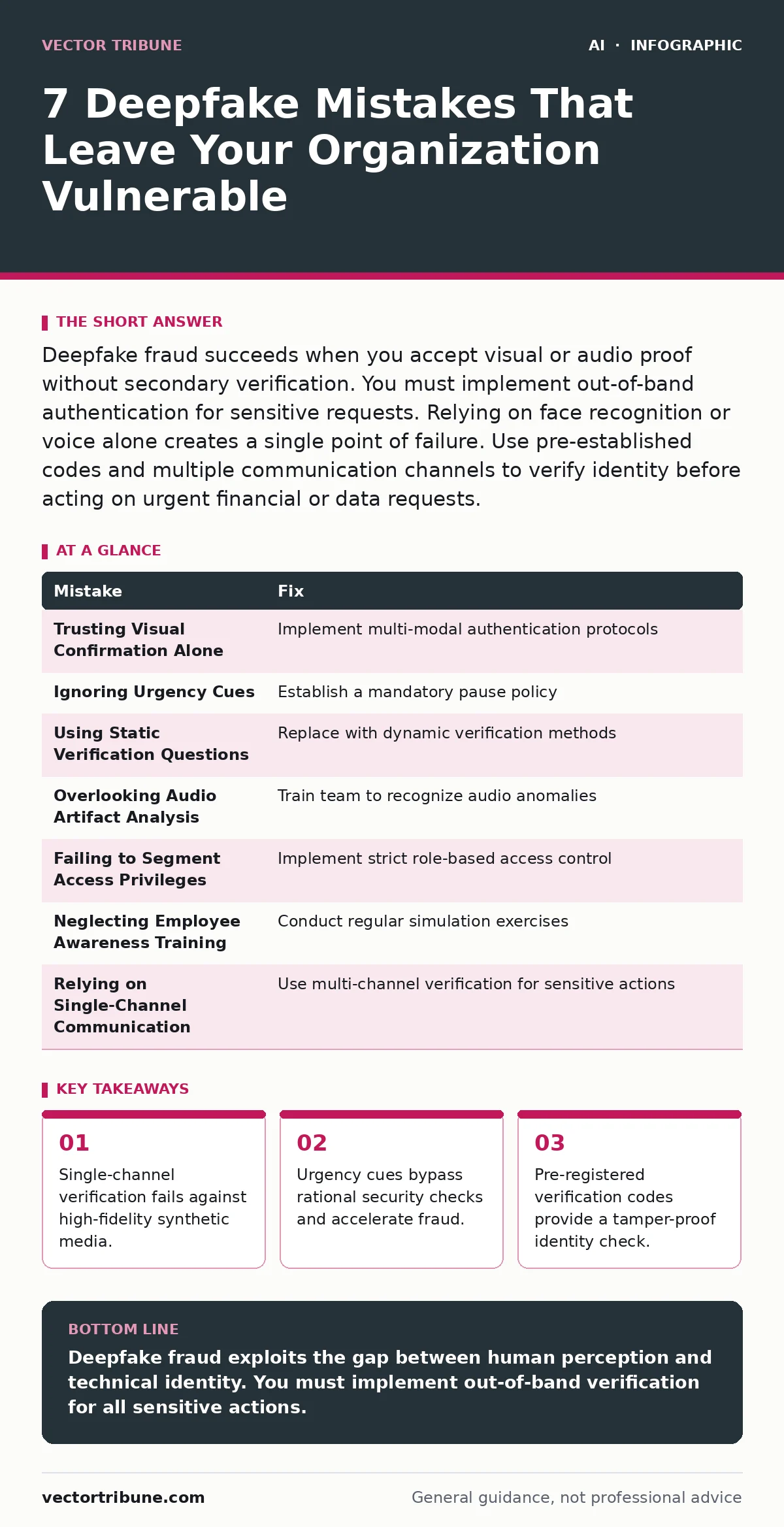
Deepfake fraud succeeds when you accept visual or audio proof without secondary verification. You must implement out-of-band authentication for sensitive requests. Relying on face recognition or voice alone creates a single point of failure. Use pre-established codes and multiple communication channels to verify identity before acting on urgent financial or data requests.
Mistake 1: Trusting Visual Confirmation Alone
Video calls provide a sense of presence that text messages lack. Attackers exploit this trust by using real-time deepfake technology. These tools synthesize facial movements and lip sync from a single source image. You see a familiar face moving naturally. You hear the correct voice. The brain accepts this as reality without further questioning. This visual confirmation creates a false sense of security. It masks the absence of cryptographic identity verification. The system relies on human perception rather than technical proof.
Why it hurts: Your verification process has a single point of failure. If the attacker generates a convincing video feed, they bypass your primary identity check. You authorize transactions or release data based on visual cues that are easily forged. This mistake ignores the gap between human perception and machine-generated reality. It allows impersonation attacks to succeed with minimal technical friction for the attacker.
The fix: Implement multi-modal authentication protocols. Require a second factor that the deepfake cannot replicate in real time. Use a pre-shared verification code that changes periodically. Ask the caller to confirm this code during the video session. This adds a layer of proof that exists outside the visual channel. It forces the attacker to compromise additional security controls. See our guide on deepfake detection for technical analysis of synthetic artifacts.
Mistake 2: Ignoring Urgency Cues in Communication
Fraudsters design deepfake scenarios to trigger immediate action. They claim a crisis has occurred. They state that funds are needed now. They say a deadline is minutes away. This urgency suppresses your critical thinking. It forces you to skip standard verification steps. You act to avoid perceived loss rather than to ensure security. The attacker relies on your psychological response to time pressure. This bypasses procedural safeguards that would normally catch the fraud.
Why it hurts: Urgency creates a cognitive blind spot. You prioritize speed over accuracy. You abandon verification protocols that require time to execute. The attacker gains an advantage by racing you to the finish line. Your compliance with urgent requests becomes the vulnerability. The consequence is unauthorized data access or financial transfer before you can pause and verify. This mistake turns your operational efficiency into a security liability.
The fix: Establish a mandatory pause policy for urgent requests. Define what constitutes a high-risk action. Require a cooling-off period before executing these actions. Use this time to verify through a separate channel. Do not accept "emergency" as a reason to bypass procedure. Train your team to recognize urgency as a social engineering tactic. This restores control to the verification process rather than the attacker.
Mistake 3: Using Static Verification Questions
Knowledge-based authentication relies on static facts. You might ask for a mother’s maiden name. You might request a favorite childhood pet. These answers remain constant over time. Attackers can harvest this information from public profiles. They can find it in old social media posts. They can purchase it from data brokers. Once an attacker knows these static answers, they can impersonate you indefinitely. This method provides no defense against sophisticated identity theft. It assumes secrecy where only convenience exists.
Why it hurts: Static questions offer zero resistance to determined attackers. The answer does not change, so the risk does not decrease. If the data is exposed once, it is compromised forever. You cannot reset a childhood memory. This creates a permanent vulnerability in your identity verification chain. The attacker gains persistent access without needing to breach new systems. This mistake ignores the permanence of leaked personal data.
The fix: Replace static questions with dynamic verification methods. Use out-of-band authentication where possible. Send a one-time code to a registered device. Require biometric confirmation through a secure app. These methods generate new proof for each session. They limit the value of stolen historical data. This approach aligns with principles discussed in our guide on AI transparency. It ensures identity proof is fresh and context-specific.
Mistake 4: Overlooking Audio Artifact Analysis
Voice synthesis technology has improved significantly. Modern tools can clone voices from short audio samples. They match tone, pitch, and cadence. However, current synthesis methods leave subtle artifacts. These include unnatural breathing patterns. They show inconsistent background noise. They lack the micro-variations of human speech. Most users do not listen for these details. They focus on the message content. They ignore the acoustic structure of the voice. This oversight allows low-quality fakes to pass inspection.
Why it hurts: You miss technical indicators of fraud. The human ear is not calibrated for signal analysis. You trust the familiarity of the voice. You do not detect the synthetic origin. The attacker succeeds because you lack the tools to analyze the audio signal. This mistake leaves you vulnerable to lower-effort attacks. It assumes voice uniqueness is a sufficient security control.
The fix: Train your team to recognize audio anomalies. Look for robotic undertones or inconsistent room tone. Use automated tools where possible. Refer to resources on deepfake detection for technical markers. Require video confirmation for audio-only requests. This adds a visual layer to catch audio fakes. Do not rely solely on auditory recognition for high-value decisions. Combine human intuition with technical verification steps.
Mistake 5: Failing to Segment Access Privileges
Deepfake attacks often target specific roles. They impersonate executives to request wire transfers. They pose as IT staff to reset passwords. They mimic vendors to change payment details. If every user has broad access, the damage spreads. An attacker gains control of multiple systems. They move laterally through the network. This lack of segmentation amplifies the impact of a single successful impersonation. You give the attacker more tools than they need.
Why it hurts: Excessive privileges increase the attack surface. A compromised identity grants unnecessary access. The attacker can explore other systems. They can exfiltrate data from unrelated departments. This mistake violates the principle of least privilege. It allows a localized breach to become a systemic failure. The consequence is widespread data loss and operational disruption.
The fix: Implement strict role-based access control. Limit user permissions to their immediate needs. Require additional approval for sensitive actions. Use just-in-time access for administrative tasks. This contains the damage of a successful deepfake attack. It prevents lateral movement within your infrastructure. See our guide on AI supply chain risks for broader access control strategies. This ensures that even if identity is compromised, capability is limited.
Mistake 6: Neglecting Employee Awareness Training
Technology alone cannot stop social engineering. Users must understand the threat. They need to recognize the signs. They must know the verification procedures. Without training, employees remain passive targets. They accept requests at face value. They do not question anomalies. This human factor remains the weakest link. Attackers exploit this gap consistently. Your technical controls are undermined by human error.
Why it hurts: Untrained staff fail to apply security protocols. They miss obvious red flags. They bypass verification steps for convenience. This creates predictable vulnerabilities. Attackers can tailor their approaches to exploit this ignorance. The consequence is repeated successful fraud. Your organization becomes a low-effort target. This mistake ignores the behavioral component of security.
The fix: Conduct regular simulation exercises. Use realistic deepfake scenarios in training. Teach employees to verify through secondary channels. Reinforce the mandatory pause policy. Make verification a habitual response. This builds a culture of skepticism. It empowers users to challenge suspicious requests. This aligns with frameworks in MITRE ATLAS. It addresses the human element of AI-driven attacks.
Mistake 7: Relying on Single-Channel Communication
Using one channel for verification creates a single path for failure. If you only use email, attackers spoof the address. If you only use phone, they use voice cloning. If you only use video, they use face swapping. Each channel has specific vulnerabilities. Attackers exploit the weakness of the chosen medium. You lack a cross-reference point. You cannot validate the source independently. This dependency on one medium leaves you exposed.
Why it hurts: A single channel provides no redundancy. The attacker only needs to compromise one vector. They do not need to break all defenses. This reduces their effort significantly. You lose the ability to cross-check information. The consequence is a higher success rate for fraud. This mistake assumes channel security equals identity security. It ignores the multi-vector nature of modern attacks.
The fix: Use multi-channel verification for all sensitive actions. Confirm via email and phone. Verify through a secure portal. Use pre-registered contact methods. This requires the attacker to compromise multiple systems simultaneously. It increases the difficulty of the attack. It reduces the likelihood of successful fraud. This approach integrates with retrieval-augmented generation security principles. It ensures data integrity across communication layers.
| Mistake | Fix |
|---|---|
| Trusting Visual Confirmation Alone | Implement multi-modal authentication protocols |
| Ignoring Urgency Cues | Establish a mandatory pause policy |
| Using Static Verification Questions | Replace with dynamic verification methods |
| Overlooking Audio Artifact Analysis | Train team to recognize audio anomalies |
| Failing to Segment Access Privileges | Implement strict role-based access control |
| Neglecting Employee Awareness Training | Conduct regular simulation exercises |
| Relying on Single-Channel Communication | Use multi-channel verification for sensitive actions |
Key takeaways
- Single-channel verification fails against high-fidelity synthetic media.
- Urgency cues bypass rational security checks and accelerate fraud.
- Pre-registered verification codes provide a tamper-proof identity check.
Deepfake fraud exploits the gap between human perception and technical identity. You must implement out-of-band verification for all sensitive actions.
Frequently asked questions
Can AI tools reliably detect deepfakes in real-time?
Current detection tools have high false-positive rates. They struggle with novel synthesis techniques. Relying solely on automated detection is risky. Combine detection with human verification protocols.
How do I verify a caller's identity securely?
Use out-of-band verification methods. Call back on a pre-registered number. Use multi-factor authentication. Do not rely on the contact information provided in the initial request.
What is the role of AI watermarking in fraud prevention?
Watermarking can help identify synthetic content. It is not foolproof and can be removed. It serves as an additional layer, not a primary control. See our guide on AI watermarking for details.
Should I train staff to spot deepfakes visually?
Visual detection is unreliable for high-quality fakes. Focus on procedural verification instead. Teach staff to pause and verify through secondary channels. This is more effective than trying to spot artifacts.
How this guide was produced: written by the Vector Tribune editorial team with AI assistance, checked against the public references listed below, and reviewed when the facts change. See our editorial policy or report an error.