
RAG Security Mistakes: 7 Errors to Prevent Data Leaks
Most RAG failures stem from indexing unstructured data without sanitization, allowing attackers to extract sensitive information through indirect prompts.
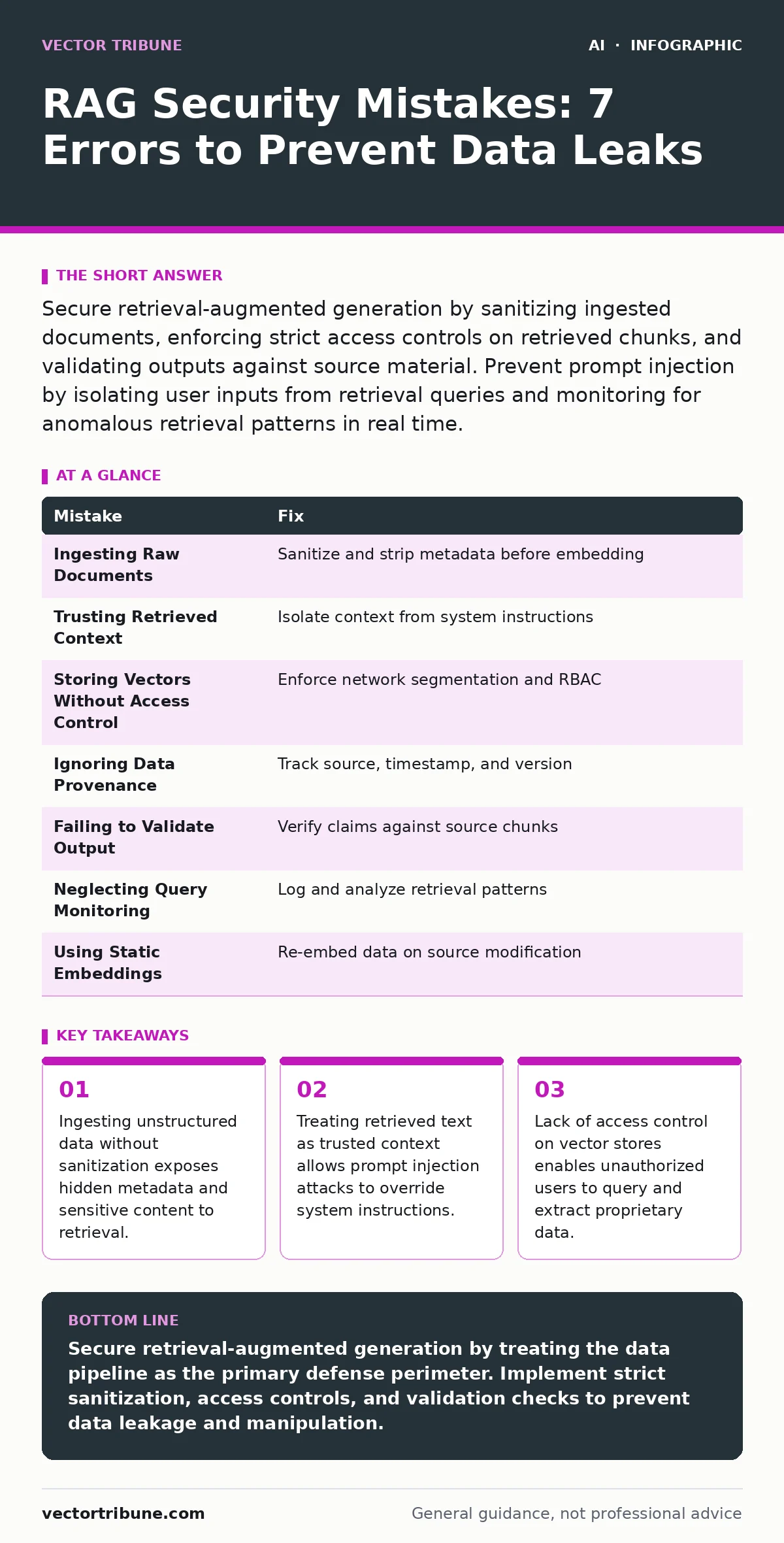
Secure retrieval-augmented generation by sanitizing ingested documents, enforcing strict access controls on retrieved chunks, and validating outputs against source material. Prevent prompt injection by isolating user inputs from retrieval queries and monitoring for anomalous retrieval patterns in real time.
Retrieval-augmented generation combines large language models with external knowledge bases. This architecture improves accuracy but introduces new attack surfaces. The security challenge shifts from protecting the model weights to securing the data pipeline and the retrieval logic. You must treat the vector database as a sensitive asset, not just a search index.
Mistake 1: Ingesting Raw Documents Without Sanitization
Developers often feed raw PDFs, Word docs, or emails directly into the embedding pipeline. These files contain hidden metadata, headers, footers, and comments that are not visible in the rendered view. When you embed this raw text, the vector store indexes these hidden elements alongside the visible content.
Why it hurts:
An attacker can craft a query that matches the hidden metadata rather than the main content. This allows them to extract sensitive information like author names, internal file paths, or confidential comments that were never intended for public consumption. It turns your document store into a leakage vector for internal communications.
The fix:
Implement a preprocessing step that strips all non-essential metadata and hidden text before embedding. Use a dedicated parser that extracts only the visible body text. Validate the extracted text against a whitelist of allowed characters and formats. This reduces the attack surface by ensuring only intended content is searchable.
Mistake 2: Trusting Retrieved Context as System Instruction
Many implementations concatenate retrieved text directly into the prompt as part of the system message or context window. The model treats this retrieved text as authoritative background information. If an attacker controls any document in the vector store, they can embed malicious instructions within that text.
Why it hurts:
This is a form of indirect prompt injection. The model may prioritize the injected instruction over your original system prompt. The attacker can force the model to ignore safety guidelines, reveal other users' data, or execute arbitrary logic. The system appears to function normally, but the output is manipulated.
The fix:
Isolate user inputs and retrieved context from the system instructions. Use clear delimiters to separate different parts of the prompt. Instruct the model explicitly that retrieved text is data, not command. Better yet, use a separate model or a lightweight classifier to scan retrieved chunks for injection patterns before passing them to the main generation model.
Mistake 3: Storing Vectors Without Access Control
Vector databases are often deployed with open access for ease of development. The assumption is that the application layer handles authentication, so the database itself does not need strict permissions. This creates a single point of failure if the application logic is bypassed.
Why it hurts:
If an attacker gains access to the vector database directly, they can perform brute-force queries or dump the entire index. Since vectors represent semantic meaning, an attacker can reconstruct sensitive information by analyzing the similarity clusters. They can also infer relationships between data points that were never meant to be linked.
The fix:
Enforce network-level segmentation and strict authentication on the vector database. Do not rely solely on application-level checks. Implement role-based access control at the database level, ensuring that only the application service account can read and write vectors. Regularly audit access logs for unusual query patterns that suggest enumeration attempts.
Mistake 4: Ignoring Data Provenance in Retrieval
When a query returns multiple relevant chunks, the system often selects the top-k results based on similarity score alone. It does not verify the source or recency of these chunks. This treats all data as equally trustworthy, regardless of its origin or age.
Why it hurts:
Outdated or unverified information can be retrieved and presented as fact. An attacker who has poisoned the data source can ensure their malicious chunk ranks high in similarity. Without provenance tracking, you cannot distinguish between a legitimate update and a malicious insertion. This erodes user trust and leads to hallucinated or incorrect outputs.
The fix:
Store metadata about the source, timestamp, and version of each chunk alongside its vector. Filter retrieval results based on these attributes before passing them to the model. Implement a confidence score that reflects both semantic similarity and source reliability. This ensures that the model prioritizes authoritative and current information.
Mistake 5: Failing to Validate Output Against Source
The generation model creates a natural language response based on the retrieved context. Many systems output this response directly without checking if it aligns with the source material. This assumes the model will not hallucinate or misinterpret the context.
Why it hurts:
The model may generate plausible-sounding but factually incorrect statements. It might mix information from different sources or invent details that were not in the retrieved text. This leads to misinformation and potential liability if the output is used for decision-making. It also masks the failure of the retrieval step.
The fix:
Implement a verification step that checks the generated response against the retrieved source chunks. Use a separate model or a rule-based system to verify that every claim in the response is supported by the source. If the verification fails, reject the response or flag it for human review. This adds a layer of integrity to the final output.
See also: AI Transparency Statement: What It Is and Why You Need One
Mistake 6: Neglecting to Monitor for Anomalous Queries
Standard logging often records only the final output, not the internal retrieval process. This means you cannot see what queries are being run against the vector store or how the retrieval results are being used. This lack of visibility makes it difficult to detect attacks in progress.
Why it hurts:
Attackers can probe the system by sending queries that test the boundaries of the data. Without monitoring, these probes go unnoticed until a breach occurs. You cannot distinguish between legitimate user behavior and malicious enumeration. This delays incident response and allows attackers to refine their techniques.
The fix:
Log all queries sent to the vector store, including the input text and the retrieved results. Monitor for patterns such as high-frequency queries, queries with unusual semantic distances, or queries that target specific metadata fields. Set up alerts for anomalies that suggest data exfiltration or injection attempts. This provides early warning of potential security incidents.
Mistake 7: Using Static Embeddings for Dynamic Data
Embeddings are generated from text at a specific point in time. If the underlying data changes, the embeddings do not automatically update. Many systems fail to re-embed data when it is modified, leading to stale or inconsistent representations.
Why it hurts:
The vector store may return outdated information that contradicts the current state of the data. This creates confusion and reduces the reliability of the system. An attacker could exploit this by modifying data in the source system but not triggering a re-embedding, causing the system to serve old, potentially compromised information.
The fix:
Implement a change data capture mechanism that triggers re-embedding whenever source data is modified. Ensure that the old vectors are deleted or invalidated before the new ones are inserted. This keeps the vector store synchronized with the source of truth. It prevents stale data from influencing retrieval results.
| Mistake | Fix |
|---|---|
| Ingesting Raw Documents | Sanitize and strip metadata before embedding |
| Trusting Retrieved Context | Isolate context from system instructions |
| Storing Vectors Without Access Control | Enforce network segmentation and RBAC |
| Ignoring Data Provenance | Track source, timestamp, and version |
| Failing to Validate Output | Verify claims against source chunks |
| Neglecting Query Monitoring | Log and analyze retrieval patterns |
| Using Static Embeddings | Re-embed data on source modification |
Key takeaways
- Ingesting unstructured data without sanitization exposes hidden metadata and sensitive content to retrieval.
- Treating retrieved text as trusted context allows prompt injection attacks to override system instructions.
- Lack of access control on vector stores enables unauthorized users to query and extract proprietary data.
- Ignoring provenance breaks the chain of trust, making it impossible to verify if an answer is grounded in fact.
Secure retrieval-augmented generation by treating the data pipeline as the primary defense perimeter. Implement strict sanitization, access controls, and validation checks to prevent data leakage and manipulation.
Frequently asked questions
Does RAG eliminate the need for model fine-tuning?
No, RAG provides external knowledge, while fine-tuning adjusts model behavior. They address different needs and can be used together for improved accuracy and control.
How do I prevent data poisoning in the vector store?
Validate all incoming data for integrity and authenticity before embedding. Implement strict access controls and monitor for unusual ingestion patterns to detect potential poisoning attempts.
Is it safe to use public vector databases for sensitive data?
Generally, no. Public databases may lack the necessary security controls for sensitive data. Use private, self-hosted solutions with robust encryption and access management for confidential information.
Can RAG systems be used for real-time threat detection?
Yes, by integrating real-time data feeds and monitoring retrieval patterns, RAG systems can help identify emerging threats and provide contextual analysis for security operations. See AI in security operations for more details.
How this guide was produced: written by the Vector Tribune editorial team with AI assistance, checked against the public references listed below, and reviewed when the facts change. See our editorial policy or report an error.