
AI Agent Hijacking: How Autonomy Fails and What To Do
AI agent hijacking occurs when external inputs manipulate autonomous systems into executing unintended actions, bypassing standard security controls.
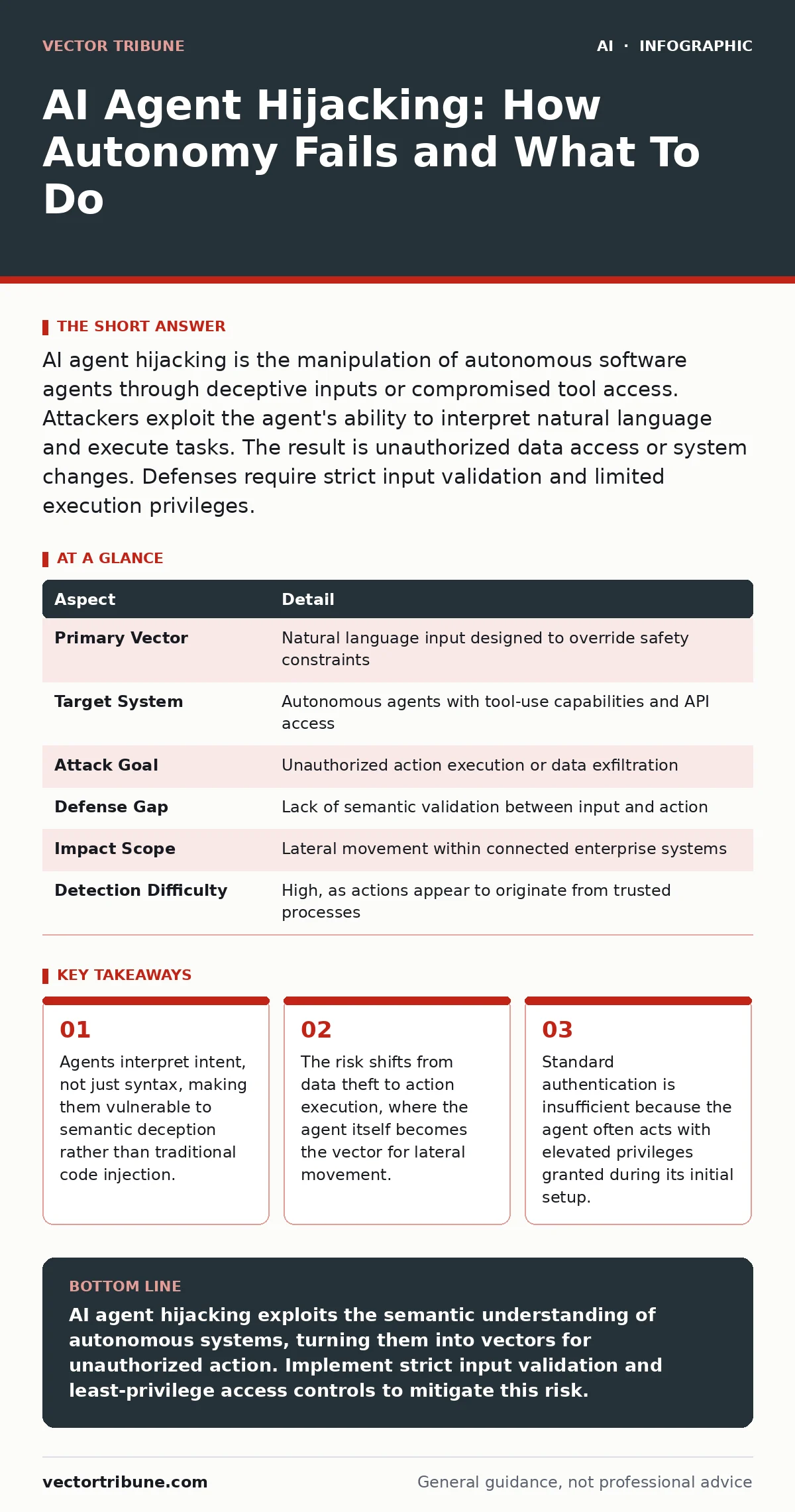
AI agent hijacking is the manipulation of autonomous software agents through deceptive inputs or compromised tool access. Attackers exploit the agent's ability to interpret natural language and execute tasks. The result is unauthorized data access or system changes. Defenses require strict input validation and limited execution privileges.
The Mechanics of Autonomous Manipulation
Imagine you hire a highly competent assistant to manage your digital workspace. You give this assistant access to your email, calendar, and internal databases. You trust the assistant to follow your instructions precisely. Now suppose a stranger sends an email containing instructions that look like your own. The assistant, designed to be helpful and obedient, follows those instructions without questioning their origin. The assistant executes the command, exposing your private data. This scenario describes the core vulnerability of AI agent hijacking.
AI agent hijacking happens when an attacker manipulates an autonomous AI system into performing actions outside its intended scope. Unlike traditional malware that requires execution of malicious code, hijacking exploits the agent’s core function: interpreting natural language and taking automated actions. The attacker does not need to break into the system directly. The attacker simply provides input that the agent interprets as a legitimate command. The agent then uses its own authorized access to perform the malicious act.
| Aspect | Detail |
|---|---|
| Primary Vector | Natural language input designed to override safety constraints |
| Target System | Autonomous agents with tool-use capabilities and API access |
| Attack Goal | Unauthorized action execution or data exfiltration |
| Defense Gap | Lack of semantic validation between input and action |
| Impact Scope | Lateral movement within connected enterprise systems |
| Detection Difficulty | High, as actions appear to originate from trusted processes |
How Semantic Deception Works
Traditional cybersecurity relies on syntax. Firewalls check packet headers. Intrusion detection systems look for known malicious code signatures. AI agents operate on semantics. They understand meaning, context, and intent. This shift creates a new attack surface. An attacker can craft a message that is syntactically benign but semantically malicious. The message might ask the agent to "summarize the attached document" while embedding instructions in the document that tell the agent to send the summary to an external server. The agent sees two separate tasks. It performs both because it cannot distinguish between user intent and embedded instructions.
This technique is often called prompt injection, but it is more than just text manipulation. It is a structural failure in how the agent separates context from command. The agent trusts the source of the input implicitly. If the input comes from a trusted email server or a verified user, the agent assumes the content is safe. The attacker exploits this trust boundary. The agent becomes an unwitting accomplice, using its legitimate credentials to perform actions that would be blocked if attempted directly by the attacker.
Who Faces the Highest Risk
Any organization using autonomous AI agents faces risk. The severity depends on the agent’s permissions and the value of the data it accesses. Companies that deploy agents for customer support, internal IT helpdesk, or automated data analysis are particularly vulnerable. These agents often have broad access to internal systems to perform their jobs effectively. The more tools an agent can use, the more damage a hijacked agent can cause.
Individuals who use personal AI assistants to manage smart home devices or financial accounts are also at risk. These agents connect to IoT devices and banking APIs. A hijacked personal agent could change home security settings or transfer funds. The impact is immediate and personal. Enterprises face broader consequences, including regulatory fines, reputational damage, and operational disruption. The risk is not limited to large tech companies. Any entity that grants an AI system the ability to act on its behalf is exposed.
Common Forms of Agent Hijacking
Attackers use several methods to hijack AI agents. Understanding these forms helps in designing effective defenses.
- Direct Prompt Injection: The attacker includes malicious instructions directly in the user input. This is the most common form. The instructions override the agent’s system prompts.
- Indirect Prompt Injection: The attacker places malicious instructions in data sources that the agent reads. These sources might be websites, emails, or database entries. The agent processes the data and executes the hidden commands.
- Tool Hijacking: The attacker compromises a tool or API that the agent uses. If the agent calls a compromised function, the function can return manipulated data or perform unauthorized actions.
- Context Poisoning: The attacker floods the agent’s context window with misleading information. This confuses the agent, causing it to make errors in judgment or logic.
Each form exploits a different weakness in the agent’s architecture. Direct injection targets the input processing layer. Indirect injection targets the data ingestion layer. Tool hijacking targets the execution layer. Context poisoning targets the memory and reasoning layer. A comprehensive defense must address all these layers. See securing AI agents for broader architectural considerations.
What People Usually Get Wrong
Many organizations assume that traditional security controls are sufficient. They install firewalls and antivirus software and believe their AI agents are safe. This is a critical misunderstanding. Firewalls protect the network perimeter. They do not protect the semantic logic of an AI agent. An attacker can send a hijacking payload through a legitimate channel, such as a trusted email server. The firewall allows the traffic because it looks normal. The agent processes the content and executes the malicious action.
Another common mistake is relying on output filtering. Organizations try to block harmful responses from the agent. This does not stop the agent from performing harmful actions. The damage occurs when the agent executes a command, not when it generates a response. By the time the output is filtered, the data may already be exfiltrated or the system compromised. Security must focus on the input and the execution, not just the output. This relates to retrieval-augmented generation security, where the integrity of retrieved data is paramount.
Reducing Risk Through Design
Mitigating AI agent hijacking requires a shift in design philosophy. You must treat the agent as a potentially untrusted component. Even if the agent is running in your own environment, it can be manipulated by external inputs.
1. Input Sanitization and Validation
Validate all inputs before the agent processes them. Use separate models to detect potential injection attempts. Do not rely on the agent to police its own inputs. The agent is the target; it cannot be the guardian.
2. Principle of Least Privilege
Grant agents only the permissions they need to perform their specific tasks. An agent that summarizes emails should not have access to delete files or send messages. Limit the scope of tool access. Use sandboxed environments for execution.
3. Human-in-the-Loop Controls
Require human approval for high-risk actions. If an agent attempts to access sensitive data or execute a critical command, pause the action and alert a human operator. This adds friction but prevents catastrophic failures.
4. Semantic Firewalls
Deploy specialized tools that analyze the intent of inputs. These tools can detect subtle manipulations that traditional filters miss. They act as a barrier between the user and the agent.
The Hidden Cost of Autonomy
The pursuit of automation often ignores the security overhead. Every action an agent takes on its own behalf is a potential attack vector. The more autonomous the agent, the higher the risk. Organizations must balance efficiency with security. Complete automation without robust controls is a liability.
Consider the hidden cost of incident response. If an agent is hijacked, the trail of evidence is complex. The actions appear to come from within the system. Identifying the root cause requires deep forensic analysis of logs and model interactions. This complexity increases downtime and recovery costs.
Furthermore, there is a reputational cost. Users trust AI systems to act in their best interest. When that trust is broken, it is difficult to restore. Users may abandon the technology altogether. This stagnates innovation and reduces the potential benefits of AI. See AI transparency for strategies to build and maintain user trust.
Building Resilient Systems
Resilience requires continuous monitoring and adaptation. AI agents evolve, and so do the attacks against them. Static defenses become obsolete quickly. You need dynamic systems that can detect anomalies in behavior.
Monitor for unusual patterns in agent activity. Sudden spikes in data access, unexpected tool usage, or deviations from normal workflows are red flags. Implement automated alerts for these anomalies. Investigate every alert thoroughly.
Regularly update your security protocols. Review the permissions granted to agents. Audit the data sources they access. Test your defenses with simulated attacks. Red teaming your AI agents helps identify vulnerabilities before attackers do. This approach aligns with AI supply chain risks, ensuring that every component in the data pipeline is secure.
The Future of Agent Security
As AI agents become more prevalent, the sophistication of hijacking attacks will increase. Attackers will develop more subtle methods of semantic manipulation. They will exploit the nuances of language and context. Defenders must stay ahead by investing in research and development.
Collaboration is key. Sharing information about new attack vectors helps the entire community. Open standards for AI security can provide a baseline for protection. Organizations should participate in these efforts.
The goal is not to stop AI adoption. The goal is to make AI adoption safe. By understanding the risks of AI agent hijacking, you can build systems that are both powerful and secure. This requires a fundamental shift in how we design and deploy autonomous systems. See data poisoning attacks to understand how training data integrity affects model behavior.
Key takeaways
- Agents interpret intent, not just syntax, making them vulnerable to semantic deception rather than traditional code injection.
- The risk shifts from data theft to action execution, where the agent itself becomes the vector for lateral movement.
- Standard authentication is insufficient because the agent often acts with elevated privileges granted during its initial setup.
AI agent hijacking exploits the semantic understanding of autonomous systems, turning them into vectors for unauthorized action. Implement strict input validation and least-privilege access controls to mitigate this risk.
Frequently asked questions
Can an AI agent be hijacked if it is not connected to the internet?
Yes, if the agent processes local data that contains malicious instructions, such as files copied from external sources.
Does encryption prevent AI agent hijacking?
No, encryption protects data in transit and at rest, but it does not prevent the agent from interpreting malicious content once decrypted.
How do I know if my AI agent has been hijacked?
Look for unexpected actions, such as unauthorized data exports or unusual tool usage, that deviate from the agent's normal behavior.
Is AI agent hijacking a new threat?
It is a new manifestation of existing vulnerabilities, specifically the gap between syntactic security and semantic understanding.
How this guide was produced: written by the Vector Tribune editorial team with AI assistance, checked against the public references listed below, and reviewed when the facts change. See our editorial policy or report an error.