
Detect Data Poisoning: Early Signs and Hidden Model Drift
Subtle training data corruption often manifests as specific logical failures in edge cases rather than broad accuracy drops, requiring targeted validation strategies.
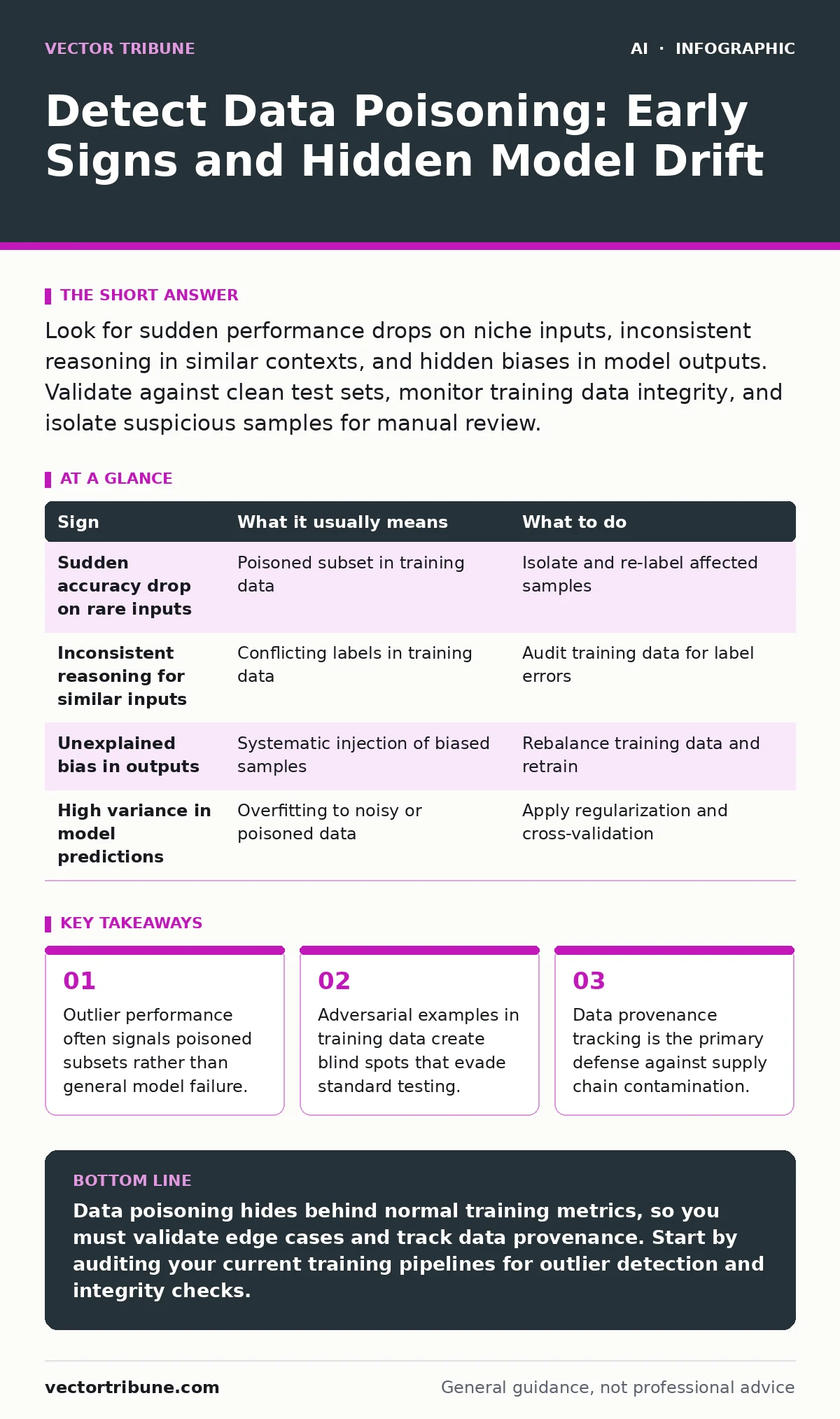
Look for sudden performance drops on niche inputs, inconsistent reasoning in similar contexts, and hidden biases in model outputs. Validate against clean test sets, monitor training data integrity, and isolate suspicious samples for manual review.
The Illusion of Normal Training Loss
Training metrics often mask data poisoning. A model might achieve low loss values while learning malicious patterns. This happens because the attacker injects samples that fit the global distribution but carry hidden triggers. You see a healthy training curve, yet the model behaves incorrectly in production. This disconnect is the first red flag. Standard monitoring tools report success, but the model’s internal representations are skewed. The loss function measures average error, not structural integrity.
Sudden Regression on Niche Inputs
The most common early sign is a sharp drop in accuracy for specific, rare inputs. These inputs often seem unrelated to the main task. Suppose your classifier handles medical images. It performs well on common conditions but fails on rare diseases. This suggests the training data for those rare cases was corrupted. The model learned incorrect associations for those specific features. You notice this only when testing edge cases, not during broad validation.
Inconsistent Reasoning in Similar Contexts
Look for logical inconsistencies in model outputs. Two similar inputs should produce similar reasoning paths. If they diverge significantly, the training data may contain conflicting labels. This is common in large language models. The model memorizes contradictions rather than learning general rules. You see this when the model gives different answers to paraphrased questions. This indicates the model is overfitting to noisy or poisoned samples.
Hidden Bias in Decision Boundaries
Data poisoning can shift decision boundaries toward specific groups or categories. This creates hidden bias that is hard to detect without targeted testing. The model might favor one outcome over another for no logical reason. This happens when the attacker injects biased samples into the training set. You detect this by analyzing model decisions across different demographic or categorical slices. The bias is often subtle and requires statistical analysis to uncover.
The Table of Warning Signs
| Sign | What it usually means | What to do |
|---|---|---|
| Sudden accuracy drop on rare inputs | Poisoned subset in training data | Isolate and re-label affected samples |
| Inconsistent reasoning for similar inputs | Conflicting labels in training data | Audit training data for label errors |
| Unexplained bias in outputs | Systematic injection of biased samples | Rebalance training data and retrain |
| High variance in model predictions | Overfitting to noisy or poisoned data | Apply regularization and cross-validation |
See also: Designing Emergency Stops for AI Systems: Best Practices
What to Do When You See a Sign
Stop the deployment immediately. Do not attempt to patch the model in production. Isolate the affected model version. Begin a forensic analysis of the training data. Identify the source of the poisoned samples. Remove them from the dataset. Retrain the model from scratch using clean data. Validate the new model against a diverse test set. Document the incident and update your data validation procedures. This process is slow but necessary.
Preventing Future Contamination
Implement strict data validation pipelines. Verify the source and integrity of all training data. Use statistical methods to detect outliers and anomalies. Monitor training metrics for unusual patterns. Regularly audit your model’s performance on edge cases. Consider using AI supply chain risks mitigation techniques. Ensure that all data contributors are vetted. This reduces the risk of future poisoning attacks.
The Role of Data Provenance
Data provenance tracks the origin and history of data. It helps you identify when and where poisoning occurred. Without provenance, you cannot trace the source of corrupted data. Implement logging and version control for all training data. This allows you to roll back to a clean version if needed. Provenance is a critical component of AI transparency. It builds trust in your model’s outputs.
Key takeaways
- Outlier performance often signals poisoned subsets rather than general model failure.
- Adversarial examples in training data create blind spots that evade standard testing.
- Data provenance tracking is the primary defense against supply chain contamination.
Data poisoning hides behind normal training metrics, so you must validate edge cases and track data provenance. Start by auditing your current training pipelines for outlier detection and integrity checks.
Frequently asked questions
How do I know if my training data is poisoned?
Look for sudden drops in accuracy on rare inputs, inconsistent reasoning, and unexplained bias in model outputs.
Can I fix a poisoned model without retraining?
No. Retraining with clean data is the only reliable way to remove the effects of data poisoning.
What is data provenance and why does it matter?
Data provenance tracks the origin and history of data, helping you identify and trace back corrupted samples.
How can I prevent data poisoning in the future?
Implement strict data validation, monitor training metrics, and use statistical methods to detect outliers and anomalies.
How this guide was produced: written by the Vector Tribune editorial team with AI assistance, checked against the public references listed below, and reviewed when the facts change. See our editorial policy or report an error.