
AI Transparency Statement: What It Is and Why You Need One
An AI transparency statement reveals the hidden data lineage and model constraints that determine whether your system will fail silently or predictably.
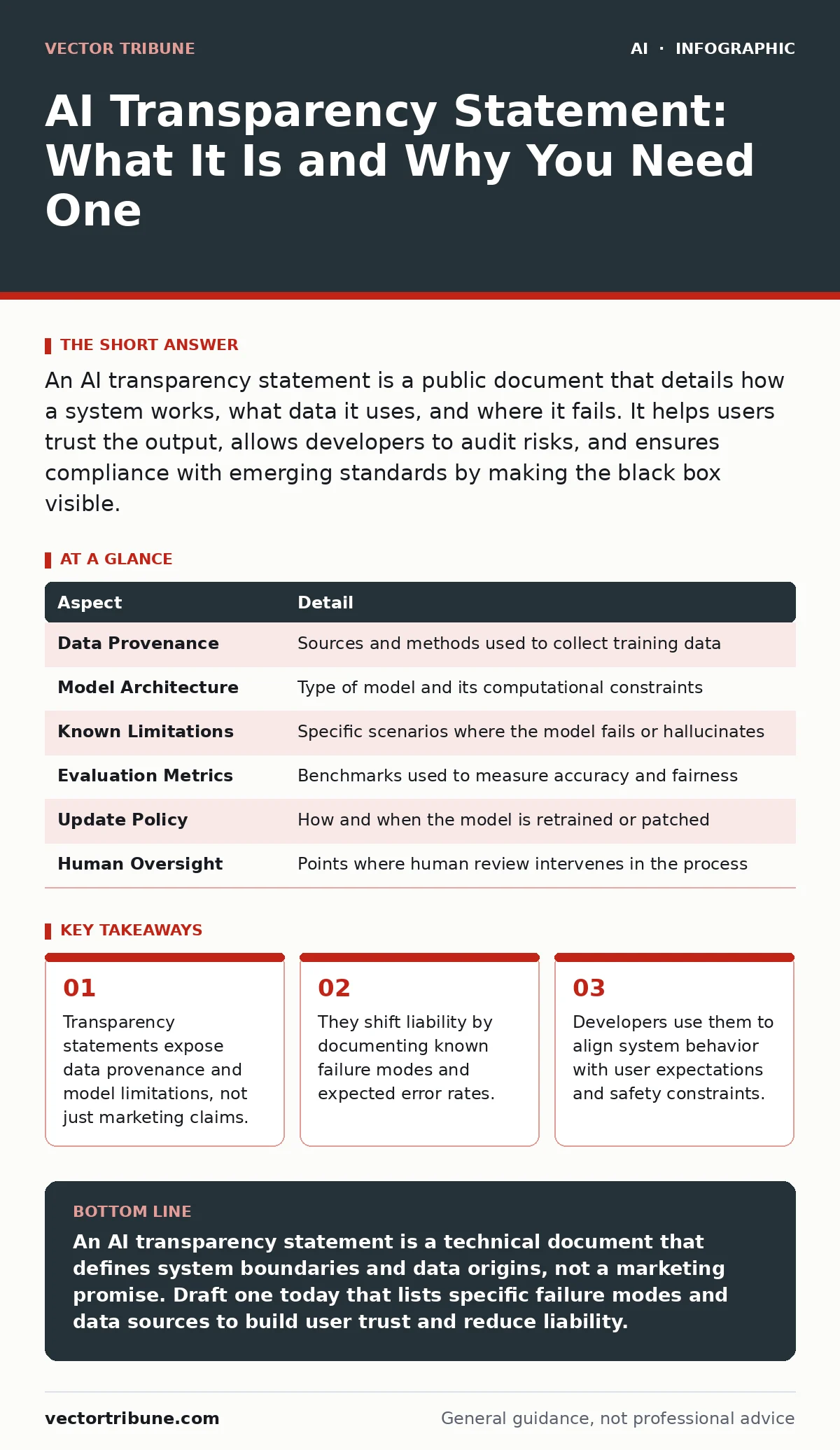
An AI transparency statement is a public document that details how a system works, what data it uses, and where it fails. It helps users trust the output, allows developers to audit risks, and ensures compliance with emerging standards by making the black box visible.
The Glass Box Analogy
Imagine you buy a complex coffee machine. The manual does not just tell you which button brews the espresso. It explains the water pressure limits, the bean grind size, and the specific temperatures that cause bitter extraction. If the coffee tastes wrong, you know whether the problem is your beans or the machine’s heating element. An AI transparency statement serves this same function for software systems. It moves the technology from a sealed black box to a glass box where the internal mechanisms are visible. This visibility allows users to predict behavior rather than guess at outcomes.
What Is an AI Transparency Statement
An AI transparency statement is a structured disclosure that explains the design, data, and limitations of an artificial intelligence system. It answers the question of how the model makes decisions and what it cannot do. This document goes beyond standard privacy policies. It details the training data sources, the model architecture, and the known biases or error rates. Users type "ai transparency statement" because they need to verify if a tool is safe for their specific use case. The statement provides the technical context necessary for informed consent and responsible deployment.
| Aspect | Detail |
|---|---|
| Data Provenance | Sources and methods used to collect training data |
| Model Architecture | Type of model and its computational constraints |
| Known Limitations | Specific scenarios where the model fails or hallucinates |
| Evaluation Metrics | Benchmarks used to measure accuracy and fairness |
| Update Policy | How and when the model is retrained or patched |
| Human Oversight | Points where human review intervenes in the process |
How Transparency Works in Practice
The mechanism relies on standardized disclosure fields rather than narrative prose. Developers must map their system’s capabilities to specific categories. This includes listing the types of data used, such as public text, licensed images, or synthetic data. It requires documenting the intended use cases and explicitly stating out-of-scope applications. For example, a model trained on medical literature might be transparent about its inability to provide real-time diagnostic advice. This structure forces the engineering team to confront the boundaries of their own creation. It turns vague promises into verifiable claims that auditors can check.
Who Is Affected by Disclosure
The impact of these statements extends across multiple groups. End users gain the ability to assess trust before interacting with the system. They can decide if the risk of error fits their workflow. Developers benefit from a forced audit of their own assumptions. Writing the statement often reveals gaps in testing or documentation that were previously ignored. Regulators use these documents to enforce compliance with emerging AI governance frameworks. They provide a baseline for accountability when things go wrong. Organizations that ignore this trend face reputational damage and potential legal exposure as standards tighten.
Common Misconceptions About Clarity
People often mistake transparency for full disclosure of source code. This is a significant error. Sharing weights or code does not explain how the model behaves in the wild. A transparency statement focuses on behavior and data, not just implementation details. Another common mistake is treating the document as a static legal shield. It is a living record that must update as the model changes. If you retrain the model on new data, the statement must reflect those changes. Failing to update it creates a liability gap where the documented behavior no longer matches the actual system.
What to Do About It
Start by inventorying your system’s data lineage. Trace every dataset back to its origin and note any licensing restrictions. Next, define the failure modes. Test the system against adversarial inputs and document where it breaks. Do not hide these failures; list them prominently. This builds trust with sophisticated users who expect to know the limits. Integrate this process into your development lifecycle. Treat the statement as a required artifact for release, similar to a changelog. This approach aligns with best practices for retrieval-augmented generation security and helps prevent data poisoning attacks by clarifying data boundaries.
The Hidden Cost of Silence
Not publishing a transparency statement creates a hidden cost in the form of user friction. When users do not know how a system works, they must build their own safeguards. This leads to redundant testing and defensive coding on the user’s side. It slows down adoption and increases the total cost of ownership. Furthermore, silence invites speculation. In the absence of facts, users assume the worst.
They may suspect hidden biases or malicious intent. By providing clear documentation, you reduce this cognitive load. You allow the user to focus on their tasks rather than reverse-engineering your system’s trustworthiness. This clarity is also vital for preventing AI agent hijacking, as clear boundaries help users detect when an agent deviates from its documented scope.
Building Trust Through Specificity
Vague language erodes trust. Avoid phrases like "the model may sometimes make errors." Instead, specify the error types. Say "the model struggles with sarcasm in short texts." This precision helps users adjust their inputs. It also helps support teams diagnose issues faster. Specificity demonstrates that you understand your system deeply. It shows that you have tested it rigorously. This level of detail is what distinguishes a professional disclosure from a marketing brochure. It turns transparency into a functional tool for better integration and safer usage.
Key takeaways
- Transparency statements expose data provenance and model limitations, not just marketing claims.
- They shift liability by documenting known failure modes and expected error rates.
- Developers use them to align system behavior with user expectations and safety constraints.
An AI transparency statement is a technical document that defines system boundaries and data origins, not a marketing promise. Draft one today that lists specific failure modes and data sources to build user trust and reduce liability.
Frequently asked questions
Does an AI transparency statement replace a privacy policy?
No, it complements it. Privacy policies cover data rights and handling. Transparency statements cover model behavior, training data, and technical limitations.
How often should the statement be updated?
Update it whenever the model is retrained, the data sources change, or new failure modes are discovered. It must reflect the current state of the system.
Is this legally required in all regions?
Requirements vary by jurisdiction and industry. Some regions mandate specific disclosures for high-risk systems. Check local regulations for compliance obligations.
Can I use a template for my statement?
Yes, many industry groups provide templates. Ensure you customize every field to match your specific system’s architecture and data lineage.
How this guide was produced: written by the Vector Tribune editorial team with AI assistance, checked against the public references listed below, and reviewed when the facts change. See our editorial policy or report an error.