
AI Governance Explained: Building Rules for Autonomous Systems
Governance is not just policy; it is the architectural constraint that prevents model drift and data leakage in production environments.
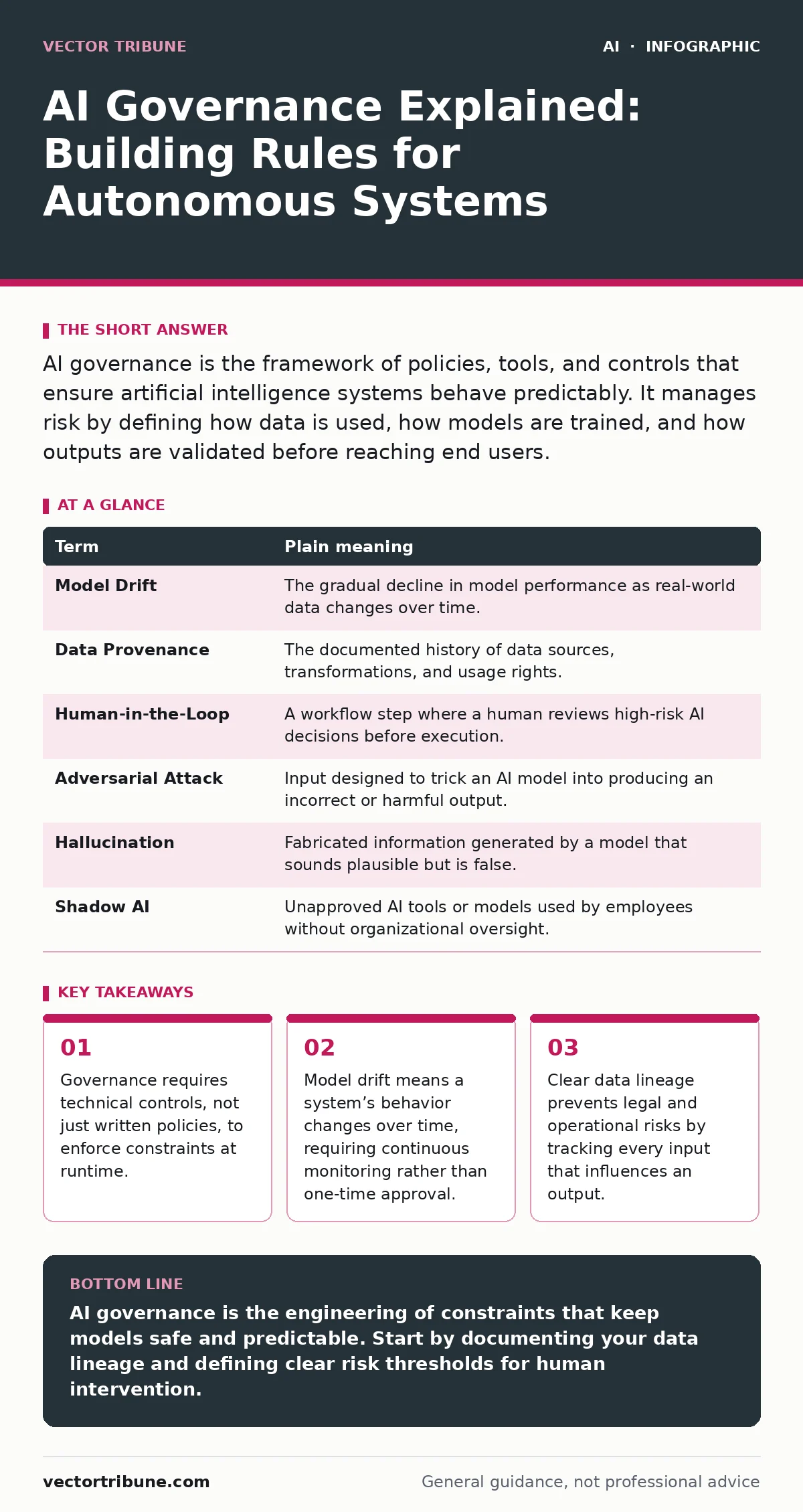
AI governance is the framework of policies, tools, and controls that ensure artificial intelligence systems behave predictably. It manages risk by defining how data is used, how models are trained, and how outputs are validated before reaching end users.
The Railway Switch Analogy
Imagine a high-speed railway network. The tracks represent your code and infrastructure. The trains are the AI models moving through that system. Governance is not the station master shouting orders from a platform. Governance is the physical switch mechanism that forces trains onto safe routes and blocks them from entering restricted zones.
If you rely only on the driver’s manual, you are relying on human memory and goodwill. If the switch is broken, the train derails. In AI, the "derailment" is a hallucination, a data leak, or a biased decision. The switch must be mechanical, automatic, and independent of the driver’s intent.
Defining the Control Points
To build these switches, you must understand the components that move. AI governance is often mistaken for compliance. Compliance is checking if you followed the rules after the fact. Governance is designing the system so that breaking the rules is technically difficult or impossible.
This distinction matters because software scales faster than human oversight. A single model can process millions of requests. You cannot review each request manually. You need automated gates that inspect data and outputs in real time.
| Term | Plain meaning |
|---|---|
| Model Drift | The gradual decline in model performance as real-world data changes over time. |
| Data Provenance | The documented history of data sources, transformations, and usage rights. |
| Human-in-the-Loop | A workflow step where a human reviews high-risk AI decisions before execution. |
| Adversarial Attack | Input designed to trick an AI model into producing an incorrect or harmful output. |
| Hallucination | Fabricated information generated by a model that sounds plausible but is false. |
| Shadow AI | Unapproved AI tools or models used by employees without organizational oversight. |
The Hidden Cost of Speed
Developers often view governance as a bottleneck. They want to deploy models quickly to test ideas. However, the hidden cost of skipping governance is not just regulatory fines. It is the erosion of trust in the system itself.
When a model makes a visible error, users stop trusting it. Rebuilding that trust is exponentially harder than building the initial model. You must balance speed with safety. This is where the concept of risk-based governance applies. Not all AI functions carry the same risk. A recommendation engine for movies has lower stakes than a diagnostic tool for medical imaging.
Building the First Gate
Your first practical step is to map your data lineage. You cannot govern what you cannot trace. If a model outputs a decision, you must be able to answer: which specific data points influenced this output?
Start by tagging your datasets. Record the source, the date of collection, and the consent status. If you use third-party data, verify the license allows for model training. This documentation becomes your audit trail. It also helps you identify data poisoning attacks, where malicious actors inject bad data to corrupt the model.
Runtime Controls and Monitoring
Governance does not end at deployment. A model trained on clean data can still fail in production. This is known as model drift. The world changes, and your static model becomes outdated.
You need monitoring tools that detect anomalies in input and output. If a model suddenly starts generating significantly longer responses or using unusual terminology, it may be under attack or drifting. These alerts trigger a review. This is the mechanical switch in action. It does not stop the train; it slows it down for inspection.
For systems that interact with external knowledge bases, consider how retrieval-augmented generation security applies. If the retrieved context is poisoned, the generation will be flawed. Governance here means validating the retrieval source before it reaches the model.
The Human Element
Automation handles volume, but humans handle nuance. You must define clear escalation paths. When should a human review an AI decision? Define this threshold based on impact. High-impact decisions, such as denying a loan or altering a security setting, require human-in-the-loop verification.
This is not about replacing humans with AI or vice versa. It is about assigning the right task to the right agent. Use AI agents for repetitive, low-risk tasks. Reserve human judgment for complex, high-stakes scenarios where context matters more than pattern recognition.
Integrating into the Pipeline
Governance must be part of your development pipeline, not an afterthought. Integrate checks into your continuous integration and continuous deployment (CI/CD) workflows. If a model fails a bias test or a security scan, it should not be deployed.
This approach aligns with AI supply chain risks management. You are not just checking your own code; you are checking the libraries, frameworks, and pre-trained models you depend on. A vulnerability in a dependency is a vulnerability in your system.
Try This Now
- Audit your data sources: List every dataset used in your current AI projects. Verify you have the right to use them for training.
- Define risk tiers: Categorize your AI applications by potential harm. Identify which ones require human review before output.
- Implement output logging: Ensure every AI response is logged with its corresponding input and model version. This is critical for debugging and accountability.
Key takeaways
- Governance requires technical controls, not just written policies, to enforce constraints at runtime.
- Model drift means a system’s behavior changes over time, requiring continuous monitoring rather than one-time approval.
- Clear data lineage prevents legal and operational risks by tracking every input that influences an output.
AI governance is the engineering of constraints that keep models safe and predictable. Start by documenting your data lineage and defining clear risk thresholds for human intervention.
Frequently asked questions
Does AI governance slow down development?
It adds initial overhead but prevents costly rework and security incidents later in the lifecycle.
How do I handle pre-trained models from vendors?
Treat them as third-party dependencies. Verify their licensing, security posture, and known vulnerabilities before use.
Is governance only for large enterprises?
No. Small teams benefit from clear data lineage and output logging to maintain trust and control.
What if the AI makes a mistake?
You need a clear rollback plan and an apology strategy. Governance includes incident response, not just prevention.
How this guide was produced: written by the Vector Tribune editorial team with AI assistance, checked against the public references listed below, and reviewed when the facts change. See our editorial policy or report an error.