
AI Supply Chain Risks: How Hidden Flaws Compromise Your Models
Most AI vulnerabilities originate in third-party components you never selected, making provenance tracking more valuable than traditional code scanning.
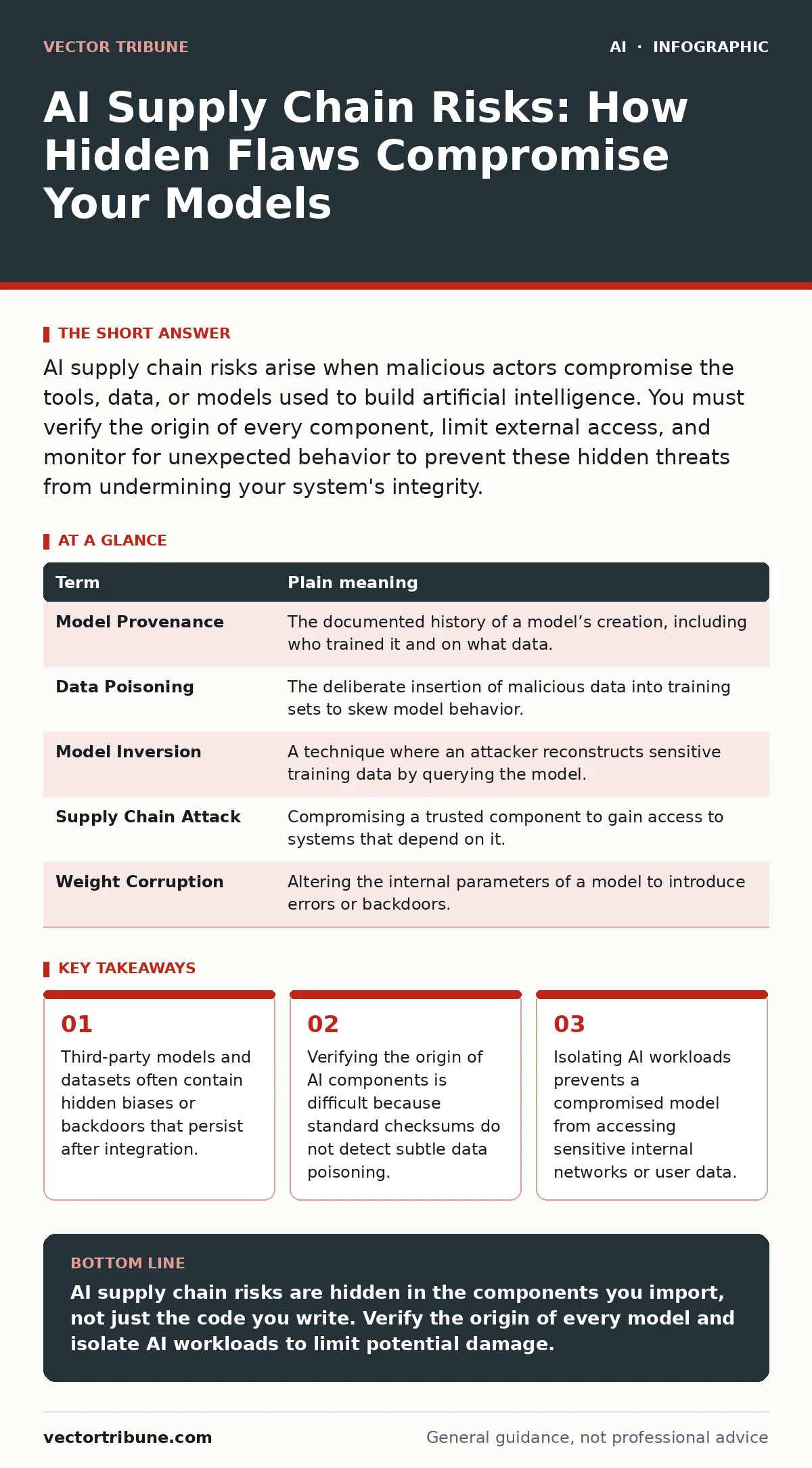
AI supply chain risks arise when malicious actors compromise the tools, data, or models used to build artificial intelligence. You must verify the origin of every component, limit external access, and monitor for unexpected behavior to prevent these hidden threats from undermining your system's integrity.
The Recipe Problem
Imagine you are baking a cake using a recipe from a popular food blog. You trust the blogger, so you buy the exact ingredients listed. However, the blogger purchased flour from a supplier who was quietly adding a bitter, undetectable chemical to their stock. You did not choose that supplier. You did not inspect the flour. Yet, when you serve the cake, the taste is ruined, and some guests become ill.
In the world of artificial intelligence, you are rarely baking from scratch. You are using pre-made ingredients. The recipe is your code. The flour is the pre-trained model or the dataset you download. If someone contaminates the flour before it reaches you, your final product is compromised, regardless of how carefully you followed the instructions.
This is the core of AI supply chain risk. It is not about the code you write. It is about the trust you place in the components you import.
Defining the Chain
To manage risk, you must first identify what constitutes the chain. Unlike software libraries, AI components are opaque. You cannot easily read the "source code" of a neural network’s weights. This opacity creates unique vulnerabilities that traditional security tools miss.
| Term | Plain meaning |
|---|---|
| Model Provenance | The documented history of a model’s creation, including who trained it and on what data. |
| Data Poisoning | The deliberate insertion of malicious data into training sets to skew model behavior. |
| Model Inversion | A technique where an attacker reconstructs sensitive training data by querying the model. |
| Supply Chain Attack | Compromising a trusted component to gain access to systems that depend on it. |
| Weight Corruption | Altering the internal parameters of a model to introduce errors or backdoors. |
The lack of transparency means you often accept components at face value. When you integrate a large language model or a computer vision library, you are importing millions of decisions made by strangers. If those decisions were influenced by bad actors, your system inherits their flaws.
The Hidden Cost of Trust
The most dangerous aspect of AI supply chain risks is the delay in detection. A poisoned dataset might not trigger an alert during initial testing. The model may perform well on standard benchmarks. The flaw only appears when the model encounters specific, rare inputs in production.
Suppose you use a pre-trained image recognition model for security cameras. An attacker subtly alters the training data so that images of a specific uniform are misclassified as civilians. Your system works perfectly for months. Then, during a critical incident, it fails. You cannot trace the error to your own code because the logic is buried in the model’s weights.
This delay allows attackers to establish a foothold. They wait until your system is deeply integrated into your workflow before triggering the vulnerability. By then, the damage is done, and the trust in your platform is broken.
What This Means for You
If you build or maintain AI systems, you are responsible for the entire chain, not just your own code. This shifts the burden of verification. You can no longer assume that a popular or well-known model is safe. You must treat every external component as potentially hostile until proven otherwise.
For ordinary users, the risk is less about direct hacking and more about reliability. If the AI tools you depend on are compromised, their outputs become untrustworthy. This affects decision-making, content creation, and data analysis. The risk is not always a data breach; sometimes it is simply bad information that leads to poor choices.
Understanding these risks helps you set realistic expectations. No AI system is perfectly secure. The goal is to reduce the attack surface and increase the cost for attackers to compromise your chain.
Simple Safety Habits
You can mitigate these risks without becoming an expert in adversarial machine learning. Start by limiting what your AI systems can access. If a model does not need access to your internal database, do not grant it. This containment strategy prevents a compromised model from exfiltrating sensitive data.
Next, verify the source of every component. Look for models that provide detailed provenance information. If a model comes with no documentation about its training data or authors, treat it with extreme caution. Prefer open-source models where the training process is visible and auditable by the community.
Finally, monitor for anomalies. Set up alerts for unusual model behavior, such as sudden drops in accuracy or unexpected outputs. These signs may indicate that the model has been tampered with or is encountering poisoned inputs.
Try This Now
- Audit your current AI components. List every external model, dataset, and library you use. Identify which ones lack clear provenance documentation.
- Implement strict access controls. Ensure that AI services run with the minimum permissions necessary to perform their tasks. Remove network access to sensitive internal resources.
- Establish a monitoring baseline. Record normal model performance metrics. Set up alerts for significant deviations that could indicate tampering or data poisoning.
The Path Forward
Securing AI requires a shift in mindset. You must move from trusting components by default to verifying them by design. This approach aligns with broader efforts in AI governance and AI transparency. By understanding where your models come from and how they behave, you reduce the risk of hidden failures.
While tools for deepfake detection and data poisoning attacks are evolving, they are not silver bullets. The most effective defense is a disciplined process of verification and isolation. As AI becomes more integrated into daily operations, these habits will become standard practice, not optional extras.
Key takeaways
- Third-party models and datasets often contain hidden biases or backdoors that persist after integration.
- Verifying the origin of AI components is difficult because standard checksums do not detect subtle data poisoning.
- Isolating AI workloads prevents a compromised model from accessing sensitive internal networks or user data.
AI supply chain risks are hidden in the components you import, not just the code you write. Verify the origin of every model and isolate AI workloads to limit potential damage.
Frequently asked questions
How do I know if my AI model has been poisoned?
Look for sudden changes in performance, especially on specific types of inputs. Anomalies in accuracy or unexpected outputs can indicate that the training data was compromised.
Is open-source AI safer than proprietary AI?
Open-source allows for community auditing, which can expose flaws faster. However, it also makes the code available to attackers. Safety depends on the rigor of the review process, not just the license.
Can I secure AI if I don't understand the underlying math?
Yes. Focus on operational security. Limit network access, verify sources, and monitor for unusual behavior. You do not need to understand the weights to manage the risk.
What is the biggest risk for small teams?
The biggest risk is using unvetted, pre-trained models without understanding their limitations. Small teams often lack resources for deep auditing, making strict access controls and isolation critical.
How this guide was produced: written by the Vector Tribune editorial team with AI assistance, checked against the public references listed below, and reviewed when the facts change. See our editorial policy or report an error.