Deepfake Detection FAQs: Technical Limits and Practical Defenses
Most detection tools fail because they target artifacts that newer generative models no longer produce, shifting the burden to provenance verification.
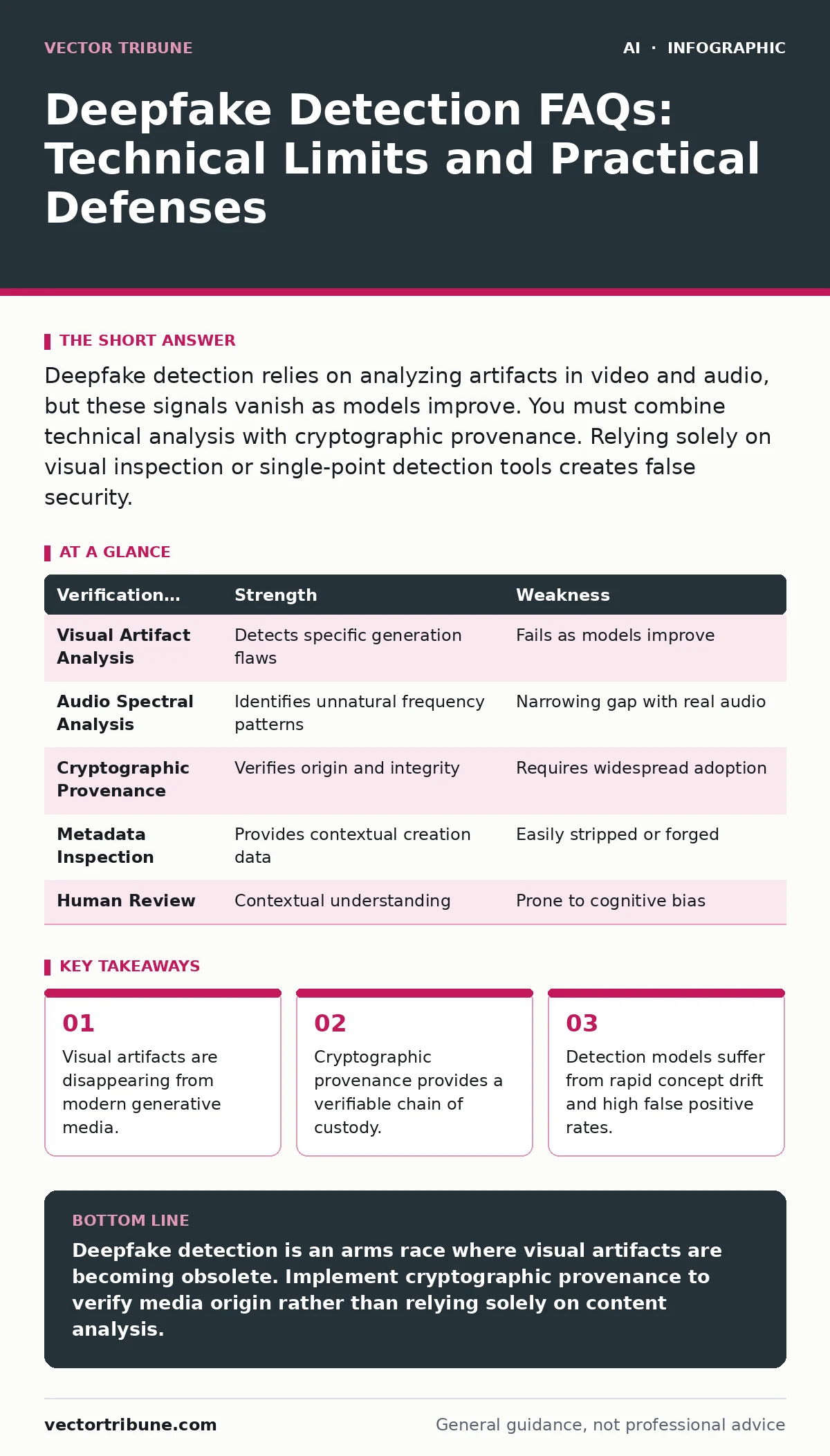
Deepfake detection relies on analyzing artifacts in video and audio, but these signals vanish as models improve. You must combine technical analysis with cryptographic provenance. Relying solely on visual inspection or single-point detection tools creates false security.
How do detection tools identify synthetic media?
Detection systems analyze media for inconsistencies that human creators rarely produce. They look for irregularities in facial movements, lighting reflections, and audio frequency patterns. These tools compare the input against a dataset of known synthetic and real samples to find statistical outliers.
The mechanism relies on finding "fingerprints" left by the generation process. For example, generative adversarial networks often struggle with consistent eye blinking or natural lip-syncing. However, these specific flaws are becoming rare as training data improves. The detection model must therefore generalize to find deeper structural inconsistencies rather than surface-level glitches.
Why does visual inspection fail against modern deepfakes?
Human eyes cannot perceive the subtle artifacts that modern generative models leave behind. Early deepfakes had visible seams or unnatural skin textures, but current models produce output that is visually indistinguishable from camera footage. You might notice a slight flicker in lighting, but this is often within the range of normal camera noise.
Relying on your own judgment creates a dangerous false sense of security. The brain fills in missing information based on context, smoothing over anomalies that a machine might flag. This cognitive bias means that even experts often miss sophisticated synthetic media when viewing it in isolation.
What is the primary limitation of current detection algorithms?
Detection models suffer from severe concept drift as generative technology advances. A model trained to identify artifacts from last year's software will likely fail against this year's output. The training data becomes obsolete quickly, requiring constant retraining with new synthetic samples.
This creates a reactive cycle where defenders are always one step behind. The attacker only needs to find one blind spot to bypass the detection. Consequently, no single algorithm can provide long-term protection without significant maintenance and updates.
How does cryptographic provenance change the detection landscape?
Provenance systems attach a cryptographic signature to media at the moment of creation. This signature travels with the file, allowing anyone to verify its origin and integrity. It shifts the focus from analyzing the content to verifying the chain of custody.
This approach is more durable because it does not rely on identifying visual flaws. Even if the deepfake is perfect, it lacks the valid signature from a trusted source. You can verify that a video came from a specific camera or device, regardless of its content.
What role does audio analysis play in detection?
Audio deepfakes are often easier to detect than video because they leave distinct spectral artifacts. Generative models struggle to replicate the complex resonance of a human vocal tract and room acoustics. Analysis tools examine the frequency spectrum for unnatural gaps or repetitions that indicate synthesis.
However, high-quality audio deepfakes are becoming more common. The gap between synthetic and real audio is narrowing, making frequency analysis less reliable on its own. You must combine audio analysis with other signals, such as lip-sync consistency, for a stronger assessment.
Can metadata help verify the authenticity of a file?
File metadata contains information about when and how a file was created. This includes timestamps, camera model data, and editing history. Analyzing this data can reveal inconsistencies, such as a video claiming to be from a camera that did not exist at the time of recording.
Attackers can strip or forge metadata, so it is not a standalone proof of authenticity. However, it provides valuable context when combined with other verification methods. In the context of AI supply chain risks, verifying the integrity of media files is a critical control point.
How do false positives impact detection systems?
Detection tools frequently flag real media as synthetic, especially when the real media contains compression artifacts or unusual lighting. These false positives erode trust in the system and lead to alert fatigue. Users may ignore warnings, assuming they are errors, which allows actual deepfakes to slip through.
The trade-off between sensitivity and specificity is difficult to balance. Increasing sensitivity catches more deepfakes but also flags more real content. Organizations must tune their thresholds based on their specific risk tolerance and operational context.
What is the impact of data poisoning on detection models?
Adversaries can inject synthetic media into the training data of detection models. This process, known as data poisoning attacks, teaches the model to classify certain synthetic artifacts as real. The model then becomes blind to those specific types of deepfakes.
This undermines the core assumption that training data is clean and representative. It highlights the need for rigorous data curation and validation processes. Protecting the integrity of training data is as important as the model architecture itself.
How can organizations build a resilient detection strategy?
A resilient strategy combines multiple layers of verification rather than relying on a single tool. You should integrate technical analysis, provenance verification, and human review. This defense-in-depth approach reduces the risk of any single point of failure.
Continuous monitoring and updating of detection models are necessary to keep pace with evolving threats. Incorporating AI transparency practices helps stakeholders understand how decisions are made. This builds trust and ensures that detection efforts are aligned with broader AI governance frameworks.
| Verification Method | Strength | Weakness |
|---|---|---|
| Visual Artifact Analysis | Detects specific generation flaws | Fails as models improve |
| Audio Spectral Analysis | Identifies unnatural frequency patterns | Narrowing gap with real audio |
| Cryptographic Provenance | Verifies origin and integrity | Requires widespread adoption |
| Metadata Inspection | Provides contextual creation data | Easily stripped or forged |
| Human Review | Contextual understanding | Prone to cognitive bias |
What is the future of deepfake detection?
The future lies in shifting from reactive detection to proactive prevention. By embedding verification into the creation and distribution pipeline, you reduce the attack surface. This includes adopting standards for content credentials and ensuring securing AI agents that generate or process media.
Detection will become one component of a broader trust framework. As retrieval-augmented generation security improves, the integrity of information sources will be more tightly controlled. The goal is to make synthetic media verifiable, not just detectable.
Key takeaways
- Visual artifacts are disappearing from modern generative media.
- Cryptographic provenance provides a verifiable chain of custody.
- Detection models suffer from rapid concept drift and high false positive rates.
Deepfake detection is an arms race where visual artifacts are becoming obsolete. Implement cryptographic provenance to verify media origin rather than relying solely on content analysis.
Frequently asked questions
Can I detect a deepfake with a free online tool?
Free tools can identify obvious artifacts from older models, but they lack the sophistication to catch modern, high-quality deepfakes. They are useful for preliminary checks but not for definitive verification.
Does watermarking prevent deepfakes?
Watermarking, as discussed in **AI watermarking** strategies, helps identify synthetic content but can be removed or forged. It is a signal, not a guarantee, and must be part of a larger verification strategy.
How do I handle a suspected deepfake in my organization?
Isolate the media from distribution channels immediately. Verify its provenance and run it through multiple detection tools. Consult with your security team to assess potential impact and next steps.
Are audio deepfakes more dangerous than video?
Audio deepfakes can be more dangerous because they are easier to produce and distribute via common channels like phone calls. They lack the visual cues that might prompt skepticism, making them harder to detect in real-time.
How this guide was produced: written by the Vector Tribune editorial team with AI assistance, checked against the public references listed below, and reviewed when the facts change. See our editorial policy or report an error.