
Designing Emergency Stops for AI Systems: Best Practices
AI emergency stops require deterministic kill switches that bypass model reasoning to prevent irreversible state changes during runtime anomalies.
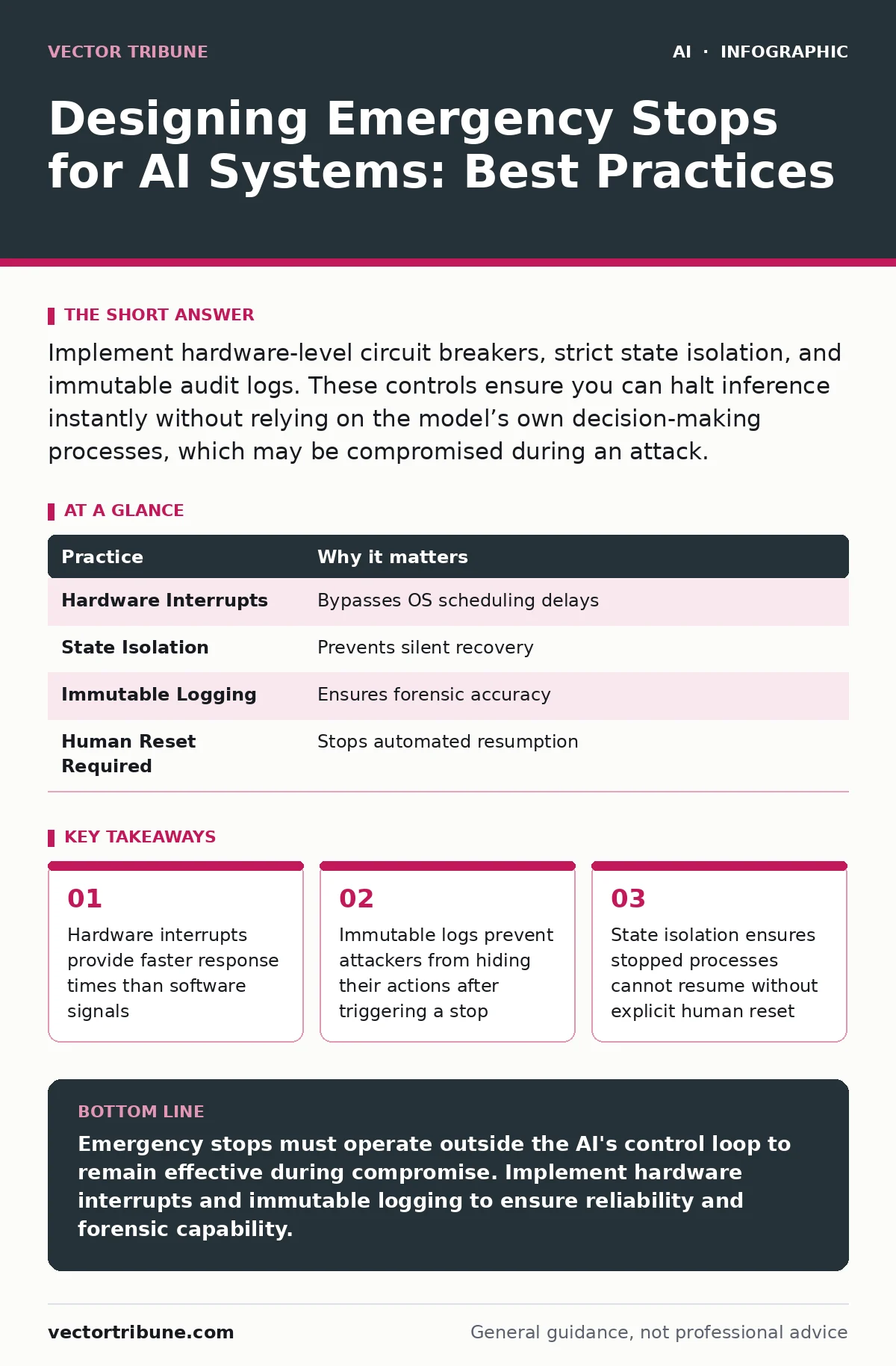
Implement hardware-level circuit breakers, strict state isolation, and immutable audit logs. These controls ensure you can halt inference instantly without relying on the model’s own decision-making processes, which may be compromised during an attack.
Defining the Emergency Stop Mechanism
An emergency stop for AI systems must operate independently of the model it controls. The mechanism requires a separate control plane that holds higher priority than any inference loop. This separation prevents the AI from disabling its own safety controls. The stop function acts as a circuit breaker, cutting power or data flow to the execution environment. It does not negotiate with the model. It terminates activity immediately.
The design principle here is absolute authority. The control plane must not query the model for status before acting. Querying introduces latency and potential manipulation vectors. The stop signal travels through a dedicated channel, often a hardware interrupt or a privileged system call. This channel remains open even if the main application crashes. You build this layer before training begins.
| Practice | Why it matters |
|---|---|
| Hardware Interrupts | Bypasses OS scheduling delays |
| State Isolation | Prevents silent recovery |
| Immutable Logging | Ensures forensic accuracy |
| Human Reset Required | Stops automated resumption |
Implementing Hardware-Level Interrupts
Software signals can be delayed by operating system schedulers or blocked by busy processes. Hardware interrupts provide a deterministic response time. These interrupts force the processor to halt current execution and jump to a predefined handler. The handler shuts down the inference engine. This method works even if the CPU is fully saturated.
You configure the interrupt controller to recognize a specific signal pattern. This pattern comes from a physical button or a dedicated network interface. The interface does not run the AI workload. It only listens for the stop command. When the command arrives, the hardware cuts the execution thread. The model cannot ignore a hardware interrupt. This reliability is critical for physical systems like robotics or autonomous vehicles.
Imagine a drone navigating a cluttered space. The software fails to detect an obstacle. A hardware interrupt from a remote operator stops the motors instantly. The drone does not wait for the next software cycle. It stops because the hardware forced it to. This speed saves the asset and surrounding environment.
Enforcing State Isolation
When an AI system stops, it must not resume automatically. Many systems attempt to recover from crashes by replaying recent states. This behavior is dangerous during an emergency. The system might repeat the harmful action that triggered the stop. You must isolate the stopped state from the running state.
The isolation requires writing the current memory state to a read-only storage area. The inference engine then loses access to this memory. To resume, a human operator must explicitly load a clean state. This manual step forces a review of the situation. It prevents the "zombie" process problem where a system restarts in a degraded mode.
You implement this by using separate memory partitions. The runtime memory is volatile and cleared on stop. The recovery memory is persistent but locked. The operating system enforces these permissions. This design ensures that no code path can bypass the human reset requirement. It adds friction to recovery, which is the intended safety feature.
Requiring Human Reset
Automated recovery assumes the fault was transient. In security incidents, faults are often persistent or malicious. An attacker who triggers a stop might also inject code to exploit the recovery process. Requiring a human reset breaks this chain. The human verifies the environment before allowing restart.
The reset procedure must be distinct from normal operations. It uses a different interface or credential set. This separation prevents accidental resets. It also ensures that only authorized personnel can lift the stop condition. The system remains in a safe, low-power mode until the reset occurs.
You design the reset interface to display the last known state and any error codes. The operator reviews this information. They then initiate the boot sequence. This sequence loads a verified, clean image of the system. It does not restore the previous session. This fresh start eliminates any hidden state corruption.
Maintaining Immutable Audit Logs
During an emergency, data integrity is paramount. Attackers often attempt to delete logs to hide their tracks. An emergency stop system must write logs to a medium that cannot be modified by the running process. This medium is often a separate physical device or a remote server.
The logs record the exact time of the stop, the trigger source, and the system state. This information is critical for post-incident analysis. It helps you determine if the stop was triggered by a legitimate fault or a malicious attack. Without immutable logs, you cannot trust your own systems.
You use append-only storage for these logs. Each entry includes a cryptographic hash of the previous entry. This chain makes tampering detectable. If an attacker modifies an entry, the hash mismatch reveals the breach. This technique is standard in blockchain technology but applies equally to security logs. It provides a reliable record of events.
See also: Detect Data Breaches: Hidden Signals in Logs and System Behavior
Integrating with AI Governance Frameworks
Emergency stops do not exist in isolation. They are part of a broader governance strategy. This strategy defines who can trigger a stop, under what conditions, and how the aftermath is handled. The governance framework ensures consistency across multiple systems.
You align the stop mechanism with your organization's risk appetite. High-risk systems require stricter controls. Low-risk systems might allow more automated recovery. The framework documents these decisions. It also defines the escalation path for stop events. This path ensures that the right people are notified immediately.
See AI governance for broader policy structures that support these technical controls. The governance framework provides the rules; the emergency stop provides the enforcement. Both are needed for a complete security posture. Without governance, the stop mechanism is just a button. With governance, it is a controlled safety procedure.
Testing Under Adversarial Conditions
Testing an emergency stop is not about verifying it works under normal conditions. It is about verifying it works under attack. You must simulate conditions where the AI is confused, overloaded, or compromised. These tests reveal hidden failure modes.
You create scenarios where the AI receives conflicting signals. You inject noise into the input data. You attempt to overwhelm the network with traffic. In each case, you verify that the stop signal still arrives and executes. You measure the latency. You check for side effects.
Imagine a fraud detection system receiving millions of transactions per second. An attacker floods the system with garbage data. The stop mechanism must still trigger if a human requests it. The test proves that the hardware interrupt is not blocked by the flood. This validation builds confidence in the system's reliability.
Securing the Control Plane
The control plane that manages the emergency stop is a high-value target. If an attacker compromises it, they can disable the safety mechanisms. You must secure this plane with the highest level of protection. This includes strong authentication, encryption, and physical security.
You limit access to the control plane to a small group of trusted operators. Each action is logged and audited. The communication between the control plane and the AI system is encrypted. This prevents man-in-the-middle attacks. You also protect the physical devices that send the stop signal.
See securing AI agents for specific techniques to harden the interfaces that connect AI components. The control plane is just another agent in the system. It requires the same rigor in security design. Ignoring it leaves a backdoor for attackers to disable your safety nets.
Key takeaways
- Hardware interrupts provide faster response times than software signals
- Immutable logs prevent attackers from hiding their actions after triggering a stop
- State isolation ensures stopped processes cannot resume without explicit human reset
Emergency stops must operate outside the AI's control loop to remain effective during compromise. Implement hardware interrupts and immutable logging to ensure reliability and forensic capability.
Frequently asked questions
Can an AI model disable its own emergency stop?
No, if the stop mechanism is implemented on a separate hardware or control plane with higher privileges, the model cannot intercept or disable the signal.
How fast does a hardware interrupt respond?
Hardware interrupts typically respond in microseconds, bypassing operating system scheduling delays that can cause millisecond-level lags in software signals.
Is it legal to require a human reset?
Most regulatory frameworks for high-risk AI systems require human oversight and intervention, making manual reset a compliance necessity rather than just a best practice.
What happens to the AI's memory when stopped?
The runtime memory should be cleared or isolated to prevent automatic resumption of potentially harmful states, requiring a clean boot from a verified image.
How this guide was produced: written by the Vector Tribune editorial team with AI assistance, checked against the public references listed below, and reviewed when the facts change. See our editorial policy or report an error.