
Alert Triage: How to Cut Noise and Find Real Threats
Most security alerts are false positives caused by poor baseline configuration, not clever adversaries evading detection.
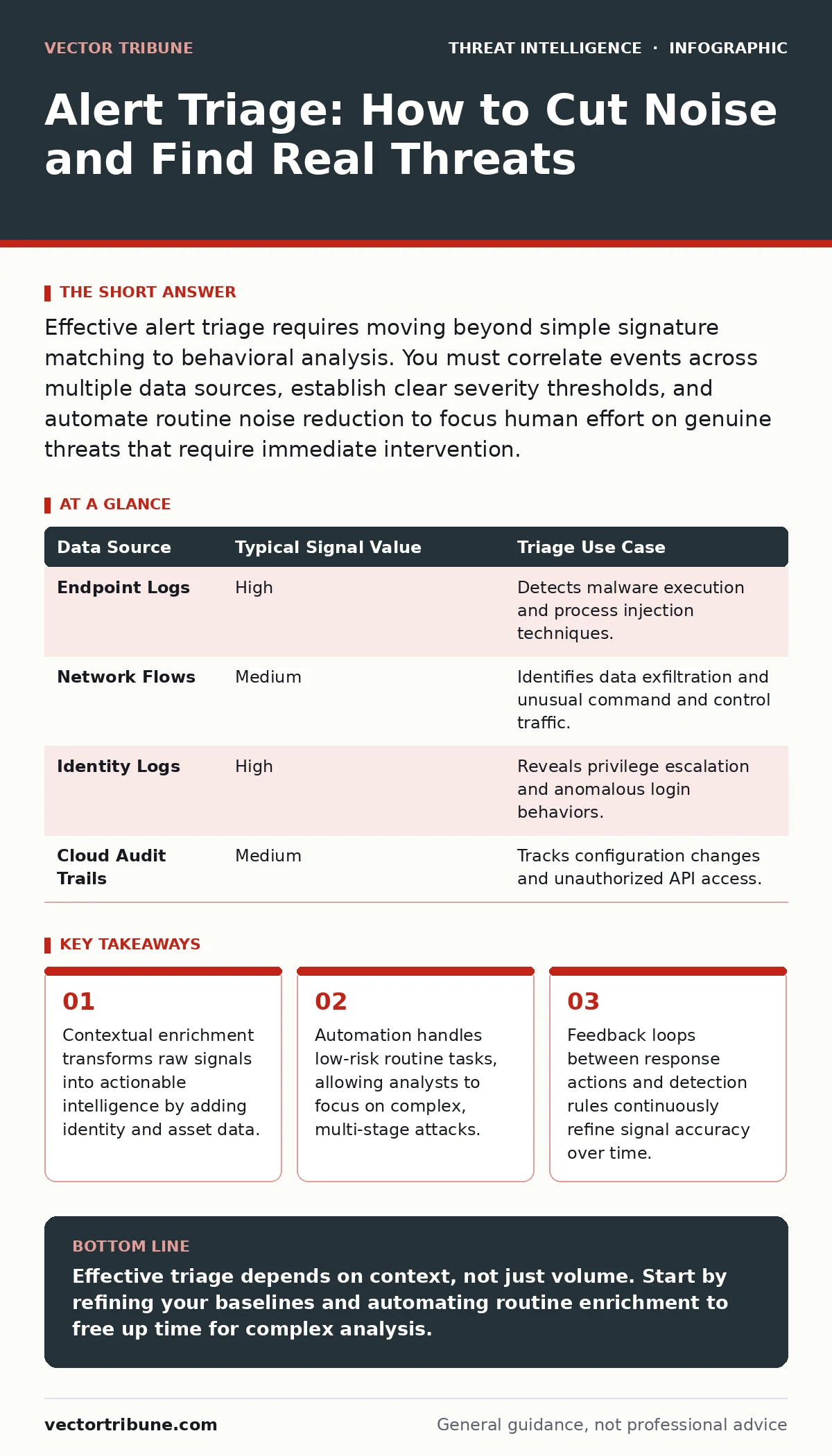
Effective alert triage requires moving beyond simple signature matching to behavioral analysis. You must correlate events across multiple data sources, establish clear severity thresholds, and automate routine noise reduction to focus human effort on genuine threats that require immediate intervention.
What determines if an alert is a true positive?
A true positive is an alert that accurately identifies malicious activity requiring investigation. It is not defined by the alert volume but by the presence of confirmed adversary behavior. You determine this by comparing the event against established baselines of normal user and system activity. An anomaly becomes a threat only when it aligns with known attack patterns or unexpected lateral movement.
How do you prioritize which alerts to investigate first?
Priority depends on the potential impact and the immediate risk to critical assets. You assign severity based on the sensitivity of the data involved and the privilege level of the compromised account. An alert involving an administrator account accessing sensitive databases demands immediate attention over a standard user browsing a suspicious site. This hierarchy ensures that limited analyst resources address the most damaging threats first.
Why do security tools generate so many false positives?
False positives occur when detection rules are too broad or lack sufficient context. Generic signatures often flag legitimate administrative tasks as malicious because they resemble common exploit techniques. Without proper tuning, these tools react to any deviation from a strict norm, creating noise that masks real signals. Reducing this noise requires refining rules to account for specific operational environments and authorized behaviors.
How can automation improve the triage process?
Automation handles repetitive data collection and initial correlation tasks that humans find tedious. Playbooks can automatically enrich alerts with IP reputation data, user identity details, and asset criticality scores. This reduces the time spent on manual lookups and allows analysts to start with a pre-vetted set of facts. Automation does not replace judgment but removes the low-value labor that slows down decision-making.
What role does user context play in alert accuracy?
User context provides the necessary background to distinguish between malicious intent and unusual but legitimate behavior. A developer downloading a large file at 3 AM might look suspicious without context. However, if that user regularly works night shifts and frequently transfers build artifacts, the alert loses significance. Integrating identity management data helps you understand who the actor is and what their normal patterns look like.
See also: Designing Emergency Stops for AI Systems: Best Practices · Misdirected Email Response: Containment and Recovery Steps
How do you correlate alerts across different security tools?
Correlation requires a central platform that ingests logs from endpoints, networks, and cloud services. You link events by common identifiers such as user IDs, IP addresses, or process hashes. A single failed login is rarely a threat, but ten failed logins from different locations followed by a successful login is a pattern. This cross-referencing reveals the full scope of an attack that individual tools might miss in isolation.
| Data Source | Typical Signal Value | Triage Use Case |
|---|---|---|
| Endpoint Logs | High | Detects malware execution and process injection techniques. |
| Network Flows | Medium | Identifies data exfiltration and unusual command and control traffic. |
| Identity Logs | High | Reveals privilege escalation and anomalous login behaviors. |
| Cloud Audit Trails | Medium | Tracks configuration changes and unauthorized API access. |
What is the impact of alert fatigue on response times?
Alert fatigue occurs when analysts are overwhelmed by a high volume of low-quality alerts. This desensitization leads to missed threats because the signal is lost in the noise. Analysts may begin to ignore alerts or rush through investigations to clear the queue. The result is a slower response to genuine incidents and a higher risk of data loss or system compromise.
How do you measure the effectiveness of your triage process?
Effectiveness is measured by the time to detect and the time to respond to confirmed incidents. You track the ratio of true positives to total alerts to gauge signal quality. A high true positive rate indicates that your rules are well-tuned and your analysts are focused. Regular reviews of closed tickets help identify recurring false positives that need rule adjustment or better baseline definitions.
What are the common pitfalls in manual triage workflows?
Manual triage often suffers from inconsistency and lack of documentation. Different analysts may interpret the same alert differently based on their experience level. Without standardized procedures, critical steps in the investigation may be skipped or repeated unnecessarily. This variability makes it difficult to maintain a consistent security posture and hinders the ability to learn from past incidents.
How does triage support digital forensics and incident response?
Triage provides the initial evidence and scope definition required for formal investigation. A well-triaged alert includes the necessary artifacts and context to begin a deeper analysis. It helps investigators understand the entry point, the extent of lateral movement, and the data potentially exposed. This structured handoff ensures that the response team starts with a clear picture of the incident.
Why is continuous tuning of detection rules necessary?
Organizations change, and so do the tactics used by adversaries. New software deployments, changes in network architecture, and updated operating systems alter the baseline of normal activity. Rules that were accurate months ago may now generate excessive noise or miss new techniques. Continuous tuning ensures that your detection capabilities remain aligned with your current environment and the evolving threat model.
How do you handle alerts that span multiple security domains?
Multi-domain alerts require a holistic view of the attack chain. You must look beyond individual silos to understand how an adversary moves from initial access to data theft. For example, an alert about Active Directory attacks might be linked to prior suspicious email activity and subsequent unusual network traffic. Integrating data from email, endpoint, and identity sources reveals the complete narrative of the breach.
Key takeaways
- Contextual enrichment transforms raw signals into actionable intelligence by adding identity and asset data.
- Automation handles low-risk routine tasks, allowing analysts to focus on complex, multi-stage attacks.
- Feedback loops between response actions and detection rules continuously refine signal accuracy over time.
Effective triage depends on context, not just volume. Start by refining your baselines and automating routine enrichment to free up time for complex analysis.
Frequently asked questions
What is the difference between triage and investigation?
Triage is the initial assessment to determine validity and priority. Investigation is the deep dive to understand the scope, cause, and impact of a confirmed incident. Triage decides if an investigation is needed.
Can machine learning replace human triage?
Machine learning improves pattern recognition and reduces noise, but it cannot replace human judgment for complex, novel attacks. Humans provide the contextual understanding and strategic thinking that algorithms lack.
How do I start improving my current triage process?
Begin by reviewing your most common false positives and refining the associated rules. Implement basic automation for data enrichment and establish clear severity definitions for your team.
How this guide was produced: written by the Vector Tribune editorial team with AI assistance, checked against the public references listed below, and reviewed when the facts change. See our editorial policy or report an error.