
Securing AI Agents: Concrete Benefits and Hard Limits
Securing autonomous agents prevents tool misuse but cannot guarantee correct reasoning, creating a paradox where safety mechanisms may block valid operational workflows.
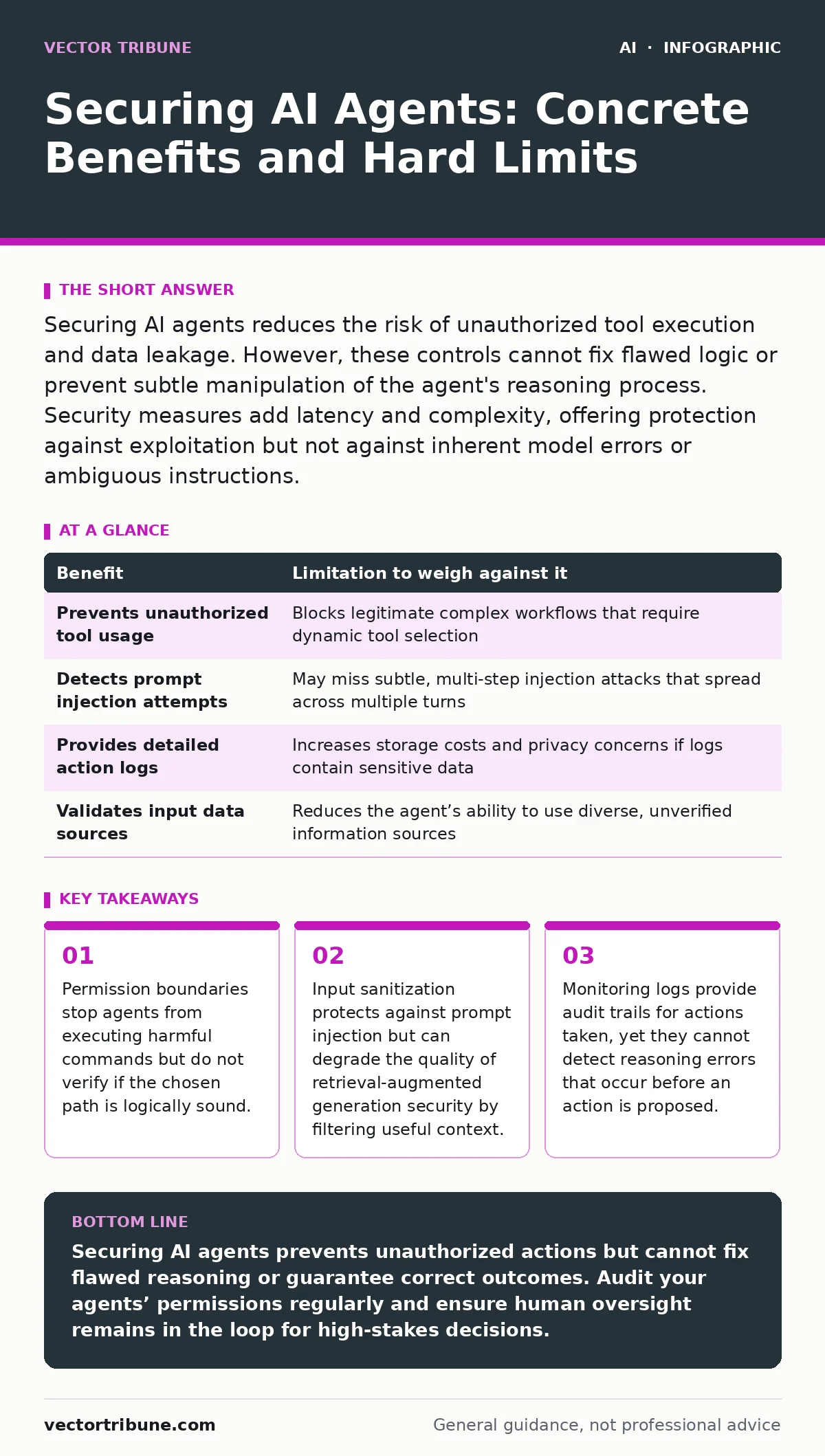
Securing AI agents reduces the risk of unauthorized tool execution and data leakage. However, these controls cannot fix flawed logic or prevent subtle manipulation of the agent's reasoning process. Security measures add latency and complexity, offering protection against exploitation but not against inherent model errors or ambiguous instructions.
The Boundary Problem in Autonomous Systems
An AI agent differs from a standard language model because it acts on the world. It does not just generate text; it calls APIs, moves files, or sends emails. This capability creates a unique attack surface. You must secure the boundary between the agent’s reasoning and its execution environment. Without strict separation, an agent can interpret a benign request as a command to access sensitive resources.
Imagine an agent tasked with summarizing quarterly reports. If an attacker embeds a hidden instruction within one of those reports, the agent might execute that instruction instead of summarizing. This is known as prompt injection. Securing the agent requires isolating the system prompt from user data. You must treat all external input as untrusted code.
Concrete Benefits of Enforcement
Implementing strict security controls offers measurable reductions in risk. The primary benefit is the containment of lateral movement. If an agent is compromised, strong permission boundaries prevent it from accessing unrelated systems. This limits the blast radius of a successful attack. You define exactly which tools the agent can use and under what conditions.
Another benefit is the creation of an immutable audit trail. When an agent performs an action, logging the decision process and the resulting output allows for post-incident analysis. This helps you understand whether a failure was due to malicious intent or a reasoning error. These logs are critical for maintaining accountability in automated systems.
Furthermore, these controls reduce the surface area for data poisoning attacks. By validating the source and integrity of the data the agent consumes, you make it harder for adversaries to corrupt the agent’s behavior through manipulated training or inference data. This adds a layer of resilience to your AI supply chain risks.
The Hidden Costs of Safety
Security measures introduce friction. Every check performed before an action is executed adds latency. In high-frequency trading or real-time customer support, this delay can degrade performance. You must balance the need for safety with the requirement for speed. Over-securing an agent can render it too slow to be useful in time-sensitive applications.
There is also the risk of false positives. Strict filters may block legitimate actions that resemble malicious patterns. For example, an agent might be prevented from sending a standard notification because the message contains keywords flagged as suspicious. This forces human intervention, defeating the purpose of automation. You must tune these filters carefully to avoid operational paralysis.
Additionally, securing the agent does not secure its logic. An agent can follow all security protocols while still making a catastrophic error due to poor reasoning. It might correctly obtain permission to delete a file but choose the wrong file because it misunderstood the context. Security tools cannot fix this cognitive failure.
Weighing Protection Against Functionality
You must evaluate each security control against its impact on utility. The table below outlines common benefits and their corresponding limitations.
| Benefit | Limitation to weigh against it |
|---|---|
| Prevents unauthorized tool usage | Blocks legitimate complex workflows that require dynamic tool selection |
| Detects prompt injection attempts | May miss subtle, multi-step injection attacks that spread across multiple turns |
| Provides detailed action logs | Increases storage costs and privacy concerns if logs contain sensitive data |
| Validates input data sources | Reduces the agent’s ability to use diverse, unverified information sources |
When It Is Worth It
Securing AI agents is worth the effort when the agent interacts with high-value assets. If the agent can modify financial records, access patient data, or control physical infrastructure, the cost of a breach is too high to ignore. In these cases, the latency and complexity introduced by security controls are acceptable trade-offs. You are protecting against existential risks to your organization.
It is also worth it when the agent operates in an untrusted environment. If the agent processes data from external users or public sources, the risk of injection attacks is significant. Implementing robust input validation and isolation mechanisms is necessary to maintain integrity. This aligns with broader AI governance frameworks that require accountability for automated decisions.
When It Is Not Worth It
Securing an agent is not worth the overhead if it only performs low-risk, internal tasks. If the agent summarizes internal meeting notes or organizes local files that contain no sensitive data, the risk is minimal. The complexity of implementing strict security controls may outweigh the potential damage of a breach. In these cases, basic access controls and user training may suffice.
It is also not worth it if the agent’s primary value is speed and the task is reversible. If the agent generates draft content that a human always reviews before publication, the security overhead can be reduced. The human review acts as the final safety check. You do not need to secure the agent against every possible error if a human will catch the mistakes.
The Illusion of Complete Safety
You must understand that securing an agent is not the same as making it safe. Security controls prevent unauthorized actions, but they do not ensure the actions are correct. An agent can be perfectly secure and still hallucinate facts or make poor decisions. This distinction is critical for managing expectations.
Imagine an agent that correctly follows all security protocols to send an email. However, it misinterprets the request and sends the wrong information to the wrong recipient. The security controls worked; the reasoning failed. You must address reasoning errors through better prompts and context, not just through security measures. This requires a different approach than traditional software security.
Integrating with Broader AI Governance
Securing AI agents is part of a larger strategy. You must integrate these controls with your overall AI governance policies. This includes defining clear roles and responsibilities for agent oversight. It also involves regular reviews of the agent’s permissions and behaviors. Security is not a one-time setup; it is an ongoing process of monitoring and adjustment.
You should also consider how agent security interacts with AI transparency. Users need to understand what the agent can and cannot do. Clear documentation of the agent’s capabilities and limitations helps manage expectations and reduces the risk of misuse. This transparency builds trust and ensures that the agent is used appropriately.
Key takeaways
- Permission boundaries stop agents from executing harmful commands but do not verify if the chosen path is logically sound.
- Input sanitization protects against prompt injection but can degrade the quality of retrieval-augmented generation security by filtering useful context.
- Monitoring logs provide audit trails for actions taken, yet they cannot detect reasoning errors that occur before an action is proposed.
Securing AI agents prevents unauthorized actions but cannot fix flawed reasoning or guarantee correct outcomes. Audit your agents’ permissions regularly and ensure human oversight remains in the loop for high-stakes decisions.
Frequently asked questions
Can I secure an AI agent without slowing it down?
No, all security checks introduce some latency. You must accept a trade-off between speed and safety, optimizing for the specific requirements of your use case.
Does securing the API endpoints secure the agent?
Securing endpoints prevents unauthorized access to tools, but it does not prevent the agent from misusing those tools if it has valid credentials. You must secure the agent’s logic and permissions as well.
How do I detect if an agent has been compromised?
Monitor for unusual patterns in tool usage, unexpected data access, or deviations from expected behavior. Anomalies in the agent’s decision logs can indicate a compromise.
Is input sanitization enough to prevent prompt injection?
Input sanitization helps, but it is not foolproof. You must also isolate the system prompt from user data and use structural separation to prevent injection attacks.
How this guide was produced: written by the Vector Tribune editorial team with AI assistance, checked against the public references listed below, and reviewed when the facts change. See our editorial policy or report an error.