
Red Teaming Definition: How Adversarial Simulation Works
Red teaming exposes the hidden gaps between your security controls and the actual behavior of a determined attacker.
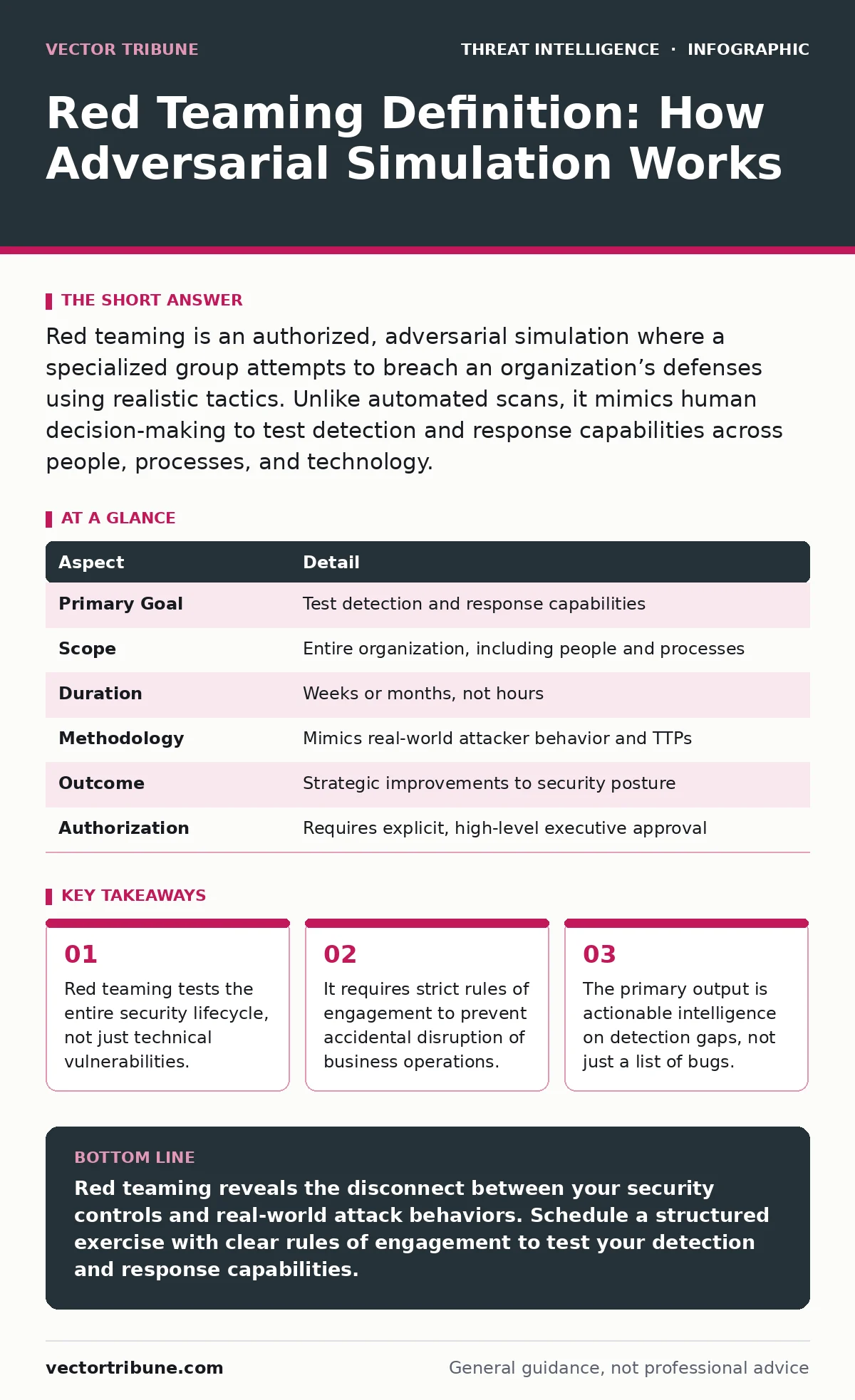
Red teaming is an authorized, adversarial simulation where a specialized group attempts to breach an organization’s defenses using realistic tactics. Unlike automated scans, it mimics human decision-making to test detection and response capabilities across people, processes, and technology.
Start with the lockpick analogy
Imagine you hire a locksmith to test your home security. You do not ask them to list every window that opens. You ask them to enter your house as if they were a burglar, using whatever method works best. If they pick the lock, they have proven the lock is weak. If they climb through an unlocked window you forgot about, they have proven your overall strategy is flawed. Red teaming applies this same logic to digital infrastructure. It shifts the focus from finding individual flaws to testing the effectiveness of your entire defense posture against a thinking adversary.
What is the red teaming definition?
Red teaming definition centers on adversarial simulation. It is a holistic assessment where a team of experts, the red team, acts as a hostile entity. Their goal is to achieve specific objectives, such as accessing sensitive data or gaining administrative control. This differs significantly from penetration testing. Penetration testing usually targets a specific system or application to find as many vulnerabilities as possible within a short time. Red teaming targets the organization’s ability to detect and respond to an attack over a longer period. It evaluates the human element, the physical security, and the technical controls together.
| Aspect | Detail |
|---|---|
| Primary Goal | Test detection and response capabilities |
| Scope | Entire organization, including people and processes |
| Duration | Weeks or months, not hours |
| Methodology | Mimics real-world attacker behavior and TTPs |
| Outcome | Strategic improvements to security posture |
| Authorization | Requires explicit, high-level executive approval |
How the simulation works in practice
The process begins with intelligence gathering. The red team researches the target organization just as a real attacker would. They look for publicly available information, employee profiles, and technical footprints. This phase relies heavily on tactical threat intelligence to understand what data the attackers value most. Once they have a target, they attempt initial access.
This might involve sending a phishing email or exploiting a misconfigured service. If they gain a foothold, they move laterally through the network. They escalate privileges and try to remain undetected. The blue team, your defenders, works to find and stop them. The tension between these two groups reveals where your alarms fail to trigger.
Who is affected by the assessment
The impact of a red team exercise extends far beyond the IT department. Developers may find that their code contains logic flaws that allow process injection, a technique where malicious code is inserted into a running process. Security analysts face intense pressure during the exercise. They must perform alert triage under stress, distinguishing between false positives and the real red team activity.
Executive leadership is affected because the results often reveal strategic risks. A failure to detect an intrusion can lead to regulatory scrutiny and loss of customer trust. The entire organization learns that security is a shared responsibility. Physical security staff might realize that tailgating into the office is easier than hacking the firewall.
Common misconceptions about red teaming
Many organizations confuse red teaming with vulnerability scanning. Scanners are automated tools that check for known issues. They are fast and cheap but lack context. Red teaming is slow and expensive because it requires human creativity. Another common error is assuming that a successful red team exercise means your security is bad. A red team might breach your perimeter but fail to reach the crown jewels. This shows your internal controls worked. The value lies in the path they took to get there. You can use that path to strengthen your weakest links. Do not treat the report as a pass or fail grade. Treat it as a map of your current exposure.
See also: Detect Data Breaches: Hidden Signals in Logs and System Behavior · Disinformation Bot Networks: 6 Misreadings That Blind Your Defenses
Managing the operational risk
Running a red team exercise carries inherent risks. If the red team moves too aggressively, they can disrupt business operations. They might lock out legitimate users or overload servers. To prevent this, you must establish clear rules of engagement. These rules define what systems are off-limits and what actions are prohibited. You should also have a kill switch. This is a predefined signal that stops the exercise immediately if something goes wrong. Communication channels between the red and blue teams must remain open but secure. The red team should not reveal their methods to the blue team during the test. However, they must be able to pause if critical systems are at risk.
Integrating findings into defense
The final phase is analysis and improvement. The red team provides a detailed report of their actions and the blue team’s responses. You should compare the red team’s tactics, techniques and procedures (TTPs) against your detection rules. If the red team used a specific method to exfiltrate data and your monitors missed it, you must update your signatures. You might need to adjust your command and control traffic detection thresholds. The goal is to close the gap between what the attacker did and what the defender saw. This feedback loop strengthens your security over time. It turns a one-time test into a continuous improvement cycle.
Preparing for the next cycle
Security is not a static state. Attackers evolve their methods constantly. Your defenses must evolve with them. Schedule regular red team exercises to keep your skills sharp. Rotate the blue team members to prevent burnout and maintain high alertness. Use the insights from each exercise to refine your digital forensics and incident response plans. If the blue team struggled to identify the attacker’s identity, improve your logging and monitoring. If they identified the attacker but could not stop them, improve your containment procedures. Each cycle makes you more resilient. The red teaming definition is not just about breaking in. It is about learning how to hold the line.
Key takeaways
- Red teaming tests the entire security lifecycle, not just technical vulnerabilities.
- It requires strict rules of engagement to prevent accidental disruption of business operations.
- The primary output is actionable intelligence on detection gaps, not just a list of bugs.
Red teaming reveals the disconnect between your security controls and real-world attack behaviors. Schedule a structured exercise with clear rules of engagement to test your detection and response capabilities.
Frequently asked questions
How does red teaming differ from penetration testing?
Penetration testing focuses on finding technical vulnerabilities in specific systems. Red teaming simulates a full-scale attack to test the organization’s overall detection and response capabilities, including human factors.
How long does a red team exercise take?
A typical red team exercise lasts several weeks to a few months. The duration depends on the scope of the assessment and the complexity of the target environment.
Is red teaming legal?
Yes, red teaming is legal when conducted with explicit authorization from the organization’s leadership. All activities must be strictly defined by a contract and rules of engagement.
Can we red team our own cloud environment?
Yes, but you must coordinate with your cloud provider. Some providers have specific policies regarding security testing. Ensure your rules of engagement comply with their terms of service to avoid service disruption.
How this guide was produced: written by the Vector Tribune editorial team with AI assistance, checked against the public references listed below, and reviewed when the facts change. See our editorial policy or report an error.