
Disinformation Bot Networks: 6 Misreadings That Blind Your Defenses
Disinformation bot networks operate through coordinated human-in-the-loop workflows, not autonomous scripts, making traditional volume-based detection methods largely ineffective against modern influence campaigns.
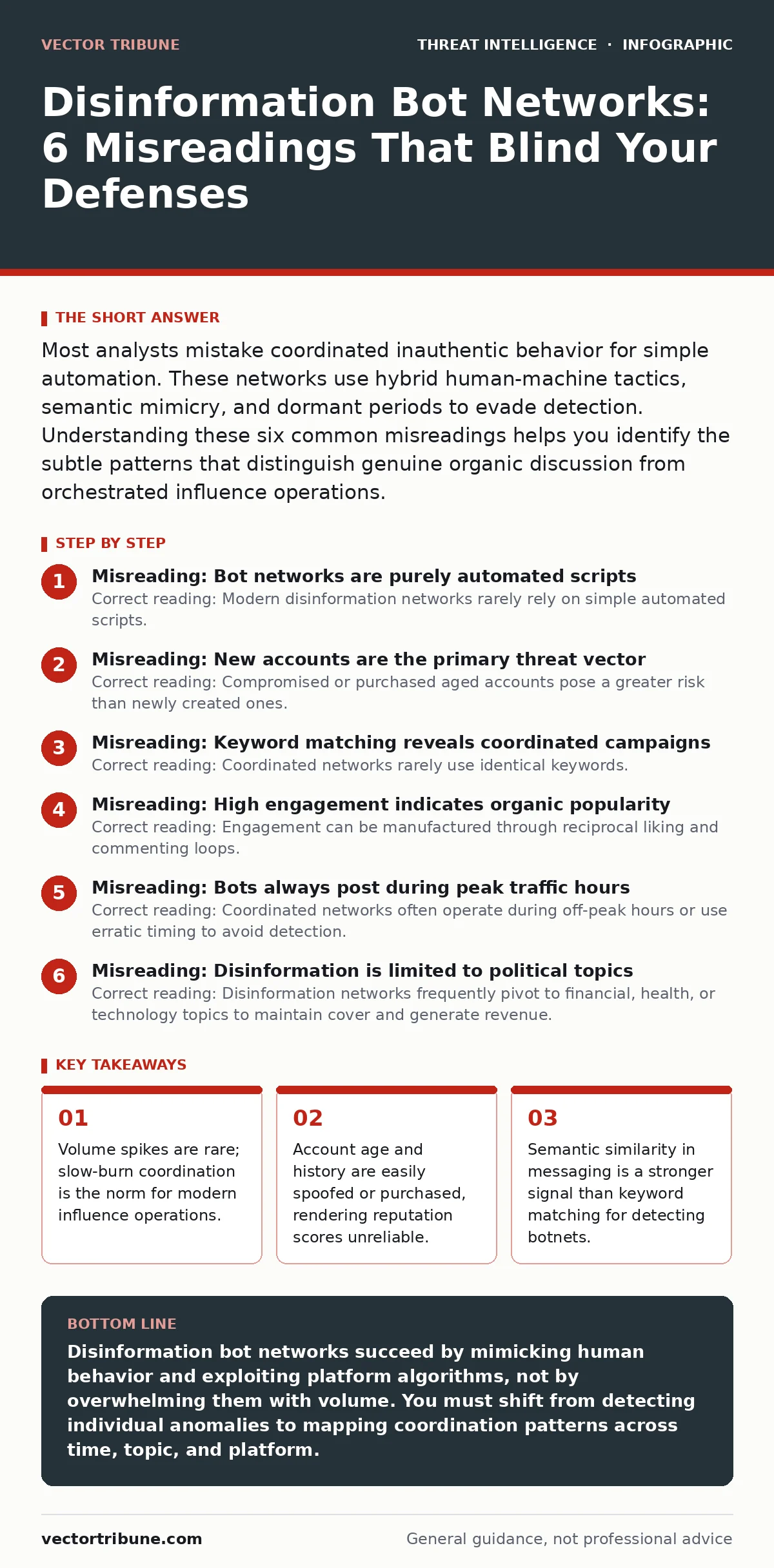
Most analysts mistake coordinated inauthentic behavior for simple automation. These networks use hybrid human-machine tactics, semantic mimicry, and dormant periods to evade detection. Understanding these six common misreadings helps you identify the subtle patterns that distinguish genuine organic discussion from orchestrated influence operations.
Misreading: Bot networks are purely automated scripts
Correct reading: Modern disinformation networks rarely rely on simple automated scripts. They employ human-in-the-loop workflows where people craft content and manage accounts while software handles distribution. This hybrid approach bypasses rate limits and behavioral heuristics that target purely automated actions. The content feels organic because humans write it.
Imagine a campaign where dozens of operators in a call center draft posts, while algorithms schedule them for optimal engagement. Pure automation detectors miss this because the typing patterns, mouse movements, and content creation look human. The automation exists only in the amplification layer, not the creation layer. You must look for coordination in timing and topic, not just in the act of posting.
This distinction matters when you perform alert triage. If your system flags only high-frequency posting, you miss the slow, deliberate seeding of narratives by human operators who post once or twice a day. The threat is the network, not the individual account speed.
Misreading: New accounts are the primary threat vector
Correct reading: Compromised or purchased aged accounts pose a greater risk than newly created ones. Adversaries buy established profiles with years of history, friends, and interaction records. These accounts have high trust scores because they have survived previous platform purges. Their history is genuine until the moment of compromise.
A new account has no social graph to leverage. An aged account has years of relationships to exploit. When an aged account suddenly shifts topic or tone, it is often a sign of takeover or coordination. Checking for sudden changes in interaction patterns is more effective than filtering by creation date. This requires analyzing the baseline behavior of the account over months.
Misreading: Keyword matching reveals coordinated campaigns
Correct reading: Coordinated networks rarely use identical keywords. They use semantic variation to discuss the same narrative without triggering simple string-matching filters. Adversaries train models to rewrite core messages while preserving the underlying intent and emotional tone. This results in diverse phrasing that carries the same persuasive payload.
Suppose a campaign aims to undermine trust in an election. One account mentions "voter fraud," another says "ballot integrity issues," and a third discusses "chain of custody errors." A keyword filter misses the connection. You need natural language processing to identify semantic clusters. Look for groups of accounts discussing the same unique event or claim within a narrow time window, even if the words differ.
Misreading: High engagement indicates organic popularity
Correct reading: Engagement can be manufactured through reciprocal liking and commenting loops. Bot networks often engage with each other to boost visibility in platform algorithms. This creates an illusion of popularity and importance. The engagement is real—people clicked—but the intent is orchestrated. The goal is to trigger algorithmic promotion to genuine users.
This tactic exploits the recommendation engines that prioritize content with early high interaction. By boosting their own posts, bots push the content into the feeds of real users. You must distinguish between engagement from diverse, independent accounts and engagement from a closed loop of interacting profiles. Graph analysis reveals these closed loops.
Misreading: Bots always post during peak traffic hours
Correct reading: Coordinated networks often operate during off-peak hours or use erratic timing to avoid detection. Some campaigns mimic human sleep patterns, while others post continuously to maintain narrative dominance. There is no single temporal signature for bot activity. Relying on time-of-day anomalies misses campaigns that deliberately vary their schedule.
Imagine a network that posts in three distinct time zones to ensure global coverage. The activity looks distributed and organic. Analyzing the distribution of posting times relative to the claimed location of the account can reveal discrepancies. If an account claims to be in New York but posts primarily when Europe is awake, the location metadata is likely false.
See also: Tactics vs Techniques vs Procedures: The Difference in Cybersecurity · Red Teaming Definition: How Adversarial Simulation Works
Misreading: Disinformation is limited to political topics
Correct reading: Disinformation networks frequently pivot to financial, health, or technology topics to maintain cover and generate revenue. Political campaigns provide the cover for infrastructure building, but the same networks may promote crypto scams or fake health remedies. The infrastructure is agnostic to the topic. The goal is often financial gain or long-term influence, not just political persuasion.
This pivoting makes topic-based filtering ineffective. A network that starts with political posts may switch to promoting a fraudulent investment scheme weeks later. The coordination patterns remain the same even if the subject changes. Monitoring for behavioral consistency across topics is key. This aligns with principles in tactical threat intelligence, where you track the adversary's methods rather than just their current message.
Misreading: Deletion ends the campaign
Correct reading: Account deletion is often part of the campaign lifecycle. Adversaries sacrifice accounts to avoid detection while the narrative persists in the feeds of other users. The content may be cached, screenshot, or reposted by other actors. The removal of the source does not remove the influence. The narrative has already been seeded.
Suppose a bot account is banned. Its posts may have already been shared by hundreds of genuine users. The ban stops the account from posting more, but the damage is done. The network has already achieved its goal of normalization. You must track the propagation of the narrative, not just the status of the source account. This requires digital forensics and incident response techniques to map the spread of content after the source is removed.
Misreading: One platform detection solves the problem
Correct reading: Disinformation networks operate across multiple platforms simultaneously. They seed content on one platform and amplify it on others. Coordinating detection across platforms is difficult due to different APIs and data structures. An account may be benign on one platform but coordinated on another. Siloed detection misses the cross-platform narrative.
Imagine a campaign that starts with a video on a short-form platform, then drives traffic to a long-form blog, and finally discusses it on a social network. Each piece looks isolated. You need to map the cross-platform references to see the full coordination. This is similar to analyzing command and control traffic, where you look for connections between seemingly unrelated network events to identify the broader infrastructure.
Misreading: Technical fingerprints are unique identifiers
Correct reading: Device and network fingerprints can be spoofed or shared. Bots often use residential proxies and emulated devices to appear unique. Two accounts may share the same IP address or device ID, but this can also be legitimate for families or offices. Conversely, distinct IPs can belong to the same network. Technical fingerprints alone are unreliable for attribution.
You must combine technical data with behavioral analysis. A shared IP is a weak signal. A shared IP plus semantic similarity in posts plus synchronized timing is a strong signal. This multi-layered approach reduces false positives. It mirrors packet capture analysis, where you look for patterns in traffic flow rather than just individual packet headers.
Misreading: Bots are easy to distinguish from humans
Correct reading: Advanced bots mimic human imperfections. They include typos, varying sentence lengths, and emotional expressions. They pause between actions and browse content before posting. The line between human and bot is blurring. Behavioral analysis must focus on coordination, not just individual authenticity. A perfectly behaving account can still be part of a botnet.
Suppose an account behaves exactly like a human. It is not necessarily benign. If it interacts only with other accounts in a specific network, it is likely part of a coordinated effort. The context of interaction matters more than the quality of behavior. This is why red teaming exercises should include human-like bot simulations to test your detection capabilities.
Key takeaways
- Volume spikes are rare; slow-burn coordination is the norm for modern influence operations.
- Account age and history are easily spoofed or purchased, rendering reputation scores unreliable.
- Semantic similarity in messaging is a stronger signal than keyword matching for detecting botnets.
Disinformation bot networks succeed by mimicking human behavior and exploiting platform algorithms, not by overwhelming them with volume. You must shift from detecting individual anomalies to mapping coordination patterns across time, topic, and platform.
Frequently asked questions
How do I detect semantic coordination in bot networks?
Use natural language processing to cluster accounts by similar messaging themes and intent, rather than matching exact keywords. Look for groups discussing unique events within narrow time windows.
Are aged accounts safer than new ones?
Aged accounts are often more dangerous because they have established trust and social graphs. Check for sudden changes in topic or interaction patterns, which may indicate compromise or takeover.
Does deleting a bot account stop the disinformation?
No. The narrative may have already been shared by genuine users. Track the propagation of the content and monitor for reposts or screenshots that keep the message alive.
Can I rely on IP address matching to find bots?
IP matching is weak because addresses are shared or spoofed. Combine IP data with behavioral signals like posting timing and semantic similarity to reduce false positives and identify true coordination.
How this guide was produced: written by the Vector Tribune editorial team with AI assistance, checked against the public references listed below, and reviewed when the facts change. See our editorial policy or report an error.