
AI Agents Explained: Answers to Security and Architecture Questions
Autonomous agents introduce hidden state vulnerabilities that traditional application security frameworks fail to detect or mitigate effectively.
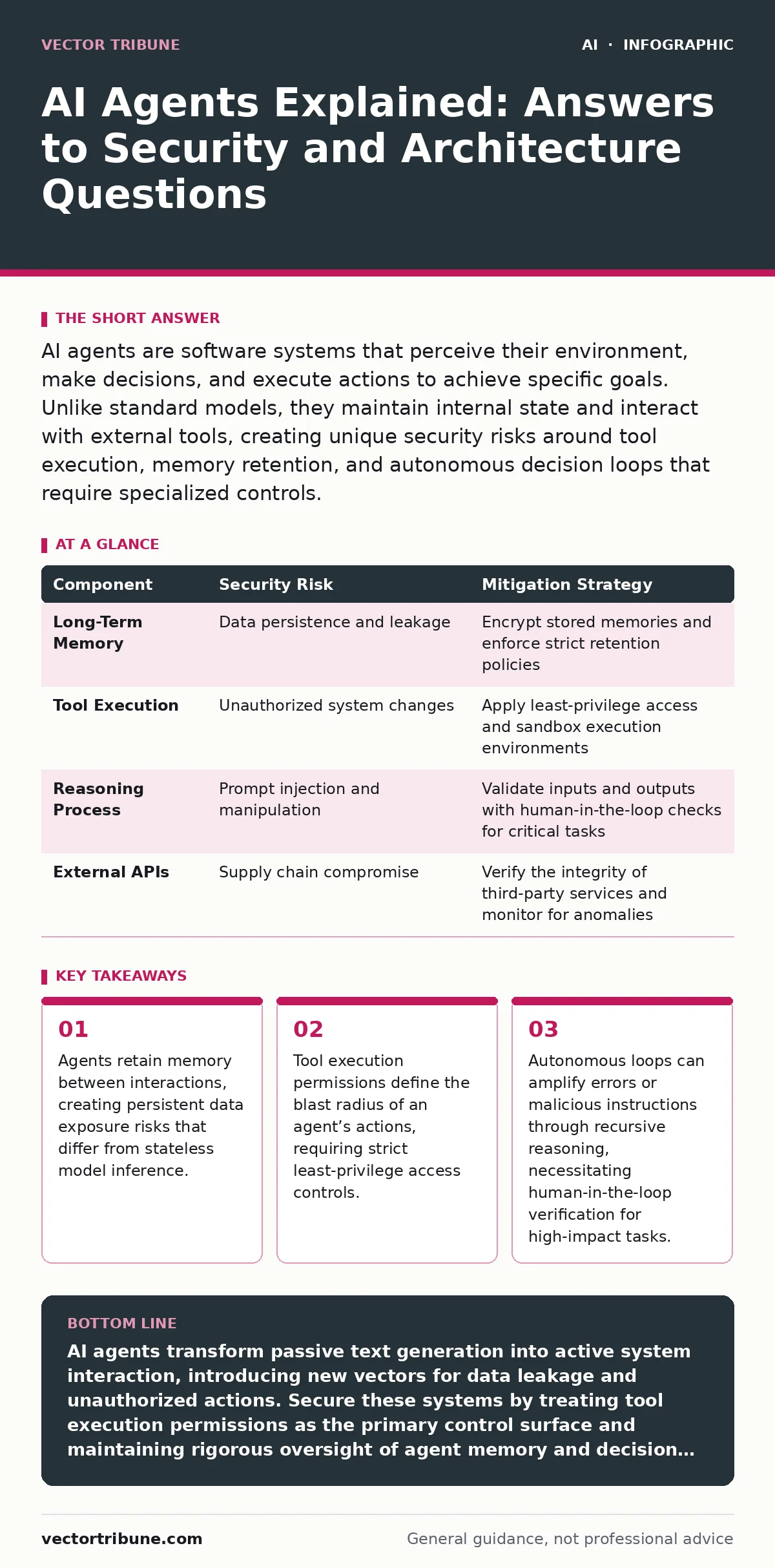
AI agents are software systems that perceive their environment, make decisions, and execute actions to achieve specific goals. Unlike standard models, they maintain internal state and interact with external tools, creating unique security risks around tool execution, memory retention, and autonomous decision loops that require specialized controls.
What distinguishes an AI agent from a standard large language model?
A standard large language model generates text based on input prompts without retaining context or taking actions beyond the response. An AI agent, by contrast, is designed to perceive its environment, plan sequences of actions, and execute those actions using external tools or APIs to achieve a defined goal. This shift from passive generation to active execution changes the security model entirely, as the system now has the ability to modify state outside its own sandbox.
How do agents maintain context across multiple interactions?
Agents use a mechanism known as long-term memory, which stores information from previous interactions in a retrievable format, such as a vector database. This allows the agent to reference past decisions, user preferences, or intermediate results when processing new requests. While this enables complex, multi-step workflows, it also means that sensitive data persists longer than in stateless inference, increasing the window for potential data exfiltration or leakage.
What role do external tools play in agent architecture?
External tools provide the agent with the ability to interact with the real world, such as querying databases, sending emails, or executing code. The agent selects which tool to use based on its internal reasoning process, passing arguments to the tool and interpreting the result. This integration creates a bridge between the model’s abstract reasoning and concrete system actions, making the security of these tools critical to the overall safety of the agent.
How can you restrict an agent’s ability to cause harm?
You limit harm by enforcing strict least-privilege access controls on the tools the agent can invoke. This means the agent should only have permissions to perform the specific actions required for its designated tasks, with no broader system access. Additionally, sandboxing the execution environment ensures that any unintended side effects from tool usage are contained and do not propagate to critical infrastructure or user data.
Why are agents more vulnerable to prompt injection than static models?
Agents are more vulnerable because they act on the output of their reasoning process, often without human verification. A prompt injection attack can trick the agent into misinterpreting its instructions, causing it to execute malicious commands via its integrated tools. Unlike a static model that might simply output harmful text, an agent can use that text to delete files, transfer funds, or access private records, turning a text-based exploit into a functional system breach.
How does the supply chain affect agent security?
Agents often rely on third-party components, including pre-trained models, tool APIs, and memory storage solutions, each of which introduces potential vulnerabilities. If a supplier embeds malicious behavior into a model or a tool API, the agent may unknowingly execute harmful actions as part of its normal operation. This interdependence means that security extends beyond your own code to include the integrity of every external service the agent interacts with, highlighting the need for careful assessment of AI supply chain risks.
Can you verify that an agent’s actions are legitimate?
Verification is difficult because agents generate dynamic, context-specific outputs that are hard to distinguish from legitimate operations using static signatures. Traditional detection methods struggle to identify subtle deviations in reasoning or tool usage that indicate malicious intent. To address this, organizations are exploring techniques like AI watermarking to tag agent-generated content, though this does not prevent the action itself, only helps in tracing its origin after the fact.
How do you detect when an agent is behaving unexpectedly?
Detection requires monitoring the agent’s decision-making process and tool usage patterns for anomalies, such as unusual sequences of API calls or deviations from expected workflows. Since agents operate with a degree of autonomy, standard log analysis may not capture the reasoning behind specific actions, making behavioral analytics essential. Integrating AI transparency measures, such as logging the agent’s internal reasoning steps, can help auditors reconstruct events and identify where the decision logic went astray.
| Component | Security Risk | Mitigation Strategy |
|---|---|---|
| Long-Term Memory | Data persistence and leakage | Encrypt stored memories and enforce strict retention policies |
| Tool Execution | Unauthorized system changes | Apply least-privilege access and sandbox execution environments |
| Reasoning Process | Prompt injection and manipulation | Validate inputs and outputs with human-in-the-loop checks for critical tasks |
| External APIs | Supply chain compromise | Verify the integrity of third-party services and monitor for anomalies |
What is the future of securing autonomous AI systems?
The future involves moving beyond perimeter-based security to models that understand the intent and context of agent actions. This includes developing standards for agent behavior verification and integrating security checks directly into the reasoning loop. As agents become more prevalent, the focus will shift from preventing all errors to containing their impact and ensuring rapid recovery, a principle central to securing AI agents.
Key takeaways
- Agents retain memory between interactions, creating persistent data exposure risks that differ from stateless model inference.
- Tool execution permissions define the blast radius of an agent’s actions, requiring strict least-privilege access controls.
- Autonomous loops can amplify errors or malicious instructions through recursive reasoning, necessitating human-in-the-loop verification for high-impact tasks.
AI agents transform passive text generation into active system interaction, introducing new vectors for data leakage and unauthorized actions. Secure these systems by treating tool execution permissions as the primary control surface and maintaining rigorous oversight of agent memory and decision logs.
Frequently asked questions
How do agents differ from chatbots?
Chatbots are designed for conversational interaction and typically respond within a fixed context, while agents are built to perform tasks, use tools, and maintain state across extended workflows to achieve specific objectives.
Can agents be used in security operations?
Yes, **AI in security operations** leverages agents to automate threat detection and response, but this requires careful configuration to prevent the agents from becoming targets for attackers or executing false-positive remediations.
What are data poisoning attacks in the context of agents?
Data poisoning attacks** involve corrupting the training data or memory stores used by agents, causing them to learn incorrect behaviors or associations that lead to flawed decision-making or security bypasses during operation.
How does retrieval-augmented generation impact agent security?
Retrieval-augmented generation security** is critical for agents that pull external information, as compromised retrieval sources can inject false data or malicious instructions into the agent’s context, influencing its subsequent actions.
How this guide was produced: written by the Vector Tribune editorial team with AI assistance, checked against the public references listed below, and reviewed when the facts change. See our editorial policy or report an error.