How Third-Party Data Breaches Work: The Hidden Attack Chain
Most third-party breaches succeed because your organization trusts external data feeds without verifying the integrity of the source or the transport mechanism.
Attackers compromise a vendor to bypass your perimeter. They exploit weak integrations or stolen credentials to move data. You can stop this by enforcing strict API authentication, monitoring for anomalous data flows, and isolating third-party access from critical systems.
The Illusion of a Closed Perimeter
Your network perimeter is no longer a wall. It is a series of doors, each leading to a different vendor, partner, or service provider. When you integrate a third-party service, you extend your attack surface. The attacker does not need to break into your fortress; they only need to walk through the door you left open for the plumber. This shift changes the nature of defense. You can control your internal code, but you cannot control the security hygiene of every company you buy from.
The assumption that a vendor’s security certification guarantees safety is a common error. Certifications like ISO 27001 indicate a framework is in place, not that it is flawlessly executed. A vendor may pass an audit today and suffer a configuration drift tomorrow. You must treat every third-party connection as untrusted by default. This mindset forces you to implement controls that verify integrity at the point of entry, rather than relying on the vendor’s promises.
The Attack Surface Expansion
Every integration point is a potential entry. When you connect to a cloud storage provider, a payment processor, or a CRM tool, you create a bridge. That bridge carries data in both directions. If the bridge is structurally sound, data flows safely. If the bridge has weak supports, the attacker can cross it. The primary risk lies in the credentials and tokens that allow this communication. These are often API keys, service accounts, or OAuth tokens.
These credentials are frequently stored in configuration files, environment variables, or code repositories. If an attacker finds one, they gain the ability to act on your behalf. This is different from a human password leak. A service account often has persistent, long-lived access. It does not expire quickly. It may have permissions to read multiple databases. The attacker does not need to guess a password; they just need to find the key.
### Stage 1: Vendor Compromise
The chain begins far from your systems. An attacker targets a third-party provider that holds data about you or has access to your systems. This provider might be a SaaS application, a managed service provider, or a software supplier. The attacker exploits a vulnerability in the vendor’s infrastructure. This could be an unpatched server, a misconfigured database, or a weak authentication mechanism.
The goal here is initial access. The attacker does not care about your data yet. They care about the vendor’s systems. Once inside, they map the environment. They look for connections to other clients. They identify which clients have sensitive data and which have active integrations. This stage is invisible to you. You may never know the vendor has been breached until your own systems show signs of intrusion.
### Stage 2: Credential Harvesting
With access to the vendor’s systems, the attacker looks for credentials. They search for API keys, database connection strings, and service account passwords. These are often stored in plain text or weakly encrypted. The attacker may also look for OAuth tokens that allow them to impersonate your organization. This is where the link between the vendor and your systems is forged.
The attacker now possesses the keys to your kingdom. They do not need to break into your firewall. They simply use the stolen credentials to authenticate as a legitimate service. This bypasses many traditional security controls. Firewalls allow the traffic because it comes from a trusted IP range. Intrusion detection systems may ignore it because the protocol is valid. The attack is now inside your perimeter, masquerading as normal business activity.
### Stage 3: Lateral Movement and Reconnaissance
The attacker uses the stolen credentials to access your systems. They start by enumerating resources. They list files, query databases, and scan for other services. This reconnaissance is quiet. It involves small, legitimate-looking requests. The attacker identifies where the valuable data lives. They look for customer records, financial data, or intellectual property.
This stage relies on the principle of least privilege being ignored. If the compromised service account has admin rights, the attacker can move freely. If it has limited rights, they may try to escalate privileges. They look for misconfigurations that allow them to access more than intended. For example, a storage bucket might be publicly readable. A database might allow remote connections without encryption. Each misconfiguration is a stepping stone.
See also: Insecure Cloud APIs: Response and Recovery Steps
### Stage 4: Data Exfiltration
Once the attacker identifies the target data, they begin the extraction. They do not dump everything at once. That would trigger alerts. Instead, they exfiltrate data in small chunks. They use the same API endpoints that your applications use. The traffic looks identical to normal operations. This is the most dangerous phase. It can go on for weeks or months.
The attacker may encrypt the data before sending it out. This hides the content from network monitoring tools. They may also use legitimate cloud services to store the stolen data. This makes forensic analysis difficult. The data is no longer on your servers, but it is still accessible to the attacker. The breach is complete, but you may not know it for some time.
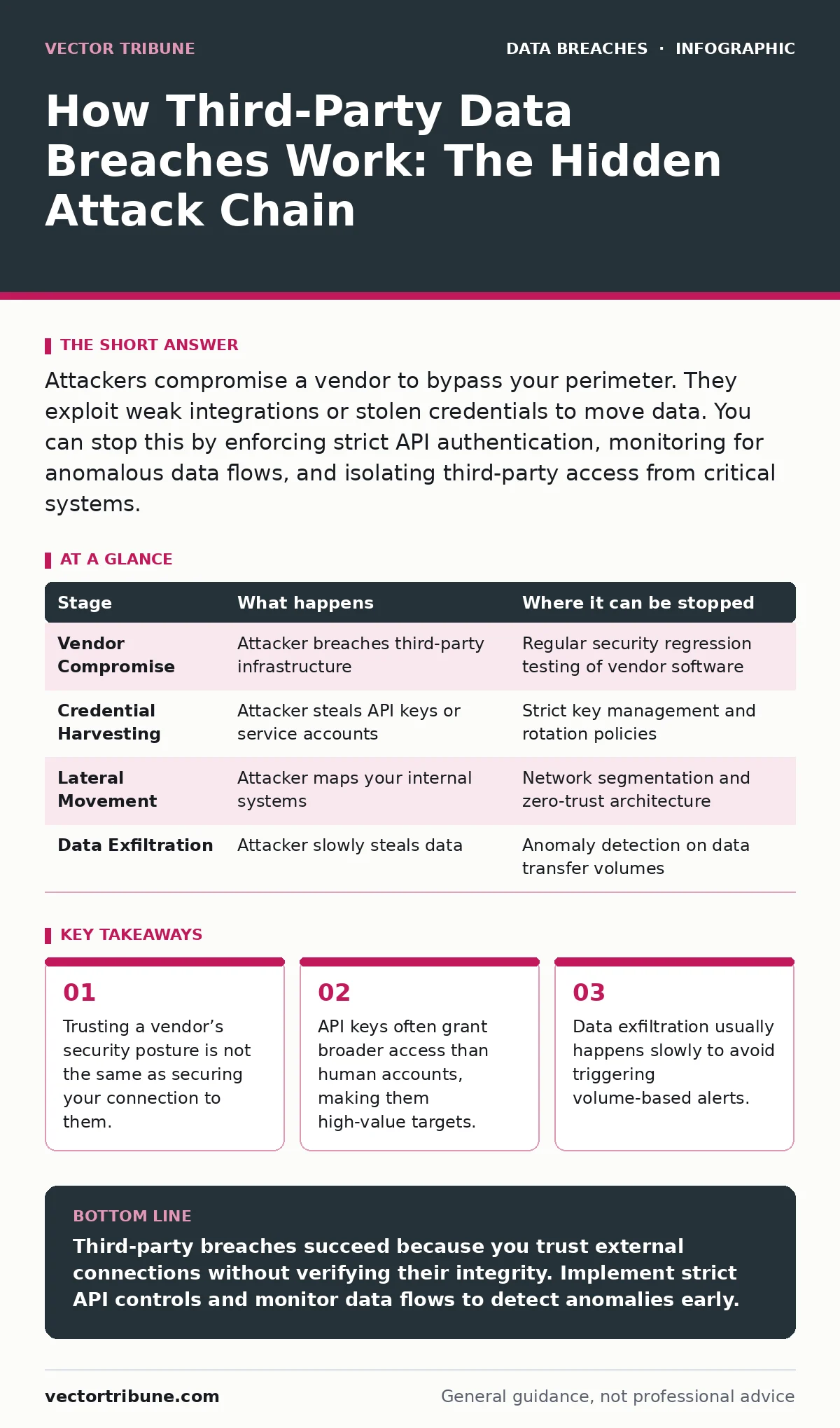
| Stage | What happens | Where it can be stopped |
|---|---|---|
| Vendor Compromise | Attacker breaches third-party infrastructure | Regular security regression testing of vendor software |
| Credential Harvesting | Attacker steals API keys or service accounts | Strict key management and rotation policies |
| Lateral Movement | Attacker maps your internal systems | Network segmentation and zero-trust architecture |
| Data Exfiltration | Attacker slowly steals data | Anomaly detection on data transfer volumes |
The Hidden Cost of Trust
The biggest failure in third-party security is the assumption of trust. You assume the vendor protects the data because they are paid to do so. You assume the connection is secure because it uses HTTPS. This is a dangerous oversimplification. HTTPS protects data in transit, but it does not validate the source. It does not prevent a stolen key from being used.
You must implement controls that verify the identity and integrity of every request. This means using mutual TLS, where both sides present certificates. It means validating the scope of every API call. It means monitoring for unusual patterns in data access. These controls add complexity, but they reduce risk. They ensure that even if a credential is stolen, the attacker cannot do much with it.
Interrupting the Chain
You can interrupt the breach at any stage. At the vendor level, you can require proof of security. You can conduct audits. You can limit the data you share. At the credential level, you can rotate keys frequently. You can use short-lived tokens. You can store keys in secure vaults. At the access level, you can segment your network. You can restrict API access to specific IP ranges. You can monitor for anomalous behavior.
Preventing third-party breaches requires a shift in perspective. You are not just protecting your own systems. You are protecting the connections between your systems and the world. This requires continuous monitoring and strict controls. It requires treating every external connection as a potential threat. By doing so, you reduce the likelihood of a successful breach. You also reduce the impact if one occurs.
Beyond the Perimeter
The threat extends beyond technical controls. Human error plays a significant role. Employees may misdirect emails containing sensitive data to third-party contacts. They may overshare on social media, revealing internal processes. They may lose devices containing credentials. These actions create additional entry points for attackers.
You must train your team to recognize these risks. You must enforce policies that limit data sharing. You must secure devices and enforce strong authentication. You must monitor for signs of insider data theft. By addressing these human factors, you close the gaps that technical controls cannot. You create a defense-in-depth strategy that covers all angles.
Key takeaways
- Trusting a vendor’s security posture is not the same as securing your connection to them.
- API keys often grant broader access than human accounts, making them high-value targets.
- Data exfiltration usually happens slowly to avoid triggering volume-based alerts.
Third-party breaches succeed because you trust external connections without verifying their integrity. Implement strict API controls and monitor data flows to detect anomalies early.
Frequently asked questions
How do I know if my API key has been compromised?
Monitor for unusual access patterns, such as requests from new IP addresses or at odd times. Rotate keys immediately if suspicious activity is detected.
Can zero-trust architecture prevent third-party breaches?
Zero-trust reduces risk by verifying every request, regardless of origin. It limits the damage if a credential is stolen by restricting access to only what is necessary.
What is the difference between a data breach and a security incident?
A security incident is any violation of security policy. A data breach is a specific type of incident where sensitive data is accessed or stolen.
How often should I rotate API keys?
Rotate keys regularly, such as every 90 days, or immediately after a suspected compromise. Short-lived tokens are even better for high-risk integrations.
How this guide was produced: written by the Vector Tribune editorial team with AI assistance, checked against the public references listed below, and reviewed when the facts change. See our editorial policy or report an error.