
Insecure Cloud APIs: Response and Recovery Steps
Most cloud breaches fail because teams patch the code before isolating the compromised credentials, allowing attackers to persist through secondary access tokens.
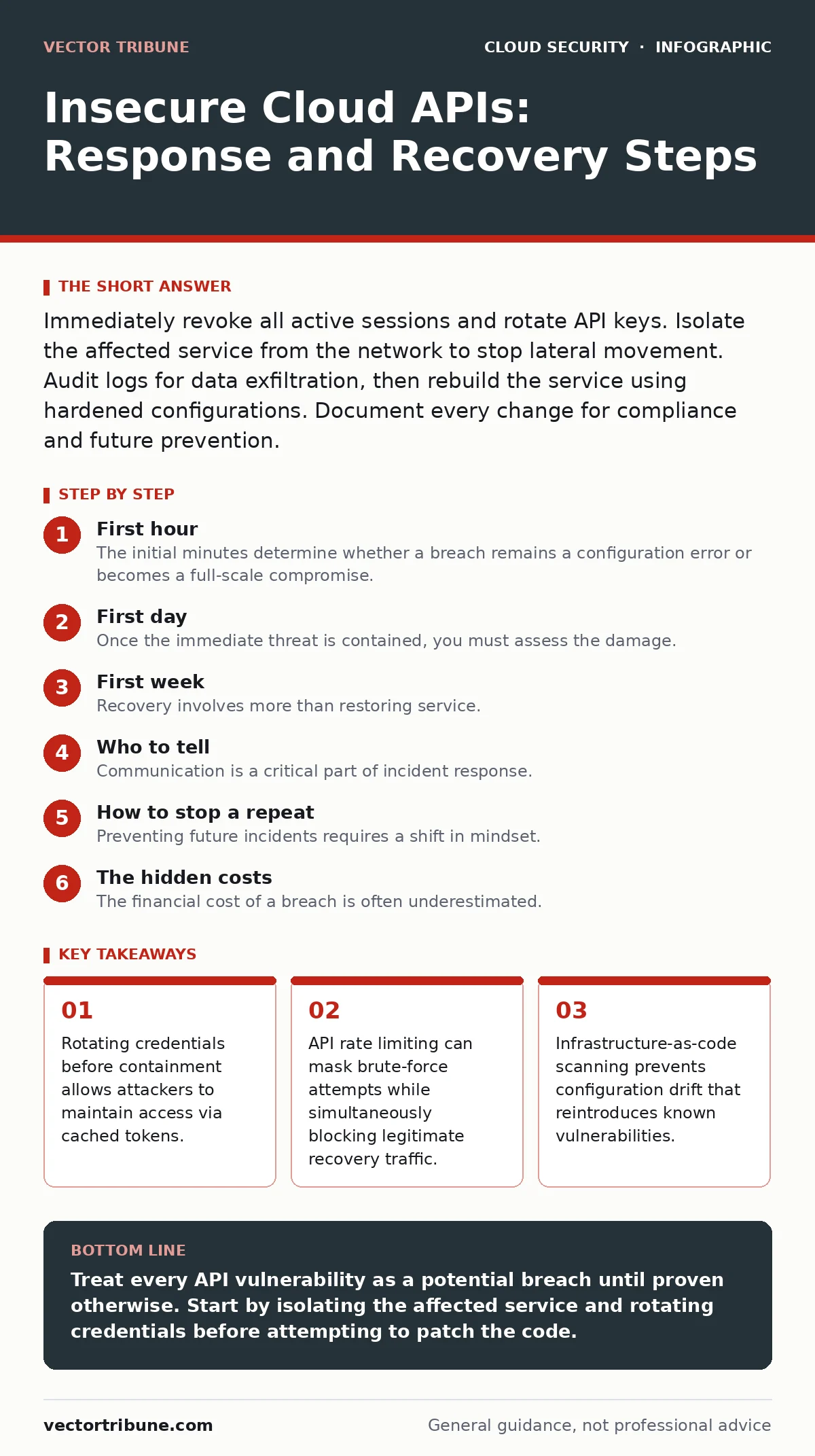
Immediately revoke all active sessions and rotate API keys. Isolate the affected service from the network to stop lateral movement. Audit logs for data exfiltration, then rebuild the service using hardened configurations. Document every change for compliance and future prevention.
First hour
The initial minutes determine whether a breach remains a configuration error or becomes a full-scale compromise. Your primary objective is to stop the bleeding without destroying forensic evidence. Panic often leads to destructive actions that erase the trail of how the attacker entered the system.
Checklist for the first hour:
- Identify the specific API endpoint and the vulnerability class.
- Revoke all active sessions and tokens associated with the service account.
- Isolate the affected resource from the network to prevent lateral movement.
- Enable verbose logging on the API gateway to capture subsequent attempts.
- Notify the incident response team and legal counsel immediately.
First day
Once the immediate threat is contained, you must assess the damage. The attacker likely used the insecure API to gather information about your environment. They may have accessed metadata services or enumerated other resources.
Review the access logs to determine what data was exposed. Look for unusual patterns in request frequency, geographic origin, or payload size. An attacker might use a slow drip exfiltration technique to avoid triggering standard alerts. This requires careful analysis of historical data, not just recent activity.
Rotate all secrets. This includes API keys, database passwords, and encryption keys. Do not assume the attacker only accessed the primary credential. They may have copied secondary tokens or used the API to generate new ones. See our guide on cloud metadata service attacks for details on how attackers harvest these secrets from instance metadata endpoints.
First week
Recovery involves more than restoring service. You must rebuild trust in the system. This means verifying that the underlying infrastructure is secure and that no backdoors remain.
Rebuild the affected service from a known good state. Do not attempt to patch the compromised instance. Use infrastructure-as-code scanning to ensure the new deployment does not contain the same misconfigurations. This process ensures that the code defining your infrastructure matches security policies.
Conduct a thorough review of the API design. Identify why the vulnerability existed. Was it a lack of input validation? Missing authentication? Improper authorization checks? Document these findings and update your security standards accordingly.
Who to tell
Communication is a critical part of incident response. You must inform internal stakeholders, external partners, and potentially customers. The timing and content of these communications depend on the severity of the breach and regulatory requirements.
Notify your legal team immediately. They will guide you on disclosure obligations. In many jurisdictions, you must notify regulators within a specific timeframe. Failure to do so can result in significant fines.
Inform your customers if their data was exposed. Be transparent about what happened, what data was affected, and what you are doing to fix it. Hiding the breach will damage your reputation more than the breach itself.
How to stop a repeat
Preventing future incidents requires a shift in mindset. Security must be integrated into the development lifecycle, not added as an afterthought.
Implement security regression testing for all API changes. This ensures that new code does not introduce vulnerabilities that were previously fixed. Automated tests should check for common issues like injection flaws, broken authentication, and sensitive data exposure.
Adopt a zero-trust architecture. Verify every request, regardless of its origin. Do not trust internal networks implicitly. Use mutual TLS to ensure that both the client and server are authenticated.
See our guide on security regression testing for techniques to automate this process.
See also: Cloud Metadata Service Attack Myths vs Reality · How Third-Party Data Breaches Work: The Hidden Attack Chain
The hidden costs
The financial cost of a breach is often underestimated. Beyond fines and legal fees, there are hidden costs. These include the time spent on incident response, the loss of customer trust, and the opportunity cost of diverted engineering resources.
Consider the impact on your development velocity. After a breach, teams often become risk-averse. They may delay releases to add extra security reviews. This slows down innovation and reduces competitiveness.
Long-term resilience
Building long-term resilience requires continuous improvement. Security is not a one-time project. It is an ongoing process.
Regularly review your API security posture. Conduct penetration tests and vulnerability assessments. Engage third-party experts to provide an independent view of your defenses.
Train your developers on secure coding practices. Make security a shared responsibility. Provide clear guidelines and tools to help them write secure code.
See our guide on multi-cloud security for strategies to manage complexity across different cloud providers.
Key takeaways
- Rotating credentials before containment allows attackers to maintain access via cached tokens.
- API rate limiting can mask brute-force attempts while simultaneously blocking legitimate recovery traffic.
- Infrastructure-as-code scanning prevents configuration drift that reintroduces known vulnerabilities.
Treat every API vulnerability as a potential breach until proven otherwise. Start by isolating the affected service and rotating credentials before attempting to patch the code.
Frequently asked questions
How do I know if an API is insecure?
Look for missing authentication, lack of rate limiting, or exposure of sensitive data in responses. Automated scanners can identify many common issues.
Should I use an API gateway?
Yes, an API gateway provides centralized security controls. It can enforce authentication, rate limiting, and input validation across all APIs.
What is the difference between an API key and a token?
An API key is a static credential used to identify an application. A token is a temporary credential used to authenticate a specific user or session.
How often should I rotate API keys?
Rotate keys regularly, especially after any security incident. Automate rotation to reduce the risk of human error.
How this guide was produced: written by the Vector Tribune editorial team with AI assistance, checked against the public references listed below, and reviewed when the facts change. See our editorial policy or report an error.