
Difference Between Logging and Monitoring: Cloud Security Architecture
Logging records discrete events for forensic analysis, while monitoring aggregates those events to detect systemic anomalies and trigger automated responses.
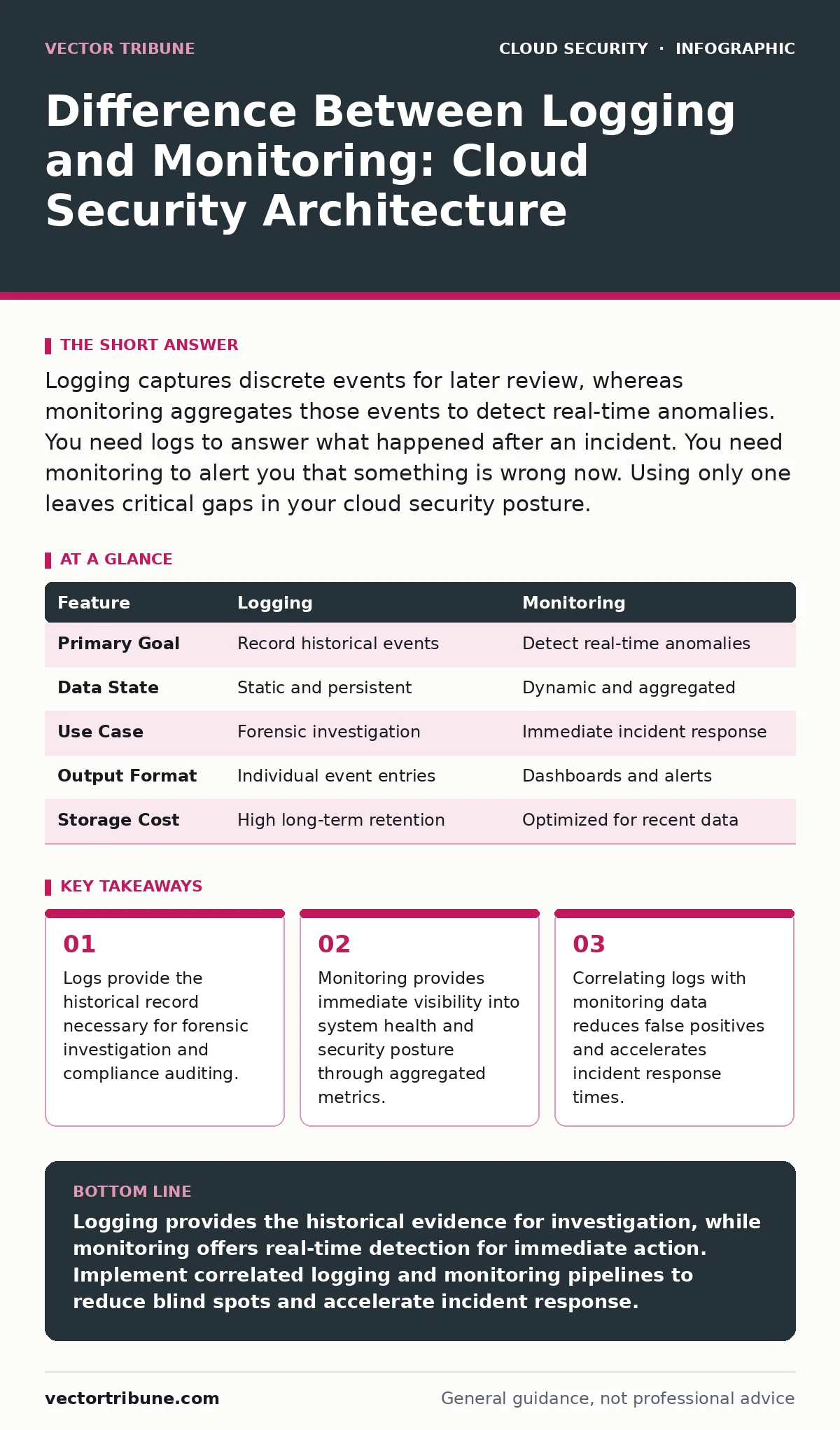
Logging captures discrete events for later review, whereas monitoring aggregates those events to detect real-time anomalies. You need logs to answer what happened after an incident. You need monitoring to alert you that something is wrong now. Using only one leaves critical gaps in your cloud security posture.
What is the difference between logging and monitoring?
Logging and monitoring serve distinct purposes in cloud security architecture. Logging records discrete events, such as user logins or file accesses, into a persistent store. Monitoring aggregates these events into metrics to detect real-time anomalies. You use logs to investigate past incidents. You use monitoring to prevent future incidents by triggering alerts. Confusing the two leads to blind spots in your defense strategy.
Why do logs fail to provide immediate security visibility?
Logs are static records that require active querying to yield insights. They do not inherently indicate whether a system is healthy or compromised. A single log entry shows one action, not the context of thousands of concurrent actions. Without aggregation, you cannot spot patterns like distributed denial-of-service attacks. You must process logs through a monitoring pipeline to convert raw data into actionable alerts. This processing step is where most teams encounter latency issues.
How does monitoring transform raw log data into alerts?
Monitoring systems ingest high-volume data streams and apply defined rules or machine learning models. These systems calculate baselines for normal behavior, such as average CPU usage or login frequency. When current activity deviates significantly from the baseline, the system generates an alert. This transformation allows you to react to threats before they cause significant damage. You configure thresholds to balance sensitivity against noise. Too many alerts cause fatigue; too few miss critical events.
| Feature | Logging | Monitoring |
|---|---|---|
| Primary Goal | Record historical events | Detect real-time anomalies |
| Data State | Static and persistent | Dynamic and aggregated |
| Use Case | Forensic investigation | Immediate incident response |
| Output Format | Individual event entries | Dashboards and alerts |
| Storage Cost | High long-term retention | Optimized for recent data |
What are the hidden costs of centralized logging?
Centralized logging requires significant infrastructure to ingest, store, and index data. You pay for storage regardless of how often you query the logs. High-volume applications generate terabytes of data daily, inflating cloud bills rapidly. You also face the complexity of maintaining pipeline reliability. If the logging pipeline fails, you lose visibility without immediate alerting. This creates a single point of failure for your audit trail. You must design redundancy into your logging architecture to mitigate this risk.
How do you correlate logs with monitoring metrics?
Correlation links specific log events to broader system metrics. Suppose a server shows high CPU usage in your monitoring dashboard. You query logs to find which process or user triggered that load. This connection turns a generic alert into a specific investigation. You use unique identifiers, such as request IDs, to trace activity across services. Without correlation, you chase shadows instead of threats. This integration is vital for reducing mean time to resolution during incidents.
See also: Insecure Cloud APIs: Response and Recovery Steps
What happens when you ignore log retention policies?
Ignoring retention policies leads to uncontrolled storage costs and compliance violations. You may retain sensitive data longer than necessary, increasing liability during breaches. Regulatory frameworks often require specific retention periods for audit logs. Deleting logs too early destroys evidence needed for forensic analysis. You must define clear policies that balance cost, compliance, and investigative needs. This prevents accidental data hoarding in your cloud environment.
Why does monitoring generate false positives?
Monitoring systems rely on thresholds that cannot perfectly model complex human behavior. Legitimate spikes in traffic, such as marketing campaigns, can trigger security alerts. You face alert fatigue when responders ignore notifications due to frequent false alarms. This desensitization causes teams to miss genuine threats buried in noise. You mitigate this by refining rules based on historical data. Continuous tuning of monitoring parameters reduces false positives over time. You must treat monitoring configuration as an ongoing process, not a one-time setup.
How do you secure the logging pipeline itself?
The logging pipeline is a high-value target for attackers. If an adversary compromises the pipeline, they can delete or alter logs to cover their tracks. You must encrypt logs in transit and at rest to prevent interception. Access controls should restrict who can modify or delete log configurations. Integrity checks, such as cryptographic hashing, verify that logs have not been tampered with. You should also consider immutable storage options that prevent deletion for a set period. This protects your audit trail even if the primary systems are compromised.
What advanced techniques improve cloud visibility?
Advanced techniques include behavioral analytics and automated response orchestration. Behavioral analytics uses machine learning to identify subtle deviations from normal patterns. Automated response connects monitoring alerts to remediation scripts, such as isolating a compromised instance. You integrate these tools to create a closed-loop security system. This approach reduces manual intervention and speeds up containment. You must validate automated actions to prevent accidental service disruption. Combining these methods creates a resilient defense against sophisticated threats.
How does this relate to broader cloud security?
Effective logging and monitoring support other security domains, such as preventing cloud metadata service attacks by detecting unusual API calls. You also rely on these systems to verify the integrity of your cloud backup processes. Without proper visibility, you cannot confirm that backups are complete and uncorrupted. Additionally, monitoring helps identify signs of cloud cryptojacking by spotting abnormal resource consumption. Integrating these practices ensures a cohesive security posture across your infrastructure.
Key takeaways
- Logs provide the historical record necessary for forensic investigation and compliance auditing.
- Monitoring provides immediate visibility into system health and security posture through aggregated metrics.
- Correlating logs with monitoring data reduces false positives and accelerates incident response times.
Logging provides the historical evidence for investigation, while monitoring offers real-time detection for immediate action. Implement correlated logging and monitoring pipelines to reduce blind spots and accelerate incident response.
Frequently asked questions
Do I need both logging and monitoring for compliance?
Yes, most compliance frameworks require persistent logs for auditing and real-time monitoring for continuous security assurance.
Can I use open-source tools for cloud logging?
Open-source solutions like the Elastic Stack or Loki provide robust logging and monitoring capabilities without vendor lock-in.
How often should I review my monitoring alerts?
Review alerts weekly to tune thresholds and reduce false positives, ensuring your team focuses on genuine threats.
What is the biggest risk in cloud logging?
The biggest risk is data loss due to pipeline failure or unauthorized deletion, which destroys forensic evidence.
How this guide was produced: written by the Vector Tribune editorial team with AI assistance, checked against the public references listed below, and reviewed when the facts change. See our editorial policy or report an error.