
Cloud Metadata Service Attack Myths vs Reality
Metadata services often expose credentials without network access, making local code execution the primary attack vector rather than external network scanning.
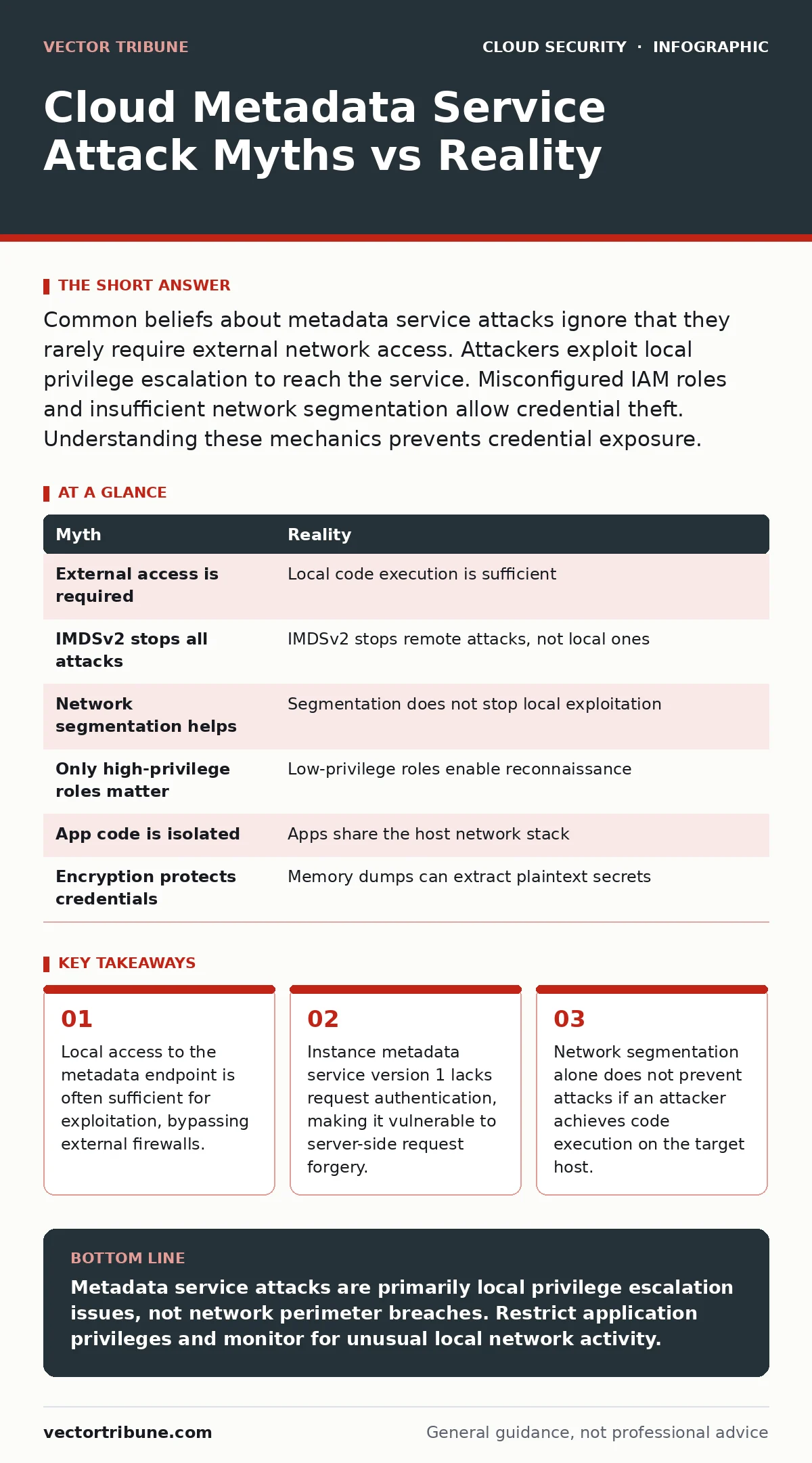
Common beliefs about metadata service attacks ignore that they rarely require external network access. Attackers exploit local privilege escalation to reach the service. Misconfigured IAM roles and insufficient network segmentation allow credential theft. Understanding these mechanics prevents credential exposure.
Myth: The metadata service is only accessible from outside the network
Reality: The cloud metadata service is designed to be accessible only from the instance itself or its immediate local network segment. It does not listen on public interfaces.
Many assume that because the service is internal, it is safe from external attackers. This view ignores how attackers operate once they breach a perimeter. An attacker does not need to reach the metadata service from the internet. They only need to execute code on a compromised instance.
Once malicious code runs on a host, it can make local HTTP requests to the metadata endpoint. This is a local privilege escalation problem, not a network perimeter problem. The metadata service trusts the local network interface implicitly.
Myth: Upgrading to IMDSv2 completely eliminates the risk
Reality: Instance Metadata Service Version 2 requires a session token for each request, which prevents many remote attacks. It does not protect against code execution on the host.
IMDSv2 mitigates server-side request forgery by forcing the requester to establish a session. This stops an attacker from tricking a web server into fetching credentials on their behalf. However, if an attacker can run arbitrary code on the instance, they can also generate the required token.
The token mechanism adds friction but does not remove the underlying trust model. The metadata service still returns sensitive data to any process that presents a valid token. If your application runs with excessive privileges, an attacker can still steal credentials. See our guide on insecure cloud APIs for more on how API design choices create hidden attack surfaces.
Myth: Network segmentation stops metadata theft
Reality: Network segmentation isolates instances from each other, but it does not isolate processes on the same instance. Code execution bypasses network rules.
You might place sensitive workloads in a private subnet with strict firewall rules. These rules prevent other instances from accessing the metadata service. They do not prevent a compromised process on the same instance from accessing it.
The metadata service is bound to a link-local address. This address is reachable by any process with network permissions on the host. If an attacker exploits a vulnerability in your application, they are already inside the security boundary. Network controls are ineffective against local exploitation.
Myth: Only privileged roles are worth targeting
Reality: Attackers often target low-privilege roles to pivot to more sensitive resources. Even read-only access can reveal infrastructure details.
A common misconception is that only roles with administrative rights are valuable. Attackers use low-privilege credentials to enumerate the environment. They list storage buckets, identify other instances, and map the network topology.
This reconnaissance allows them to plan further attacks. They might find a misconfigured resource that allows them to escalate privileges later. Even a role that can only read logs can expose secrets stored in plain text. Do not assume that limited permissions mean limited risk.
Myth: Application code is isolated from the metadata service
Reality: Applications often run with the same privileges as the operating system. They can access the metadata service if the code is vulnerable.
Developers frequently assume that application logic is separate from infrastructure management. This separation is logical, not physical. The application runs on the same kernel and shares the same network stack.
If an application has a vulnerability like a server-side request forgery flaw, an attacker can force it to fetch metadata. The application acts as a proxy for the attacker. This is why container escape techniques are so dangerous. They allow an attacker to break out of the container and interact with the host metadata service directly.
See also: Insecure Cloud APIs: Response and Recovery Steps · Watering Hole Attacks in Cyber Security: How Compromise Happens
Myth: Metadata services are static and unchanging
Reality: Cloud providers frequently update metadata services, adding new endpoints and changing behavior. Static assumptions lead to outdated defenses.
The metadata service evolves to support new features. These changes can introduce new attack vectors. For example, adding support for user-defined data can allow attackers to inject malicious configurations.
You must treat the metadata service as a dynamic component. Regularly review the documentation for changes in endpoint behavior. Ensure your security monitoring accounts for new endpoints. Relying on old knowledge can leave gaps in your defense strategy. See infrastructure-as-code scanning to ensure your deployment templates reflect current security best practices.
Myth: Encryption at rest protects metadata credentials
Reality: Encryption protects data stored on disk, but credentials are often loaded into memory. An attacker with memory access can extract them.
Credentials retrieved from the metadata service are stored in memory or temporary files. Encryption at rest does not protect data in use. If an attacker can dump the memory of a compromised process, they can find plaintext credentials.
This is a fundamental limitation of how applications handle secrets. You must assume that any process with access to the metadata service can leak credentials. Use short-lived tokens and strict least-privilege policies to limit the damage. This approach complements cloud disaster recovery plans by minimizing the impact of a breach.
| Myth | Reality |
|---|---|
| External access is required | Local code execution is sufficient |
| IMDSv2 stops all attacks | IMDSv2 stops remote attacks, not local ones |
| Network segmentation helps | Segmentation does not stop local exploitation |
| Only high-privilege roles matter | Low-privilege roles enable reconnaissance |
| App code is isolated | Apps share the host network stack |
| Encryption protects credentials | Memory dumps can extract plaintext secrets |
Key takeaways
- Local access to the metadata endpoint is often sufficient for exploitation, bypassing external firewalls.
- Instance metadata service version 1 lacks request authentication, making it vulnerable to server-side request forgery.
- Network segmentation alone does not prevent attacks if an attacker achieves code execution on the target host.
Metadata service attacks are primarily local privilege escalation issues, not network perimeter breaches. Restrict application privileges and monitor for unusual local network activity.
Frequently asked questions
How do attackers access the metadata service?
Attackers execute code on a compromised instance, allowing them to make local HTTP requests to the metadata endpoint.
Does IMDSv2 prevent all credential theft?
No, IMDSv2 prevents remote attacks like SSRF but does not stop an attacker who has already executed code on the host.
Can network segmentation stop metadata attacks?
No, segmentation isolates instances but does not prevent processes on the same instance from accessing the metadata service.
What is the best defense against metadata attacks?
Use least-privilege IAM roles, enforce IMDSv2, and assume that any code execution on the host can access metadata.
How this guide was produced: written by the Vector Tribune editorial team with AI assistance, checked against the public references listed below, and reviewed when the facts change. See our editorial policy or report an error.