
HTTPS Limits: What Encryption Cannot Protect in Your Stack
HTTPS secures data in transit but leaves your endpoints, internal networks, and application logic entirely exposed to sophisticated attacks.
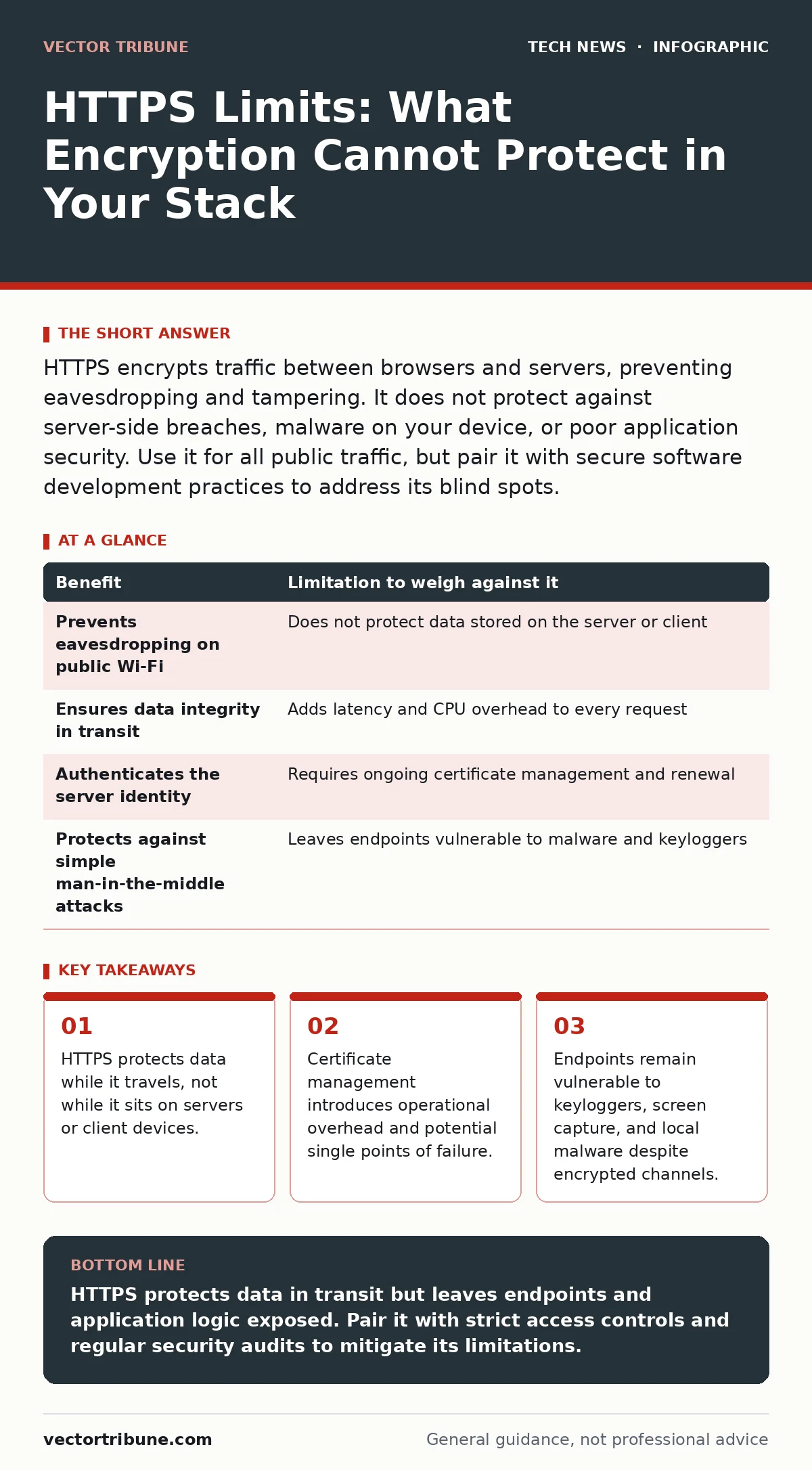
HTTPS encrypts traffic between browsers and servers, preventing eavesdropping and tampering. It does not protect against server-side breaches, malware on your device, or poor application security. Use it for all public traffic, but pair it with secure software development practices to address its blind spots.
The Illusion of Total Security
Developers often treat HTTPS as a silver bullet for security. This mindset creates a dangerous blind spot. You assume that because the lock icon appears, the data is safe. It is only safe while moving between the client and the server. Once the data reaches the server, it must be decrypted to be processed. At that moment, it is plaintext again. If your server is compromised, the attacker sees everything.
This distinction matters because most breaches do not happen on the wire. They happen at the endpoints or within the application logic. You must understand what HTTPS does not do. It does not authenticate the user beyond the certificate chain. It does not validate that the request is legitimate. It does not protect the database storing the credentials.
Imagine an attacker with access to your web server logs. They can read every request made over HTTPS. The encryption protects the transmission, not the destination. You need to layer other controls. Secure software development practices ensure that your code handles data safely after decryption. Without these layers, HTTPS is merely a decorative wrapper.
Operational Costs and Hidden Friction
Encryption is not free. It consumes CPU cycles on both the client and the server. The handshake process adds latency to the initial connection. For high-traffic applications, this overhead can become significant. You must balance security against performance. Modern processors include instructions to accelerate cryptographic operations, but the cost remains.
Certificate management is another hidden cost. Certificates expire. If you fail to renew them, your service goes dark. Automated renewal tools exist, but they introduce complexity. They require DNS access or web server configuration that can break during deployments. A misconfigured renewal process can take down your entire platform.
You also face the challenge of legacy support. Older clients may not support modern cryptographic suites. Supporting them requires falling back to weaker algorithms. This weakens your overall posture. You must decide which clients to support and which to reject. This decision affects your user base. It is a trade-off between accessibility and security.
The Endpoint Blind Spot
HTTPS cannot protect you if your device is compromised. Keyloggers record keystrokes before encryption occurs. Screen capture tools steal data as it renders in the browser. Malware can intercept data from memory. The channel is secure, but the endpoints are not.
This is why shoulder surfing remains a threat. An attacker watching your screen sees the same data as you. They do not need to intercept the network traffic. They just need a line of sight. Similarly, a compromised browser extension can read and modify data before it is sent.
You must treat your device as a hostile environment. Mobile device security practices include sandboxing and permission controls. These measures limit what malware can do. They reduce the surface area for attack. But they do not eliminate it. You must assume that your endpoints are vulnerable.
| Benefit | Limitation to weigh against it |
|---|---|
| Prevents eavesdropping on public Wi-Fi | Does not protect data stored on the server or client |
| Ensures data integrity in transit | Adds latency and CPU overhead to every request |
| Authenticates the server identity | Requires ongoing certificate management and renewal |
| Protects against simple man-in-the-middle attacks | Leaves endpoints vulnerable to malware and keyloggers |
When It Is Worth It
You should use HTTPS for all public-facing applications. The cost of not doing so is higher than the operational overhead. Without it, anyone on the network can read your traffic. They can modify it. They can inject malicious code. The risk is too high to ignore.
Even for internal applications, HTTPS is often worth it. Internal networks are not immune to threats. An insider with a packet sniffer can intercept unencrypted traffic. Using HTTPS everywhere simplifies your security policy. You do not have to maintain separate rules for internal and external traffic. It reduces configuration errors.
Consider the principle of least privilege. HTTPS enforces authentication of the server. It ensures you are talking to the right service. This prevents redirect attacks. It is a foundational control. You build other security measures on top of it. Removing it undermines the entire stack.
When It Is Not Worth It
There are scenarios where HTTPS adds little value. Local development environments are one example. If the traffic never leaves your machine, encryption is redundant. It slows down development without adding security. You can use HTTP for local testing and switch to HTTPS for staging and production.
Another case is isolated, air-gapped systems. If a network has no external connections and strict physical access controls, the risk of interception is minimal. The overhead of managing certificates may outweigh the benefit. However, you must verify that the isolation is absolute. Any breach of that isolation exposes you to the risks of unencrypted traffic.
See also: Server-Side Request Forgery: How SSRF Bypasses Your Network Defenses
Layering Defenses Beyond the Wire
To address the limitations of HTTPS, you must look beyond the transport layer. Firewall rules control access to your servers. They block unauthorized connections before they reach the application. This reduces the attack surface. It complements HTTPS by ensuring only trusted sources can connect.
Network monitoring helps you detect anomalies. You can spot unusual traffic patterns that suggest an attack. Even with HTTPS, metadata like volume and timing can reveal threats. Combine this with secure software development to prevent injection attacks. These layers work together. None of them is sufficient alone.
Preparing for Future Cryptographic Shifts
Cryptographic algorithms are not permanent. Advances in computing power and mathematics will eventually break current standards. You must design your systems to be flexible. Hardcoding algorithms makes updates difficult. Use abstraction layers that allow you to swap algorithms without rewriting your application.
This is where post-quantum cryptography becomes relevant. Quantum computers could break current encryption methods. You should monitor developments in this field. Plan for migration paths. This is not an immediate fix, but a long-term strategy. Your architecture should support updates to cryptographic primitives.
Secure Boot ensures that your devices start with trusted software. It prevents attackers from loading malicious firmware that could bypass encryption. This is another layer that complements HTTPS. It protects the endpoint from the ground up. You must integrate these technologies into your broader security strategy.
Key takeaways
- HTTPS protects data while it travels, not while it sits on servers or client devices.
- Certificate management introduces operational overhead and potential single points of failure.
- Endpoints remain vulnerable to keyloggers, screen capture, and local malware despite encrypted channels.
HTTPS protects data in transit but leaves endpoints and application logic exposed. Pair it with strict access controls and regular security audits to mitigate its limitations.
Frequently asked questions
Does HTTPS protect my data if my server is hacked?
No, HTTPS only encrypts data while it travels between the client and server. Once decrypted on the server, it is vulnerable to server-side breaches.
Can HTTPS prevent man-in-the-middle attacks?
Yes, HTTPS prevents basic man-in-the-middle attacks by authenticating the server's identity via certificates. However, it cannot stop attacks that compromise the endpoints themselves.
Is HTTPS necessary for internal company networks?
Yes, internal networks are not immune to threats. Using HTTPS internally prevents insider threats and simplifies security policies by enforcing a single standard.
How often should I update my TLS configuration?
You should update your TLS configuration whenever new vulnerabilities are discovered or when support for older protocols is dropped. Regular reviews ensure you are using the strongest available settings.
How this guide was produced: written by the Vector Tribune editorial team with AI assistance, checked against the public references listed below, and reviewed when the facts change. See our editorial policy or report an error.