
Secure Software Development for Small Teams Without Heavy Infrastructure
Small teams reduce risk by treating security as a code quality metric rather than a separate compliance phase, avoiding expensive audits.
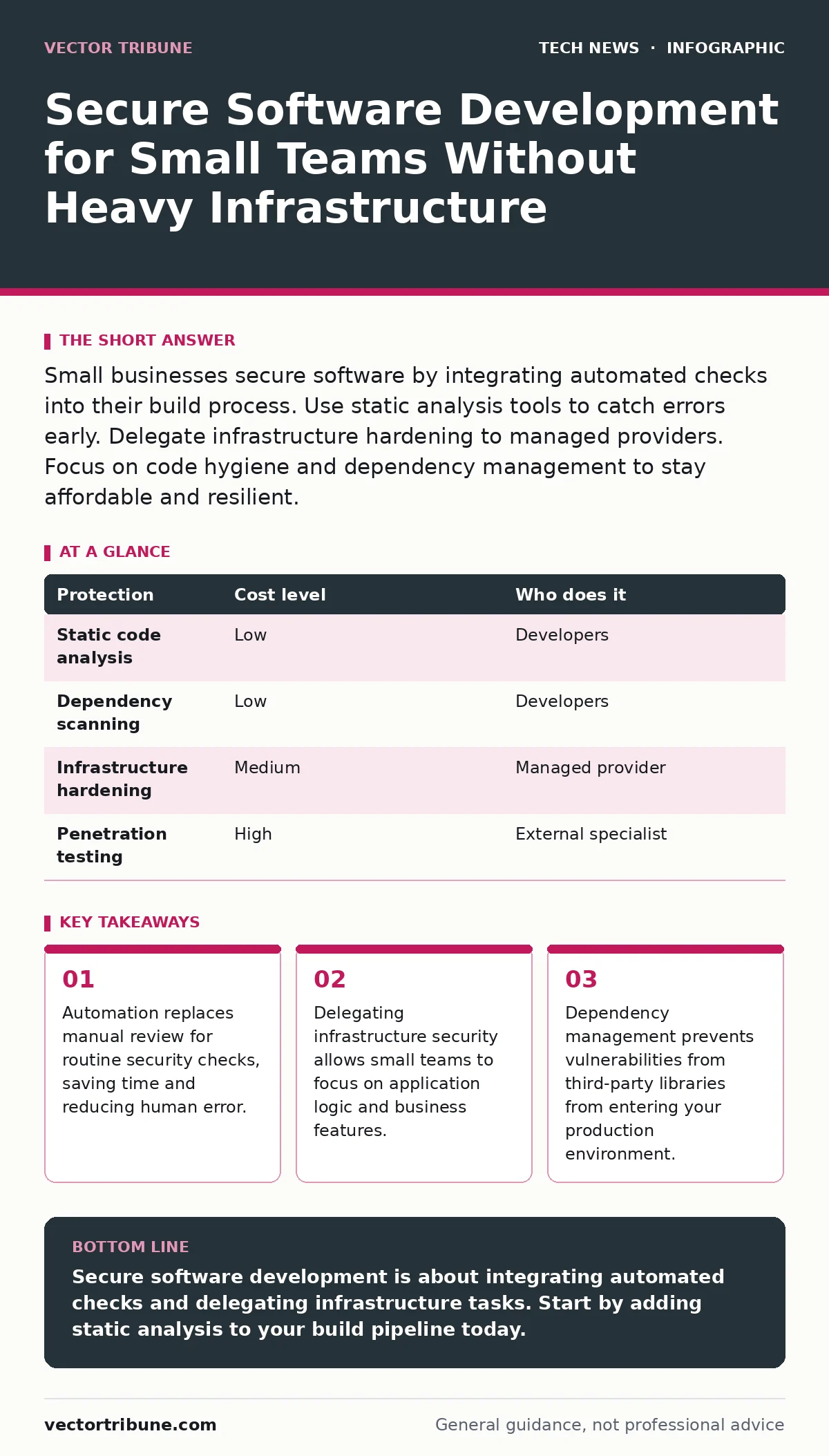
Small businesses secure software by integrating automated checks into their build process. Use static analysis tools to catch errors early. Delegate infrastructure hardening to managed providers. Focus on code hygiene and dependency management to stay affordable and resilient.
The Ten-Person Constraint
Small teams face a unique pressure. You cannot afford a dedicated security engineer. You also cannot ignore security because a single breach can end your business. The solution is not hiring more people. It is changing how you build software. You must treat security as a code quality metric. This shifts the burden from expensive, post-release audits to automated, pre-release checks.
Embedding Checks in the Build Pipeline
The most effective security measure is automation. You integrate tools into your continuous integration pipeline. These tools run every time a developer saves code. They check for common errors like buffer overflows or unescaped inputs. This is called static application security testing. It finds problems before they reach production.
You do not need expensive commercial suites. Open-source tools provide strong baseline protection. They scan your source code for patterns known to cause vulnerabilities. You configure them to fail the build if they find high-severity issues. This forces developers to fix problems immediately. It prevents technical debt from accumulating.
Managing Third-Party Dependencies
Modern applications rely on external libraries. These libraries introduce risk. A vulnerability in a library you use is a vulnerability in your product. This is known as a supply chain risk. You must manage these dependencies carefully.
Use a software composition analysis tool. This tool scans your project for known vulnerabilities in third-party code. It updates you when a fix is available. You should update dependencies frequently. Delaying updates increases the window of exposure. You also reduce the number of libraries you use. Each library is a potential entry point for attackers.
| Protection | Cost level | Who does it |
|---|---|---|
| Static code analysis | Low | Developers |
| Dependency scanning | Low | Developers |
| Infrastructure hardening | Medium | Managed provider |
| Penetration testing | High | External specialist |
Delegating Infrastructure Security
You cannot secure everything. Small teams should focus on what they control: the code. You should delegate the security of the underlying infrastructure. This includes servers, networks, and databases.
Managed service providers handle these tasks. They apply patches, configure firewalls, and monitor for intrusions. You focus on your application logic. This division of labor is efficient. It ensures that experts handle complex infrastructure tasks. You gain enterprise-grade security without hiring a network team.
When evaluating providers, ask specific questions. Do not accept vague promises. You need to know exactly what they do and what they do not do.
- What is your patch management process for operating systems?
- How do you handle incident response and notification?
- Who has access to our production environment?
- How do you secure data in transit and at rest?
The Hidden Cost of Complexity
Security tools add complexity. Each tool requires configuration and maintenance. This is a hidden cost. You must balance security with developer productivity. Too many tools slow down development. They frustrate developers and reduce morale.
Choose tools that integrate smoothly with your existing workflow. Avoid tools that require manual intervention. Automation is key. You want security checks to run in the background. They should provide clear feedback. Developers should know exactly what to fix. This reduces friction and encourages adoption.
Beyond Code: Configuration and Secrets
Security is not just about code. It is also about configuration. Misconfigured services are a common cause of breaches. You must secure your environment variables and secrets. Do not store passwords or API keys in your code repository.
Use a secrets management system. This system stores sensitive data securely. It provides access to applications at runtime. This prevents accidental exposure of credentials. You also ensure that configuration files are validated. Invalid configurations can lead to security gaps.
Reviewing and Refining
Security is an ongoing process. You must review your practices regularly. Technology changes. New threats emerge. Your defenses must evolve.
Conduct periodic reviews of your security posture. Check for new vulnerabilities in your dependencies. Update your tools and configurations. Train your developers on secure coding practices. Knowledge decay is real. Regular training keeps security top of mind.
Integrating Standards Early
You do not need to wait until launch to consider security standards. Integrate them from day one. For example, ensure your application supports HTTPS. This protocol encrypts data in transit. It prevents eavesdropping and tampering.
Consider Secure Boot for your development machines. This feature ensures that only trusted software runs at startup. It protects against firmware-level attacks. While this is a hardware feature, it secures the environment where code is written.
For broader context, see our guide on firewall rules for network-level protection. Also, review network monitoring to detect unusual activity in real-time. These measures complement your application security efforts.
The Role of Human Judgment
Automation is powerful, but it is not perfect. It can miss context-specific issues. Human judgment is still required. You must review critical code changes manually. This is especially true for complex logic or new features.
Encourage a culture of security. Developers should feel empowered to raise concerns. They should not fear retribution for finding bugs. This open communication helps identify issues early. It builds a stronger, more resilient product.
Planning for the Future
Security threats evolve. New techniques emerge. You must stay informed. Follow industry news and security advisories. Participate in developer communities. Share knowledge and learn from others.
Consider post-quantum cryptography for long-term data protection. While quantum computers are not yet a widespread threat, planning for them now is wise. It ensures your data remains secure in the future.
For teams with remote workers, review mobile device security to protect data on phones and tablets. Also, check Windows security settings if your team uses Microsoft devices. These measures protect the endpoints that access your software.
Key takeaways
- Automation replaces manual review for routine security checks, saving time and reducing human error.
- Delegating infrastructure security allows small teams to focus on application logic and business features.
- Dependency management prevents vulnerabilities from third-party libraries from entering your production environment.
Secure software development is about integrating automated checks and delegating infrastructure tasks. Start by adding static analysis to your build pipeline today.
Frequently asked questions
How much does secure software development cost for a small team?
The primary cost is time, not money. Open-source tools are free. The expense comes from developer time spent configuring and maintaining these tools.
Can we outsource all security tasks?
No. You must secure your code and logic. You can outsource infrastructure and network security. Code security requires internal knowledge and control.
What is the first step to secure our software?
Implement static code analysis in your build pipeline. This catches common errors early and builds a habit of security-first development.
Do we need a penetration test?
Not immediately. Focus on automated checks and code hygiene first. Consider penetration testing once your application is stable and widely used.
How this guide was produced: written by the Vector Tribune editorial team with AI assistance, checked against the public references listed below, and reviewed when the facts change. See our editorial policy or report an error.