
Post-Quantum Crypto Mistakes and How to Fix Them
Migrating to post-quantum algorithms often fails because engineers ignore the massive size increase of cryptographic keys and signatures.
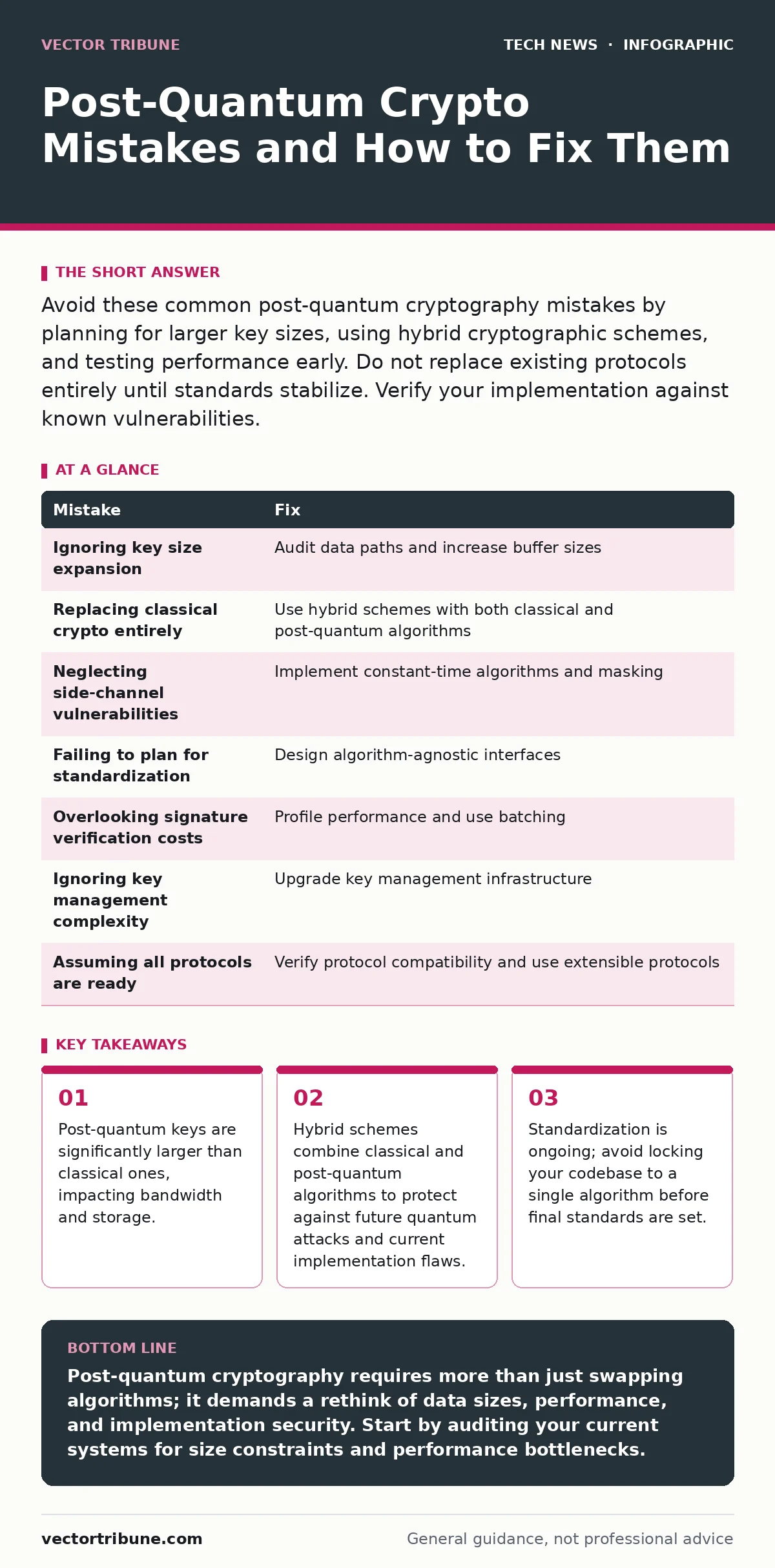
Avoid these common post-quantum cryptography mistakes by planning for larger key sizes, using hybrid cryptographic schemes, and testing performance early. Do not replace existing protocols entirely until standards stabilize. Verify your implementation against known vulnerabilities.
Mistake 1: Ignoring Key and Signature Size Expansion
Post-quantum cryptography algorithms rely on mathematical problems that quantum computers cannot solve efficiently. These problems often require much more data to represent than the elliptic curve or integer factorization problems used today. You might assume that swapping the algorithm is a simple code change, but the data structures grow substantially.
Why it hurts:
The sheer volume of data breaks existing systems. A classical RSA key might be 2,048 bits, while a post-quantum key can exceed 1,000 bytes. This expansion strains network buffers, database columns, and memory allocation. If your application assumes fixed-size headers, it will crash or truncate data.
The fix:
Audit your data paths for size constraints. Increase buffer sizes and verify that your transport layer can handle larger payloads. Consider compression if your protocol allows it, but never compress cryptographic material if it reduces security entropy. Review your secure software development practices to ensure input validation handles these new sizes.
Mistake 2: Replacing Classical Cryptography Entirely
Some engineers view post-quantum cryptography as a direct replacement for current standards. They remove RSA or ECC and install only the new algorithm. This approach assumes the new algorithm is perfect and that no side-channel attacks exist. It also assumes that quantum computers will not break the new math in ways we cannot yet predict.
Why it hurts:
If the post-quantum algorithm has a flaw, your entire system is exposed. Classical algorithms like RSA have been studied for decades. Removing them removes a layer of defense. If an attacker finds a weakness in the new algorithm, there is no fallback. You lose the benefit of decades of cryptanalysis on the classical side.
The fix:
Use a hybrid approach. Combine a classical algorithm with a post-quantum algorithm. The system remains secure as long as at least one of the two algorithms is secure. This strategy protects you against a broken post-quantum algorithm and a future quantum computer. It adds minimal overhead while doubling your security margin.
Mistake 3: Neglecting Side-Channel Vulnerabilities
Side-channel attacks do not break the math; they exploit the physical implementation. Timing variations, power consumption, and electromagnetic leaks can reveal secret keys. Post-quantum algorithms often involve complex polynomial arithmetic or lattice operations. These operations are more sensitive to timing variations than classical algorithms.
Why it hurts:
Your code might be mathematically sound but physically leaky. An attacker can measure how long your device takes to decrypt a message. By analyzing these timing differences, they can reconstruct the private key. This risk is higher in post-quantum cryptography because the operations are more intricate.
The fix:
Implement constant-time algorithms. Ensure that your code takes the same amount of time regardless of the input data. Use masking techniques to hide intermediate values. Test your implementation with side-channel analysis tools. Do not rely on the compiler to optimize away timing leaks; you must enforce constant-time behavior explicitly.
Mistake 4: Failing to Plan for Standardization Changes
The field of post-quantum cryptography is still evolving. New algorithms are being proposed, analyzed, and sometimes discarded. You might choose an algorithm that looks strong today, only to find it weakened by new research tomorrow. Standardization bodies are still finalizing their recommendations.
Why it hurts:
Locking your code to a specific algorithm creates technical debt. If the standard changes, you must rewrite your cryptographic layer. This is expensive and risky. You might also choose an algorithm that is later found to have subtle weaknesses. Your system becomes obsolete before it is even deployed.
The fix:
Design your system to be algorithm-agnostic. Abstract the cryptographic operations behind an interface. This allows you to swap algorithms without rewriting the entire application. Monitor standardization efforts closely. Be prepared to update your implementation when new standards are released. Check network monitoring logs for any anomalies during the transition period.
Mistake 5: Overlooking Signature Verification Costs
Digital signatures are used to verify the authenticity of messages. Post-quantum signatures are often slower to verify than classical signatures. This slowdown can bottleneck high-throughput systems. You might assume that signing is the expensive part, but verification happens much more frequently.
Why it hurts:
Your system becomes slow and unresponsive. Every incoming message requires a costly verification step. This can lead to denial-of-service conditions where attackers flood your system with invalid signatures. The CPU spends most of its time verifying signatures rather than processing legitimate requests.
The fix:
Profile your verification performance early. Use batching techniques to verify multiple signatures at once. Consider offloading verification to hardware accelerators if available. Optimize your code for verification speed, not just signing speed. Ensure your firewall rules can handle the increased traffic load during peak times.
Mistake 6: Ignoring Key Management Complexity
Post-quantum keys are larger and more complex to manage. Generating, storing, and rotating these keys requires more resources. You might assume that your existing key management system can handle them, but it might not. The increased size impacts storage and transmission.
Why it hurts:
Key rotation becomes slower and more error-prone. If you cannot rotate keys frequently, you increase the risk of compromise. Larger keys mean more data to back up and recover. If your key management system is not designed for this, you will face operational failures.
The fix:
Upgrade your key management infrastructure. Ensure it can handle larger key sizes and faster rotation schedules. Automate key generation and distribution to reduce human error. Integrate with existing security frameworks to maintain consistency. Review your Windows security settings to ensure they support the new key formats.
Mistake 7: Assuming All Protocols Are Ready
Not all communication protocols support post-quantum cryptography. Some protocols have fixed message formats or size limits. You might try to insert post-quantum keys into a protocol that cannot accommodate them. This leads to interoperability issues and security gaps.
Why it hurts:
Your system cannot communicate with other systems. If the receiving end does not support the new algorithm, the connection fails. You might be forced to fall back to insecure classical algorithms, defeating the purpose of the upgrade. This fragmentation undermines your security posture.
The fix:
Verify protocol compatibility before implementation. Use protocols that support extensibility, such as TLS with custom extensions. Test interoperability with peers early. If a protocol does not support post-quantum cryptography, consider encapsulating the secure communication within a different layer. Ensure your HTTPS configurations allow for hybrid cipher suites.
| Mistake | Fix |
|---|---|
| Ignoring key size expansion | Audit data paths and increase buffer sizes |
| Replacing classical crypto entirely | Use hybrid schemes with both classical and post-quantum algorithms |
| Neglecting side-channel vulnerabilities | Implement constant-time algorithms and masking |
| Failing to plan for standardization | Design algorithm-agnostic interfaces |
| Overlooking signature verification costs | Profile performance and use batching |
| Ignoring key management complexity | Upgrade key management infrastructure |
| Assuming all protocols are ready | Verify protocol compatibility and use extensible protocols |
Key takeaways
- Post-quantum keys are significantly larger than classical ones, impacting bandwidth and storage.
- Hybrid schemes combine classical and post-quantum algorithms to protect against future quantum attacks and current implementation flaws.
- Standardization is ongoing; avoid locking your codebase to a single algorithm before final standards are set.
Post-quantum cryptography requires more than just swapping algorithms; it demands a rethink of data sizes, performance, and implementation security. Start by auditing your current systems for size constraints and performance bottlenecks.
Frequently asked questions
Can I use post-quantum cryptography on mobile devices?
Yes, but you must account for limited battery and processing power. Use hybrid schemes to balance security and performance. Review **mobile device security** guidelines for optimization.
How do I test for side-channel attacks?
Use specialized hardware and software tools to measure timing and power consumption. Compare results against constant-time baselines.
Should I wait for final standards before migrating?
No. Start planning and abstracting your cryptographic interfaces now. This allows you to adapt quickly when standards are finalized.
What is the biggest risk in post-quantum migration?
Implementation errors. The math is complex, and small mistakes can lead to severe vulnerabilities. Focus on rigorous testing and code review.
How this guide was produced: written by the Vector Tribune editorial team with AI assistance, checked against the public references listed below, and reviewed when the facts change. See our editorial policy or report an error.