
Memory-Safe Languages: 8 Questions Answered for Secure Code
Memory safety eliminates entire classes of vulnerabilities by enforcing access rules at compile time or runtime, preventing attackers from corrupting program state through buffer overflows.
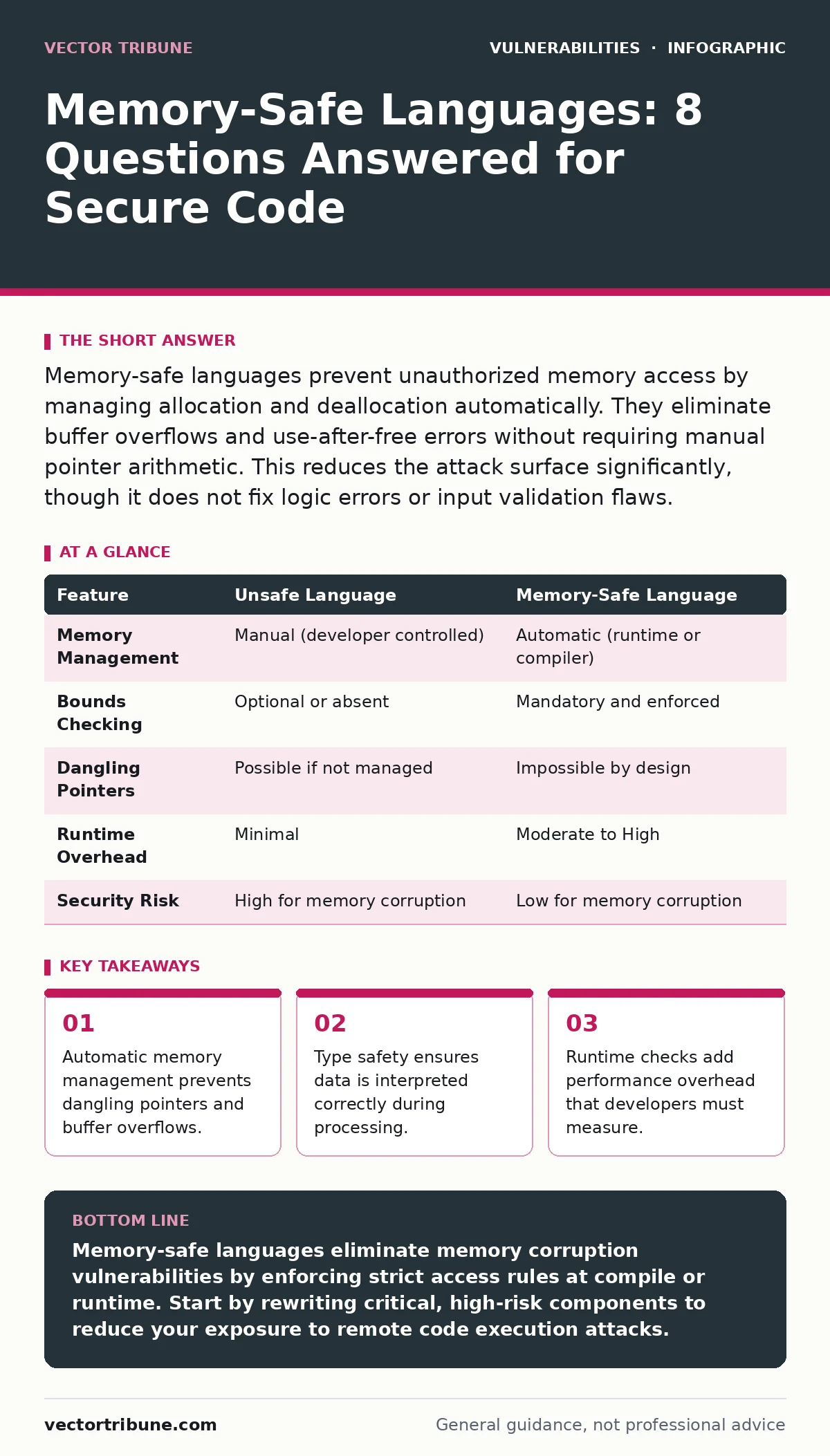
Memory-safe languages prevent unauthorized memory access by managing allocation and deallocation automatically. They eliminate buffer overflows and use-after-free errors without requiring manual pointer arithmetic. This reduces the attack surface significantly, though it does not fix logic errors or input validation flaws.
What defines a memory-safe programming language?
A memory-safe programming language prevents programs from accessing memory locations they are not authorized to read or write. These languages enforce strict boundaries during execution or compilation. They manage memory allocation and deallocation automatically, removing the need for manual pointer management. This structural constraint stops attackers from exploiting memory corruption to execute arbitrary code. The safety guarantee applies to the entire lifecycle of the data object.
How do these languages prevent buffer overflow vulnerabilities?
Buffer overflow vulnerabilities occur when a program writes more data to a buffer than it can hold, overwriting adjacent memory. Memory-safe languages prevent this by tracking the size of every array or buffer. Any attempt to access an index outside the defined bounds triggers an immediate error. The program halts or handles the exception safely instead of corrupting the stack or heap. This mechanism removes the primary vector for many remote code execution vulnerabilities.
What is the performance cost of memory safety?
Memory safety introduces computational overhead because the runtime or compiler must verify access permissions. Bounds checking adds instructions to every array access. Garbage collection pauses execution to reclaim unused memory. These checks consume CPU cycles and can increase latency. Developers must profile their applications to identify bottlenecks. In high-frequency trading or real-time systems, this overhead may be unacceptable, requiring careful optimization or hybrid approaches.
| Feature | Unsafe Language | Memory-Safe Language |
|---|---|---|
| Memory Management | Manual (developer controlled) | Automatic (runtime or compiler) |
| Bounds Checking | Optional or absent | Mandatory and enforced |
| Dangling Pointers | Possible if not managed | Impossible by design |
| Runtime Overhead | Minimal | Moderate to High |
| Security Risk | High for memory corruption | Low for memory corruption |
Does type safety contribute to memory safety?
When a language enforces strong typing, it prevents a pointer from being cast to an unrelated structure. This stops attackers from reinterpreting data structures to gain unauthorized access. Type safety and memory safety work together to maintain program integrity. A type error often indicates a deeper logic flaw that could lead to security issues.
Can memory-safe languages eliminate all software vulnerabilities?
Memory-safe languages cannot eliminate all software vulnerabilities. They specifically address memory corruption issues like use-after-free and double-free errors. They do not protect against logic errors, business logic flaws, or input validation mistakes. An attacker can still exploit improper authentication or injection flaws. You must still validate all external inputs and enforce least privilege. Relying solely on language safety creates a false sense of security.
How do borrow checkers work in Rust?
Borrow checkers analyze code at compile time to ensure references are valid. They track who owns a piece of memory and who is borrowing it. The compiler rejects code where multiple mutable references exist simultaneously. It also ensures that no references outlive the data they point to. This static analysis catches memory errors before the program runs. It provides safety without the runtime cost of garbage collection.
Is garbage collection the only way to achieve safety?
Garbage collection is not the only way to achieve memory safety. Reference counting tracks how many pointers reference an object and frees it when the count reaches zero. Manual verification with static analysis, as seen in Rust, also ensures safety. Each method has trade-offs in performance and complexity. Garbage collection offers simplicity but unpredictable latency. Reference counting offers predictability but requires careful cycle management. Static analysis offers zero runtime cost but stricter coding rules.
How does this impact attack surface management?
Using memory-safe languages significantly reduces the attack surface for memory-based exploits. It removes thousands of potential entry points for attackers. However, the application logic remains exposed. You must still manage your IT asset inventory to track which components use safe languages. Mixing safe and unsafe code creates boundaries that require careful auditing. Unauthenticated remote code execution remains a risk if the application logic is flawed.
What about dependency confusion attacks?
Dependency confusion attacks exploit the way applications retrieve libraries from public registries. Memory-safe languages do not protect against this supply chain threat. Attackers publish malicious packages with names that shadow legitimate internal libraries. The application downloads and executes the malicious code regardless of the language's memory safety features. You must verify package sources and use private registries. Language safety does not replace secure software supply chain practices.
How do zero-day vulnerabilities interact with safe languages?
Zero-day vulnerabilities are unknown flaws that attackers exploit before a patch is available. Memory-safe languages reduce the likelihood of memory-related zero-days. However, logic-based zero-days can still exist. If a new flaw is discovered in the runtime or garbage collector, it may not be covered by the language's safety guarantees. Regular updates and vulnerability disclosure policies remain necessary. Safe languages shift the vulnerability landscape rather than eliminating it.
What should you do next?
Evaluate your current codebase for memory-unsafe components. Identify critical paths where memory corruption would be catastrophic. Consider rewriting these components in a memory-safe language. Start with new development to build familiarity. Measure performance impacts early in the process. Integrate these changes into your broader attack surface management strategy.
Key takeaways
- Automatic memory management prevents dangling pointers and buffer overflows.
- Type safety ensures data is interpreted correctly during processing.
- Runtime checks add performance overhead that developers must measure.
- Safe languages do not replace the need for secure input validation.
Memory-safe languages eliminate memory corruption vulnerabilities by enforcing strict access rules at compile or runtime. Start by rewriting critical, high-risk components to reduce your exposure to remote code execution attacks.
Frequently asked questions
Can I use memory-safe languages for kernel development?
Some memory-safe languages are being adapted for kernel development, but they require significant changes to low-level hardware interactions and driver support.
Does Rust require garbage collection?
No, Rust uses a borrow checker to manage memory at compile time, avoiding the need for a garbage collector and its associated runtime overhead.
Are Python and Java memory-safe?
Yes, both Python and Java are memory-safe languages that use garbage collection to manage memory automatically and prevent manual pointer errors.
How do I audit existing C code for safety?
You can use static analysis tools and sanitizers to detect potential memory errors in existing C code before migrating to a safer language.
How this guide was produced: written by the Vector Tribune editorial team with AI assistance, checked against the public references listed below, and reviewed when the facts change. See our editorial policy or report an error.