
Vulnerability Disclosure Policies: Correcting 6 Common Misunderstandings
Disclosure policies define legal boundaries and communication protocols, not technical fixes or guarantees of immediate remediation for reported security flaws.
Disclosure policies are legal frameworks that define how researchers report flaws and how vendors respond. They do not guarantee fixes, limit liability for all actions, or replace security testing. Misunderstanding these boundaries leads to legal risk, delayed patches, and ineffective coordination between finders and maintainers.
Misreading: The policy guarantees a fix
Correct reading: A vulnerability disclosure policy establishes a communication channel, not a remediation contract. Vendors acknowledge receipt of a report and triage it based on severity and resource constraints. They do not promise to patch every reported issue. Some findings may be deemed acceptable risk, out of scope, or technically infeasible to address without breaking compatibility. You must treat the policy as a legal framework for dialogue, not a service level agreement for code changes.
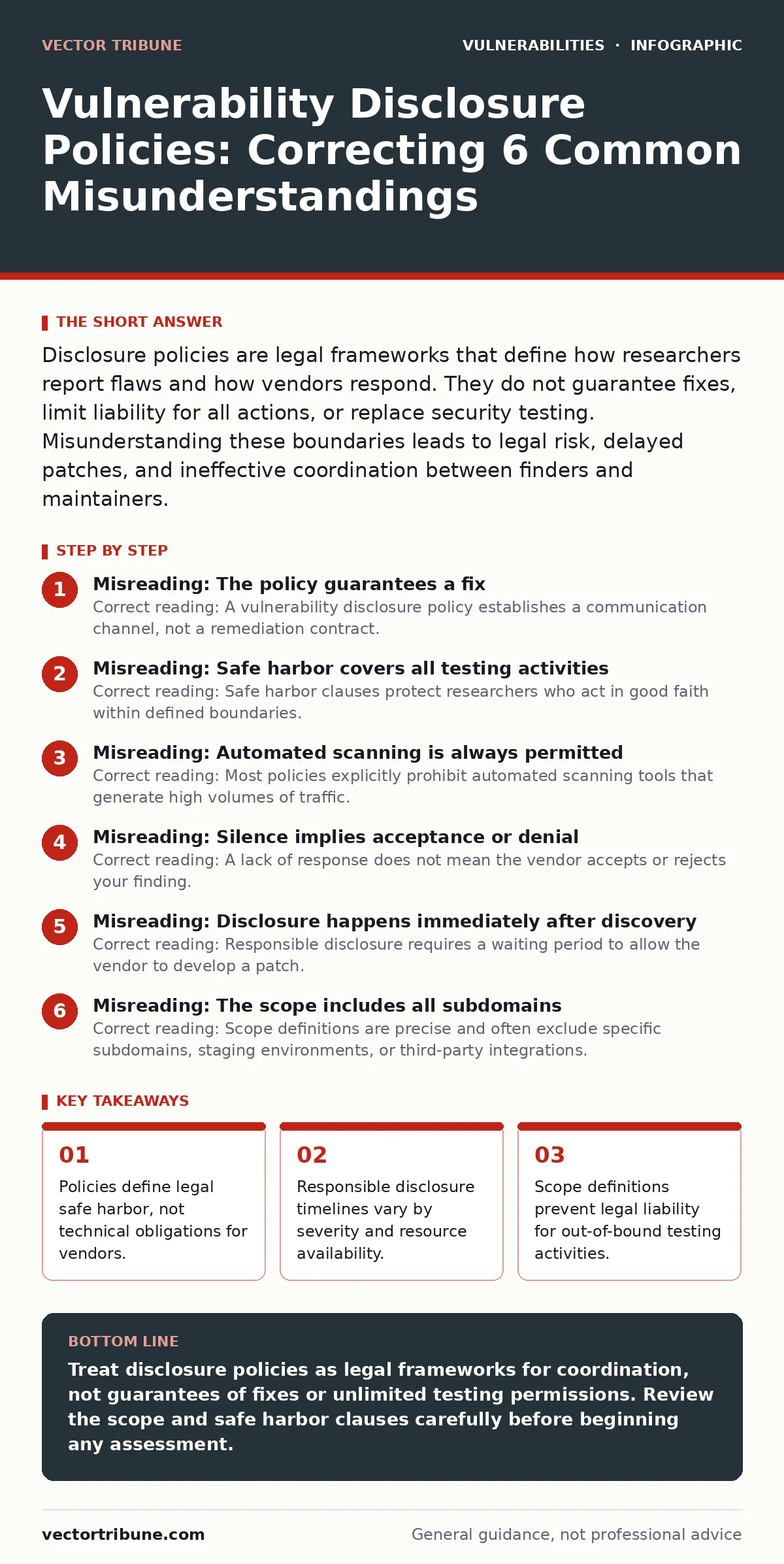
Misreading: Safe harbor covers all testing activities
Correct reading: Safe harbor clauses protect researchers who act in good faith within defined boundaries. They do not shield actions that cause service disruption, data exfiltration, or harm to third parties. Testing must remain non-destructive and confined to the specified scope. Imagine you discover a path to access another user’s data. Extracting that data to prove the bug violates the safe harbor. You must demonstrate the vulnerability conceptually, not by abusing it.
Misreading: Automated scanning is always permitted
Correct reading: Most policies explicitly prohibit automated scanning tools that generate high volumes of traffic. These tools can trigger rate-limiting mechanisms, exhaust server resources, or inadvertently trigger defensive responses that block legitimate users. Manual verification is often required to confirm a finding. Using a scanner against a production environment without explicit written permission breaches the terms of service. You should assume that any automated interaction is forbidden unless the policy states otherwise. This protects the stability of the service you are evaluating.
Misreading: Silence implies acceptance or denial
Correct reading: A lack of response does not mean the vendor accepts or rejects your finding. It often indicates triage bottlenecks, staffing shortages, or internal debate about the severity. Vendors prioritize issues based on exploitability and impact. A complex chain requiring multiple conditions may sit in a queue for months. You should follow up politely after the stated acknowledgment period. Do not assume silence means the bug is closed. Persistent, respectful communication helps keep the issue visible without antagonizing the maintainer.
Misreading: Disclosure happens immediately after discovery
Correct reading: Responsible disclosure requires a waiting period to allow the vendor to develop a patch. Publicly releasing details before a fix is available exposes users to unmitigated risk. This practice is known as full disclosure and is generally discouraged unless the vendor fails to respond within a reasonable timeframe. The standard window ranges from 90 to 120 days. If you release details too early, you may violate the policy and harm the user base. You must balance transparency with the practical reality of software development cycles.
Misreading: The scope includes all subdomains
Correct reading: Scope definitions are precise and often exclude specific subdomains, staging environments, or third-party integrations. Testing outside the defined scope voids the safe harbor protection. A wildcard domain entry like *.example.com may include development servers that are not hardened for public interaction. You must read the scope section carefully. If it lists specific domains, do not test others. If it uses wildcards, verify whether exclusions apply. Misinterpreting scope leads to accidental attacks on unrelated systems and potential legal liability.
Misreading: Severity ratings are objective facts
Correct reading: Severity ratings like CVSS scores are estimates, not absolute truths. Different analysts may assign different scores to the same vulnerability based on their assumptions about the environment. A remote code execution vulnerability might be rated higher than a server-side request forgery (SSRF) issue, but context matters. An SSRF flaw in a cloud environment may lead to credential theft, raising its effective severity. You should provide evidence of impact, not just a score. The vendor will make the final call on priority. Disputing the score rarely changes the outcome.
Misreading: Policies replace security testing
Correct reading: A disclosure policy is not a substitute for rigorous security testing. It is a mechanism for handling findings after they are discovered. Attack surface management requires continuous monitoring and proactive identification of weaknesses. Relying solely on external reporters leaves gaps in your defense. You must integrate disclosure workflows into your broader security strategy. This includes automating triage, tracking remediation progress, and communicating with the community. The policy supports your testing efforts; it does not replace them.
Misreading: Zero-day vulnerabilities are handled differently
Correct reading: The process for reporting zero-day vulnerabilities is the same as for other flaws. The term "zero-day" refers to the lack of a public patch, not a different reporting protocol. Vendors treat these with high priority due to the immediate risk. However, the legal protections and communication steps remain identical. You must still follow the scope and safe harbor rules. Do not assume special treatment or expedited processes exist outside the stated policy. Clarity and adherence to the documented process are your best protections.
Misreading: Liability is fully eliminated
Correct reading: Safe harbor clauses reduce legal risk but do not eliminate it entirely. If your testing causes significant damage, you may still face legal action. The policy is a statement of intent from the vendor, not a court order. It shows that the vendor does not intend to prosecute good-faith researchers. However, laws vary by jurisdiction. You should understand the legal context of your location. The policy provides a layer of protection, but it is not an absolute shield. Prudence and minimal impact are your best defenses.
Misreading: Memory-safe languages eliminate disclosure needs
Correct reading: Using memory-safe programming languages reduces the likelihood of certain vulnerabilities, such as buffer overflows. It does not eliminate all security risks. Logic errors, configuration mistakes, and dependency flaws remain possible. Unauthenticated remote code execution can still occur through insecure APIs or misconfigured services. You must still report these issues. The language choice affects the type of vulnerabilities you find, not the need for a disclosure process. Maintainers still rely on external researchers to find non-memory-related flaws.
Key takeaways
- Policies define legal safe harbor, not technical obligations for vendors.
- Responsible disclosure timelines vary by severity and resource availability.
- Scope definitions prevent legal liability for out-of-bound testing activities.
- Automated scanning often violates terms of service regardless of intent.
Treat disclosure policies as legal frameworks for coordination, not guarantees of fixes or unlimited testing permissions. Review the scope and safe harbor clauses carefully before beginning any assessment.
Frequently asked questions
What if the vendor ignores my report?
Follow up politely after the stated acknowledgment period. If there is still no response after the disclosure window, you may consider public disclosure, but document all attempts to contact the vendor.
Can I test third-party services linked from the target?
No, unless the policy explicitly includes them. Testing third-party services usually voids safe harbor and may violate their own terms of service.
Do I need written permission for every test?
No, if the policy covers the activity. The policy serves as prior permission for testing within the defined scope and guidelines.
What is the difference between a bug bounty and a disclosure policy?
Bug bounties offer financial rewards and often have stricter rules. Disclosure policies focus on legal protection and coordination without monetary compensation.
How this guide was produced: written by the Vector Tribune editorial team with AI assistance, checked against the public references listed below, and reviewed when the facts change. See our editorial policy or report an error.