
Network Monitoring Explained: How to Detect Anomalies Before They Escalate
Passive observation reveals hidden patterns in data flow that active scanning misses, allowing you to distinguish normal operations from malicious activity without altering system behavior.
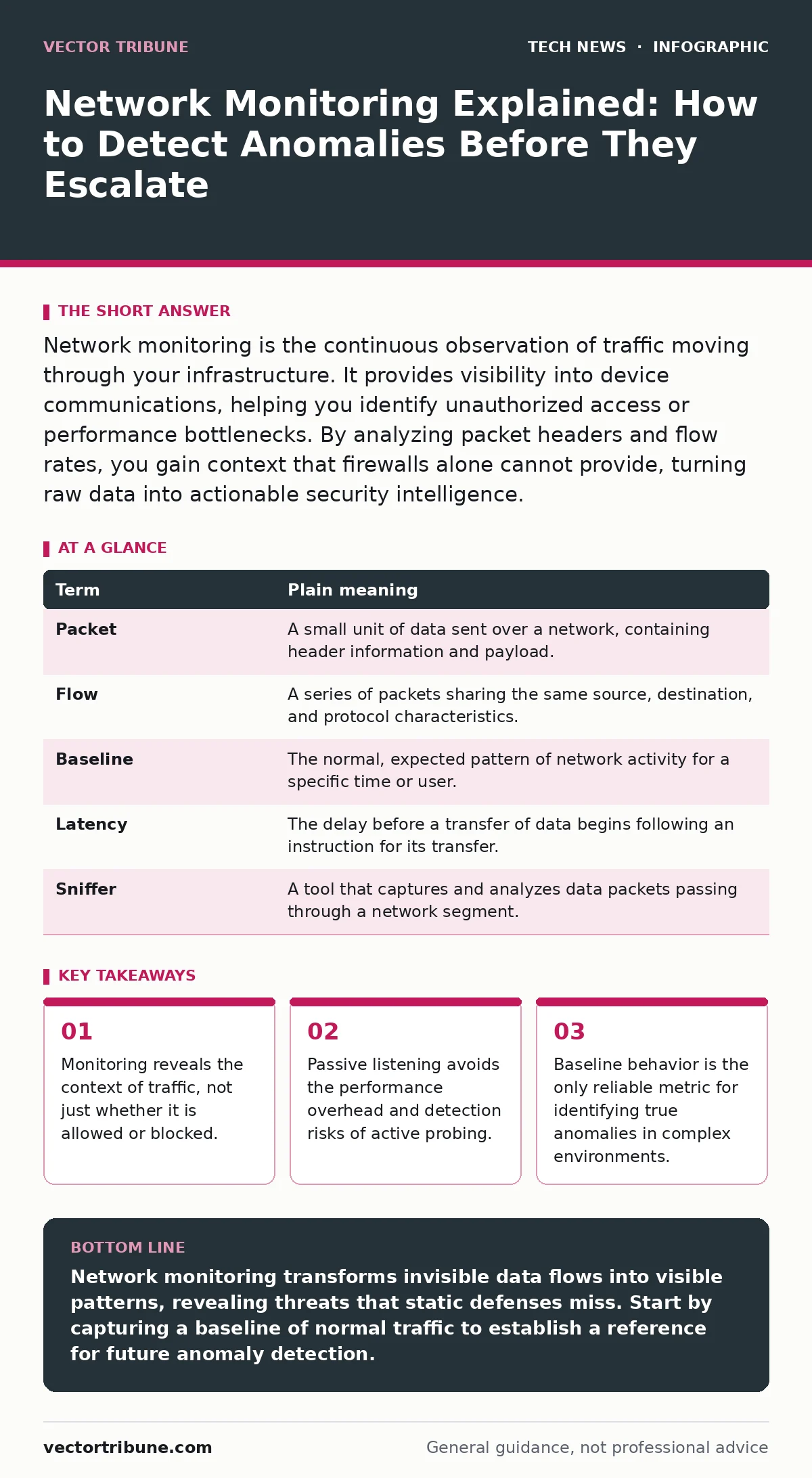
Network monitoring is the continuous observation of traffic moving through your infrastructure. It provides visibility into device communications, helping you identify unauthorized access or performance bottlenecks. By analyzing packet headers and flow rates, you gain context that firewalls alone cannot provide, turning raw data into actionable security intelligence.
The Post Office Analogy
Imagine your network is a busy post office. The firewall is the security guard at the front door. He checks every envelope against a list of banned senders. If the name is on the list, he throws it out. If it is not, he lets it through. He does not read the letters. He does not know if a letter is a bill, a love note, or a threat. He only knows if the sender is allowed to hand over the package.
Now imagine a supervisor standing on a raised platform, watching the sorting belts. She sees that one person is receiving hundreds of letters every minute. She notices the letters are all identical. She sees another person sending heavy boxes to an unknown address at 3:00 AM. The guard at the door saw nothing wrong because the addresses were valid. The supervisor sees the pattern. Network monitoring is that supervisor. It observes the flow, volume, and destination of data to find what the gatekeeper misses.
Defining the Mechanics
To understand what you are watching, you must define what you are looking at. Most beginners confuse monitoring with intrusion detection. Monitoring is the collection of data. Detection is the analysis of that data for threats. You can monitor without detecting, but you cannot detect without monitoring.
| Term | Plain meaning |
|---|---|
| Packet | A small unit of data sent over a network, containing header information and payload. |
| Flow | A series of packets sharing the same source, destination, and protocol characteristics. |
| Baseline | The normal, expected pattern of network activity for a specific time or user. |
| Latency | The delay before a transfer of data begins following an instruction for its transfer. |
| Sniffer | A tool that captures and analyzes data packets passing through a network segment. |
The Hidden Cost of Silence
The most common mistake is assuming that silence means safety. In a well-configured environment, malicious traffic often mimics legitimate behavior. An attacker who compromises a server will not send obvious malware signatures. They will use the server’s existing credentials to exfiltrate data. This traffic looks like normal business operations. It uses standard ports. It respects firewall rules. Without monitoring the volume and timing of these flows, you cannot see the theft.
Establishing a Behavioral Baseline
You cannot identify an anomaly if you do not know what normal looks like. Every network has a rhythm. Morning hours have high email traffic. Backup windows have high disk I/O. A sudden spike in DNS queries at midnight is not inherently bad, but it is different from the baseline. You must record this normal state over weeks. This historical data becomes your reference point. When traffic deviates from this pattern, you investigate. This approach reduces false positives because you are not looking for known bad signatures, but for unknown strange behavior.
The First Practical Step
You do not need expensive hardware to start. Most modern operating systems include tools to capture traffic. The first step is to capture a small sample of traffic on a low-traffic segment. Use a standard packet capture tool to record one minute of activity. Save this file. Do not analyze it yet. This file is your initial baseline. In a week, capture another minute. Compare the two. Look for new destinations or increased packet sizes. This simple comparison teaches you more about your network’s variability than any static rule set.
See also: VLANs in Networking: How Virtual Segments Control Traffic Flow · Operating System Hardening Techniques for Secure Infrastructure
Integrating with Secure Controls
Monitoring provides the context that other security measures lack. For example, firewall rules can block external threats, but they cannot stop an insider from accessing sensitive files. Monitoring reveals the insider’s unusual access patterns. Similarly, understanding secure software development practices helps you anticipate where vulnerabilities might exist, but monitoring tells you if those vulnerabilities are being exploited in real time. You can correlate network spikes with application logs to pinpoint the exact code path being targeted.
Limitations of Visibility
Monitoring is not magic. It cannot see what is encrypted if you do not have the decryption keys. If your organization uses HTTPS for all web traffic, you can see the destination server and the amount of data transferred, but you cannot see the specific URLs or the content within the pages. You must trust the endpoint. If a laptop is compromised, it can encrypt malicious traffic, making it look like normal web browsing to the network monitor. This is why endpoint security and network monitoring must work together. One sees the intent, the other sees the result.
Try This Now
- Identify a non-critical segment of your network, such as a guest Wi-Fi or a development sandbox.
- Use a packet capture tool to record ten minutes of traffic during normal business hours.
- Review the capture to list the top five destination IP addresses and the most common protocols used.
This exercise forces you to look at the raw data. You will likely find services you did not know were communicating. This discovery is the foundation of all effective security operations. You cannot protect what you do not see.
Key takeaways
- Monitoring reveals the context of traffic, not just whether it is allowed or blocked.
- Passive listening avoids the performance overhead and detection risks of active probing.
- Baseline behavior is the only reliable metric for identifying true anomalies in complex environments.
Network monitoring transforms invisible data flows into visible patterns, revealing threats that static defenses miss. Start by capturing a baseline of normal traffic to establish a reference for future anomaly detection.
Frequently asked questions
Does network monitoring slow down my network?
Passive monitoring uses a copy of the traffic, so it does not impact performance. Active scanning can introduce latency and should be scheduled carefully.
Can I monitor encrypted traffic?
You can see metadata like source, destination, and volume. To see content, you need to decrypt traffic at the endpoint or use a man-in-the-middle proxy with proper certificates.
How long should I keep monitoring data?
Keep raw captures for a short period for immediate analysis. Store aggregated flow data for months or years to track long-term behavioral changes and support forensic investigations.
Is monitoring enough to stop an attack?
No. Monitoring detects activity. You need automated response tools or manual intervention to block or mitigate the threat once it is identified.
How this guide was produced: written by the Vector Tribune editorial team with AI assistance, checked against the public references listed below, and reviewed when the facts change. See our editorial policy or report an error.