
Detecting Cryptojacking: Signs, Logs, and Blind Spots
Resource usage spikes often mask themselves as normal workload variance, requiring baseline comparison to reveal unauthorized mining processes hiding in plain sight.
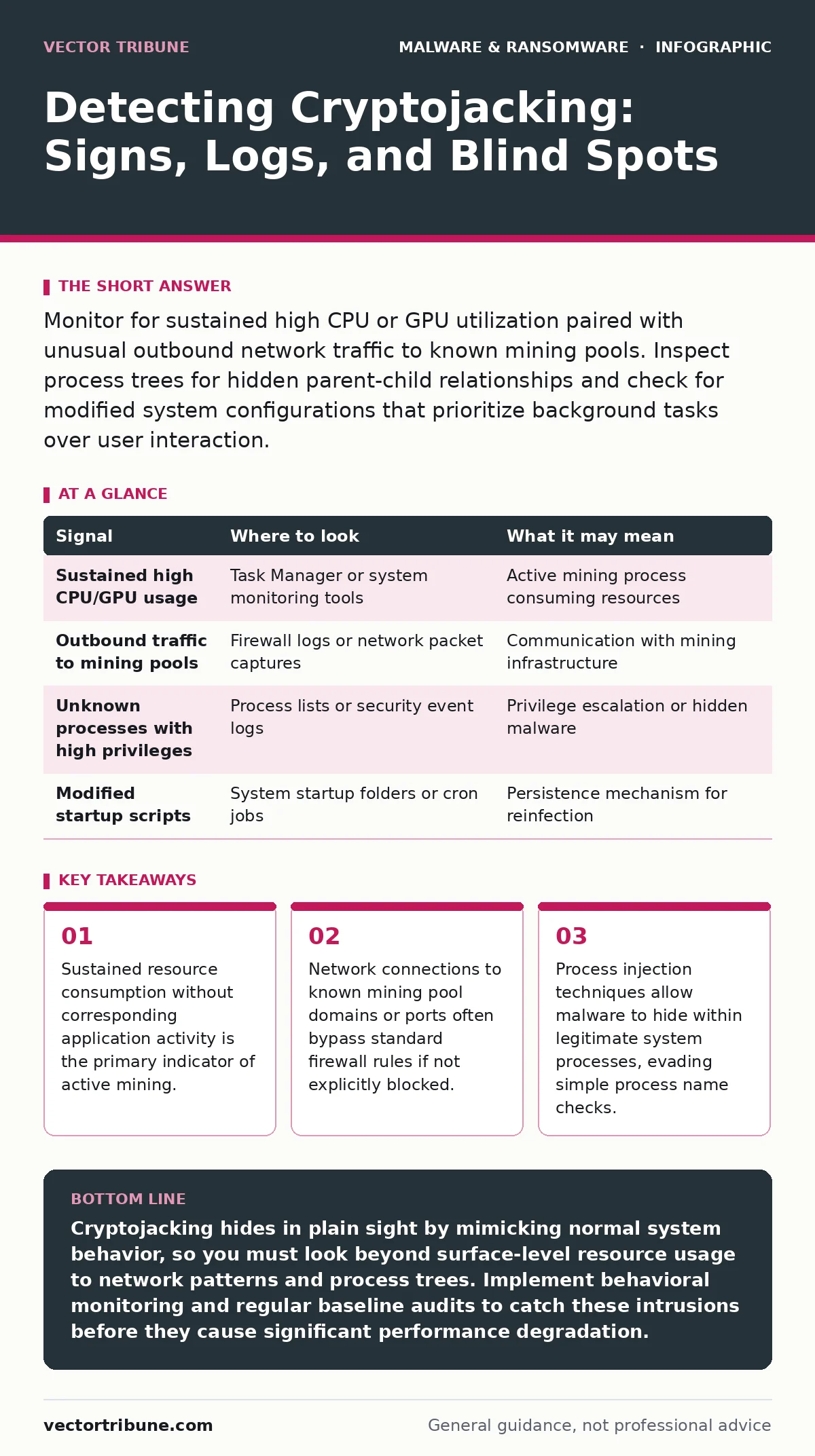
Monitor for sustained high CPU or GPU utilization paired with unusual outbound network traffic to known mining pools. Inspect process trees for hidden parent-child relationships and check for modified system configurations that prioritize background tasks over user interaction.
Resource Anomalies and Baseline Deviation
Cryptojacking software prioritizes computational efficiency over stealth in the short term, creating measurable deviations in system performance. You must establish a baseline for normal resource usage across your environment to detect these anomalies effectively. A sudden spike in CPU or GPU utilization that persists during off-hours or idle periods is a strong indicator of unauthorized activity.
Look for processes that consume significant resources but do not correspond to any known application or service. These processes often run under generic names or mimic system utilities to avoid immediate suspicion. The trade-off for the attacker is that they must balance mining intensity with the risk of detection. If the system becomes too slow for the user, the intrusion will be reported.
Network Traffic Patterns and Mining Pools
Mining requires constant communication with a central server, known as a mining pool, to receive work and submit results. This traffic pattern is distinct from typical user activity or standard business applications. You should inspect outbound connections for traffic directed to known mining pool domains or IP addresses.
Many mining pools operate on standard ports, such as 3333 or 8080, which may not be blocked by default firewall rules. However, the volume and consistency of the traffic often stand out. Look for steady streams of data packets to a single destination over extended periods. This behavior differs significantly from the bursty nature of web browsing or email synchronization.
| Signal | Where to look | What it may mean |
|---|---|---|
| Sustained high CPU/GPU usage | Task Manager or system monitoring tools | Active mining process consuming resources |
| Outbound traffic to mining pools | Firewall logs or network packet captures | Communication with mining infrastructure |
| Unknown processes with high privileges | Process lists or security event logs | Privilege escalation or hidden malware |
| Modified startup scripts | System startup folders or cron jobs | Persistence mechanism for reinfection |
Process Injection and Parent-Child Relationships
Sophisticated cryptojacking malware often uses process injection to hide its activities within legitimate system processes. This technique allows the malware to execute its code within the memory space of a trusted application, such as a web browser or system service. You must examine the parent-child relationships of running processes to identify these anomalies.
A process that should not be spawning child processes, or a child process that does not belong to its parent, is a red flag. For example, a web browser launching a command-line interpreter is unusual and may indicate an attempt to execute a script. This method complicates detection because the process name alone appears legitimate. You need to look deeper into the process tree to spot the irregularity.
Log Analysis and Event Correlation
System logs contain critical evidence of cryptojacking attempts, but the signals are often buried among thousands of normal events. You should focus on logs related to process creation, network connections, and script execution. Look for repeated failed attempts to connect to known mining pools or unusual script activities.
Correlating events across different log sources is essential for confirming an intrusion. A single log entry may be ambiguous, but a pattern of events across system, network, and application logs can reveal the full scope of the attack. Pay attention to timestamps and user accounts involved in these activities. Automated log analysis tools can help highlight these correlations without manual review.
Common Blind Spots in Detection
One major blind spot is the assumption that all high-resource processes are visible in standard task managers. Some mining software uses rootkits or kernel-level drivers to hide their presence from user-mode tools. These techniques require deeper inspection methods, such as memory forensics, to detect.
Another blind spot is the reliance on signature-based detection alone. Cryptojacking malware often changes its code or uses polymorphic techniques to evade signature updates. Behavioral analysis, which looks for suspicious actions rather than specific code signatures, is more effective against these evolving threats. Additionally, many organizations fail to monitor guest or shared devices, which can serve as entry points for cryptojacking scripts.
See also: Network Monitoring Explained: How to Detect Anomalies Before They Escalate
Tools and Techniques for Effective Detection
You need a combination of tools to effectively detect and respond to cryptojacking. Endpoint Detection and Response (EDR) solutions provide visibility into process behavior and can isolate infected systems. However, EDR alone may not catch network-level indicators.
Integrating EDR with extended detection and response (XDR) platforms allows for broader correlation of signals across endpoints, networks, and cloud environments. This holistic view helps identify patterns that single-point solutions might miss. Additionally, regular audits of system configurations and startup scripts can reveal persistence mechanisms that survive reboots or malware removal.
Preventing Future Intrusions
Prevention requires a multi-layered approach that addresses both technical and procedural vulnerabilities. Implementing strict access controls and least-privilege principles reduces the risk of unauthorized script execution. Regular patching of operating systems and applications closes known vulnerabilities that attackers often exploit.
Educating users about the risks of malicious websites and scripts is also critical. Many cryptojacking infections start with a user visiting a compromised website or downloading a malicious file. Incorporating these practices into your disaster recovery plans ensures that you can quickly restore systems and minimize downtime in the event of an intrusion.
Key takeaways
- Sustained resource consumption without corresponding application activity is the primary indicator of active mining.
- Network connections to known mining pool domains or ports often bypass standard firewall rules if not explicitly blocked.
- Process injection techniques allow malware to hide within legitimate system processes, evading simple process name checks.
Cryptojacking hides in plain sight by mimicking normal system behavior, so you must look beyond surface-level resource usage to network patterns and process trees. Implement behavioral monitoring and regular baseline audits to catch these intrusions before they cause significant performance degradation.
Frequently asked questions
Can cryptojacking damage my hardware?
Prolonged high utilization can increase wear on components like CPUs and GPUs, potentially shortening their lifespan, though immediate physical damage is rare.
How do I stop a cryptojacking script in my browser?
Use browser extensions that block known mining scripts and ensure your browser is up to date to patch vulnerabilities that allow script injection.
Is cryptojacking considered malware?
Yes, it is a form of malware because it installs and runs unauthorized software on a system without the user's consent, even if it does not steal data.
Can cryptojacking affect cloud environments?
Yes, attackers can compromise cloud instances and use their resources for mining, leading to unexpected costs and potential service disruptions.
How this guide was produced: written by the Vector Tribune editorial team with AI assistance, checked against the public references listed below, and reviewed when the facts change. See our editorial policy or report an error.