
API Abuse: How Attackers Exploit Digital Interfaces
API abuse bypasses traditional perimeter defenses by exploiting logic flaws and excessive permissions rather than breaking encryption or guessing credentials.
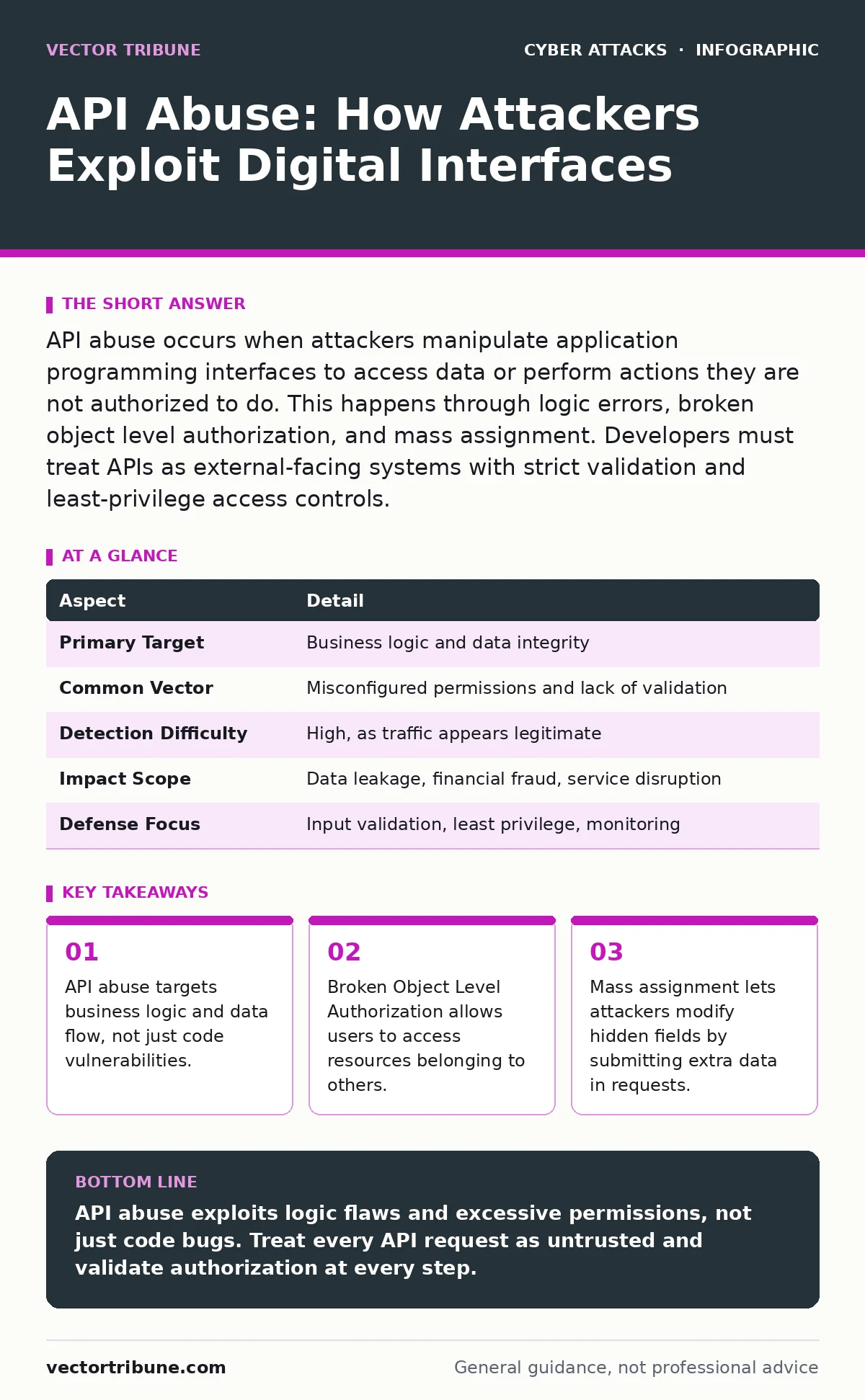
API abuse occurs when attackers manipulate application programming interfaces to access data or perform actions they are not authorized to do. This happens through logic errors, broken object level authorization, and mass assignment. Developers must treat APIs as external-facing systems with strict validation and least-privilege access controls.
The Digital Door Analogy
Imagine a hotel with a secure main entrance. The front desk checks IDs, scans passports, and verifies reservations. This is your traditional web application firewall. Now imagine a service elevator in the back that staff use to move linens and supplies. The elevator has a keycard reader, but the card grants access to every floor because the building manager never updated the permissions after the laundry staff left.
Attackers do not always try to break down the front door. They look for the service elevator. They find an interface that was designed for convenience or internal automation, and they exploit the fact that it lacks the same scrutiny as the public lobby. This is the essence of API abuse. It is not about breaking the lock; it is about walking through a door that was left slightly ajar due to poor design assumptions.
Defining the Threat Surface
An Application Programming Interface, or API, is a set of rules that allows different software systems to communicate. When you check the weather on your phone, an app sends a request to a weather service API, which returns data. APIs are the plumbing of modern software. They connect front-end interfaces to back-end databases, third-party services, and internal microservices.
API abuse refers to the exploitation of these interfaces to perform unauthorized actions or access sensitive data. Unlike traditional hacking, which might involve injecting malicious code into a website, API abuse often uses the API exactly as intended, but in ways the developer did not anticipate. The attacker follows the protocol correctly but violates the business logic. This makes detection difficult because the traffic looks legitimate to standard security tools.
| Aspect | Detail |
|---|---|
| Primary Target | Business logic and data integrity |
| Common Vector | Misconfigured permissions and lack of validation |
| Detection Difficulty | High, as traffic appears legitimate |
| Impact Scope | Data leakage, financial fraud, service disruption |
| Defense Focus | Input validation, least privilege, monitoring |
How the Exploitation Occurs
The core issue is that APIs are often built for speed and functionality, not security. Developers assume that the client application will only send valid requests. They forget that a determined user can intercept that request, modify it, and send it directly to the server. This is where the abstraction layer fails. The server receives a request that looks syntactically correct but semantically malicious.
For example, an API endpoint might accept a user ID to retrieve a profile. The developer assumes the user ID will belong to the logged-in user. An attacker changes the user ID in the request to that of an administrator. If the API does not verify that the requester owns that ID, it returns the admin’s data. This is not a bug in the code syntax; it is a flaw in the authorization logic. The API is doing exactly what it was told to do, which is the problem.
Common Forms of API Abuse
Broken Object Level Authorization is the most prevalent form. It occurs when an API exposes an object identifier, such as a document ID or account number, and does not verify that the user has permission to access it. This is often called Insecure Direct Object Reference. It is a simple oversight that leads to massive data exposure.
Mass Assignment is another common vector. Many APIs accept JSON or XML payloads to update user profiles. If the API blindly maps all fields in the payload to the database, an attacker can add extra fields like "isAdmin" or "balance" and set them to true or a high number. The server updates the database based on the input, granting the attacker elevated privileges or funds they do not own.
Excessive Data Exposure happens when an API returns more data than the client needs. For instance, a request for a user’s name might return the entire user object, including social security numbers or internal notes. The front-end interface hides this data, but the API transmits it. An attacker simply reads the raw response to harvest sensitive information.
Business Logic Abuse is harder to detect. It involves manipulating the sequence of operations. An attacker might exploit a race condition by sending multiple requests simultaneously to bypass inventory checks, allowing them to purchase more items than are in stock. Or they might manipulate pricing parameters during checkout. These attacks look like normal usage patterns, making them nearly invisible to standard intrusion detection systems.
Who Is Affected
Every organization that exposes an API is at risk. This includes e-commerce platforms, financial services, healthcare providers, and even small startups. The impact varies. For a consumer app, API abuse might lead to account takeover or identity theft. For a financial institution, it can result in direct monetary loss through fraudulent transactions.
Developers are the primary point of failure, not because they are careless, but because security is often an afterthought in the development lifecycle. The pressure to release features quickly leads to shortcuts in validation and authorization. Operations teams also suffer, as they must monitor complex traffic patterns to identify anomalies. The cost of remediation is high because fixing API logic often requires architectural changes, not just a patch.
See also: Post-Quantum Crypto Mistakes and How to Fix Them
What People Usually Get Wrong
A common misconception is that authentication is enough. Developers often implement OAuth or JWT tokens to verify who the user is, assuming this prevents abuse. Authentication confirms identity, but it does not define permission. Just because a user is logged in does not mean they should have access to every endpoint or every resource. Authorization must be checked at every single request, not just at login.
Another mistake is relying on obscurity. Hiding API endpoints or using complex naming conventions does not stop attackers. Tools can scan for common patterns, and documentation leaks are frequent. Security through obscurity fails when the underlying logic is flawed. If the API allows mass assignment, hiding the endpoint only delays the inevitable discovery.
Finally, many believe that traditional web application firewalls protect APIs. These tools are designed to stop SQL injection and cross-site scripting. They do not understand business logic. They cannot tell the difference between a legitimate request to update a profile and a malicious request to change account ownership. You need specialized API security testing and monitoring, not just a generic firewall.
Reducing the Risk
Start with the principle of least privilege. Every API endpoint should require the minimum permissions necessary to function. Do not grant read access if only write access is needed, and vice versa. Implement strict input validation on the server side. Never trust data from the client. Validate data types, lengths, and formats before processing.
Use rate limiting to prevent abuse. If an endpoint is called too frequently, block the request. This mitigates brute force attacks and some forms of business logic abuse. Monitor API traffic for anomalies. Look for unusual patterns, such as a single user accessing many different resource IDs or requests coming from unexpected geographic locations.
Regular security testing is non-negotiable. Static analysis tools can find some issues, but dynamic testing and penetration testing are required to uncover logic flaws. Developers should be trained to think like attackers. They should ask, "What happens if I change this ID?" or "What if I add this field?" This mindset shift is critical.
Consider related threats when designing your defenses. For instance, phishing can steal the credentials used to access APIs, making strong authentication like passkeys more valuable. Similarly, social engineering can trick employees into exposing API keys, which is why privileged access management is necessary for internal tools. Understanding the broader context helps you build a more resilient system.
Key takeaways
- API abuse targets business logic and data flow, not just code vulnerabilities.
- Broken Object Level Authorization allows users to access resources belonging to others.
- Mass assignment lets attackers modify hidden fields by submitting extra data in requests.
- Rate limiting and proper authentication are necessary but insufficient defenses.
API abuse exploits logic flaws and excessive permissions, not just code bugs. Treat every API request as untrusted and validate authorization at every step.
Frequently asked questions
Is API abuse the same as hacking?
API abuse is a specific type of hacking that exploits the intended functionality of an interface rather than breaking into the system through code vulnerabilities like SQL injection.
Can I stop API abuse with a firewall?
A traditional firewall cannot stop API abuse because it does not understand business logic. You need specialized API security tools and rigorous code testing.
What is the biggest mistake developers make?
The biggest mistake is assuming that authentication equals authorization. Just because a user is logged in does not mean they should have access to every resource.
How do I know if my API is secure?
You know your API is secure if it has undergone rigorous penetration testing, implements least-privilege access, and validates all inputs on the server side.
How this guide was produced: written by the Vector Tribune editorial team with AI assistance, checked against the public references listed below, and reviewed when the facts change. See our editorial policy or report an error.