
Security Bulletins: How to Read Them Without Misinterpreting Risk
Bulletins describe technical flaws, not immediate threats, and treating them as urgent alerts creates noise that hides genuine risks in your infrastructure.
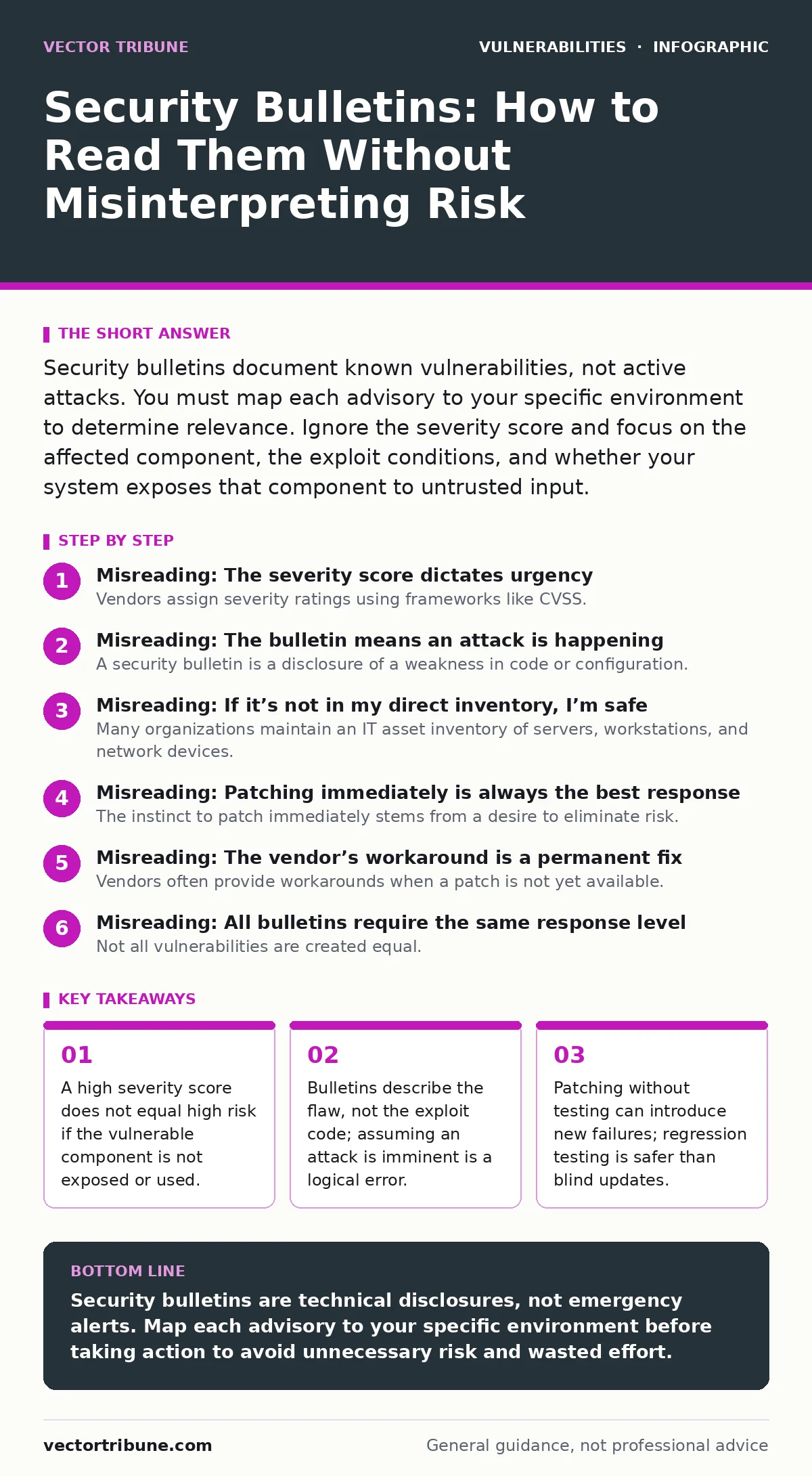
Security bulletins document known vulnerabilities, not active attacks. You must map each advisory to your specific environment to determine relevance. Ignore the severity score and focus on the affected component, the exploit conditions, and whether your system exposes that component to untrusted input.
Misreading: The severity score dictates urgency
Vendors assign severity ratings using frameworks like CVSS. These scores measure the theoretical maximum impact if an attacker exploits the flaw under ideal conditions. They do not account for your network topology, access controls, or the presence of compensating controls. A score of 9.8 suggests a severe flaw, but it does not mean your server is under attack.
Correct reading: Treat the score as a technical descriptor, not a timeline. Evaluate the exploit complexity and required privileges. If the vulnerability requires physical access or local admin rights, the immediate risk to your remote services is low, regardless of the score.
Misreading: The bulletin means an attack is happening
A security bulletin is a disclosure of a weakness in code or configuration. It is not a report of active exploitation. Reading a bulletin often triggers a panic response because the brain associates "vulnerability" with "breach." This association leads to rushed decisions, such as applying patches during peak business hours without adequate testing.
Correct reading: View the bulletin as a notification of a potential entry point. Attackers may use these disclosures to find targets, but the disclosure itself is passive. Your response should be measured assessment, not reactive firefighting. This distinction prevents burnout and allows for proper security regression testing before changes go live.
Misreading: If it’s not in my direct inventory, I’m safe
Many organizations maintain an IT asset inventory of servers, workstations, and network devices. This list is often incomplete regarding software libraries and dependencies. You might believe you are safe because your web server is not the vulnerable product. However, your application likely relies on third-party libraries that contain the flaw.
Correct reading: You must map the vulnerable component to your entire software supply chain. This includes client-side scripts, server-side frameworks, and database drivers. If you do not track these dependencies, you remain blind to risks like server-side request forgery (SSRF) or server-side template injection that originate from updated libraries.
Misreading: Patching immediately is always the best response
The instinct to patch immediately stems from a desire to eliminate risk. However, patches are complex code changes that can introduce new bugs or break existing functionality. Applying a patch without understanding its impact can cause service outages or create new security regression testing failures. The cost of a broken system often exceeds the cost of a theoretical vulnerability.
Correct reading: Assess the exploitability first. If the vulnerability requires specific conditions that do not exist in your environment, you can delay patching. Use virtual patching or network segmentation to mitigate the risk temporarily. This allows you to test the update in a staging environment, ensuring stability before production deployment.
Misreading: The vendor’s workaround is a permanent fix
Vendors often provide workarounds when a patch is not yet available. These workarounds might involve disabling a feature, changing a configuration setting, or filtering traffic. They are temporary measures designed to reduce exposure until a proper code fix is released. Treating a workaround as a final solution leads to technical debt and reduced functionality.
Correct reading: Document every workaround as a temporary control. Set a reminder to review the workaround when the official patch is released. Workarounds often bypass security features or reduce performance. For example, disabling a specific API endpoint might stop an attack but also break legitimate integrations. Monitor for the official patch and plan for its integration.
Misreading: All bulletins require the same response level
Not all vulnerabilities are created equal. Some allow remote code execution vulnerabilities that compromise the entire system, while others only leak non-sensitive information. Treating every bulletin with the same intensity wastes resources. You must differentiate between critical infrastructure components and isolated, low-impact systems.
Correct reading: Prioritize based on exposure and impact. A vulnerability in a public-facing API is more urgent than one in an internal logging tool. Consider the sensitivity of the data processed by the affected component. Use privileged access management principles to limit the damage if a low-priority vulnerability is eventually exploited. This triage approach ensures you address the most dangerous flaws first.
Misreading: The bulletin covers all related products
Vendors often release bulletins for specific products or versions. They may not mention related products that share the same underlying code. Assuming a bulletin covers all your software from that vendor can leave gaps. You must verify the scope of the advisory against your entire stack.
Correct reading: Check the "Affected Products" section carefully. Look for shared libraries or frameworks that might be used by other applications. If your organization uses email aliases for system notifications, ensure the bulletin covers the mail server software, not just the client application. Cross-referencing documentation helps identify hidden dependencies.
Misreading: The bulletin is the final word on the issue
Security bulletins are often initial disclosures. Additional details, such as proof-of-concept code or updated mitigation strategies, may emerge later. Relying solely on the initial bulletin can lead to incomplete mitigation. The security community often discusses edge cases and bypass techniques after the initial release.
Correct reading: Monitor for updates to the bulletin. Security researchers may find ways to bypass the recommended workaround. Engage with technical communities to understand the real-world exploitability. However, be cautious of unverified claims. Stick to established knowledge and avoid speculation.
Misreading: Ignoring the disclosure timeline
Bulletins are released on a schedule, often coordinated with vendors. The timing of the release can influence the availability of patches and exploit code. Ignoring the timeline can lead to missing the window for safe patching. You must understand the disclosure process to plan your response effectively.
Correct reading: Note the release date and the expected patch availability. If the patch is not yet available, implement compensating controls. This proactive approach reduces the window of exposure.
Misreading: Assuming all users need to see the bulletin
Security bulletins are technical documents. Sharing them with all employees can cause unnecessary alarm and confusion. Only those responsible for maintaining the affected systems need to understand the details. General staff should be aware of the existence of the vulnerability but not its technical specifics.
Correct reading: Distribute bulletins based on role. System administrators and developers need the full technical details. End users need a simplified notification about potential impacts and required actions, such as restarting their computers. This targeted communication prevents panic and ensures the right people take the right actions.
Misreading: Forgetting to document the response
After addressing a bulletin, you must document the actions taken. This documentation is critical for audits and future reference. Without it, you cannot prove that you addressed the risk. It also helps in understanding the effectiveness of your mitigation strategies.
Correct reading: Record the bulletin ID, the affected systems, the actions taken, and the outcome. Store this information in your security management system. This practice ensures accountability and provides a history of your security posture. It also helps in identifying trends and recurring issues.
Key takeaways
- A high severity score does not equal high risk if the vulnerable component is not exposed or used.
- Bulletins describe the flaw, not the exploit code; assuming an attack is imminent is a logical error.
- Patching without testing can introduce new failures; regression testing is safer than blind updates.
- Supply chain dependencies often hide vulnerabilities that direct asset inventories miss.
Security bulletins are technical disclosures, not emergency alerts. Map each advisory to your specific environment before taking action to avoid unnecessary risk and wasted effort.
Frequently asked questions
How do I know if a vulnerability affects my system?
Compare the affected component and version listed in the bulletin with your current software inventory. If your system runs the affected version and exposes the vulnerable component, you are at risk.
Should I patch everything immediately?
No. Assess the exploitability and impact first. If the risk is low or the patch is untested, implement compensating controls and schedule the patch for a later date.
What if the vendor says the vulnerability is not exploitable?
Verify the claim against your specific configuration. Vendors may not test every scenario. If you are unsure, implement additional monitoring or controls to detect potential exploitation.
How often should I review security bulletins?
Review them regularly, at least weekly, or set up automated alerts for critical vulnerabilities affecting your core systems. Consistent review ensures timely response to new threats.
How this guide was produced: written by the Vector Tribune editorial team with AI assistance, checked against the public references listed below, and reviewed when the facts change. See our editorial policy or report an error.