
Difference Between Pseudonymization and Anonymization Explained
Pseudonymization keeps data personal by design, while anonymization destroys the link to identity. You must know which one you are using to avoid regulatory penalties.
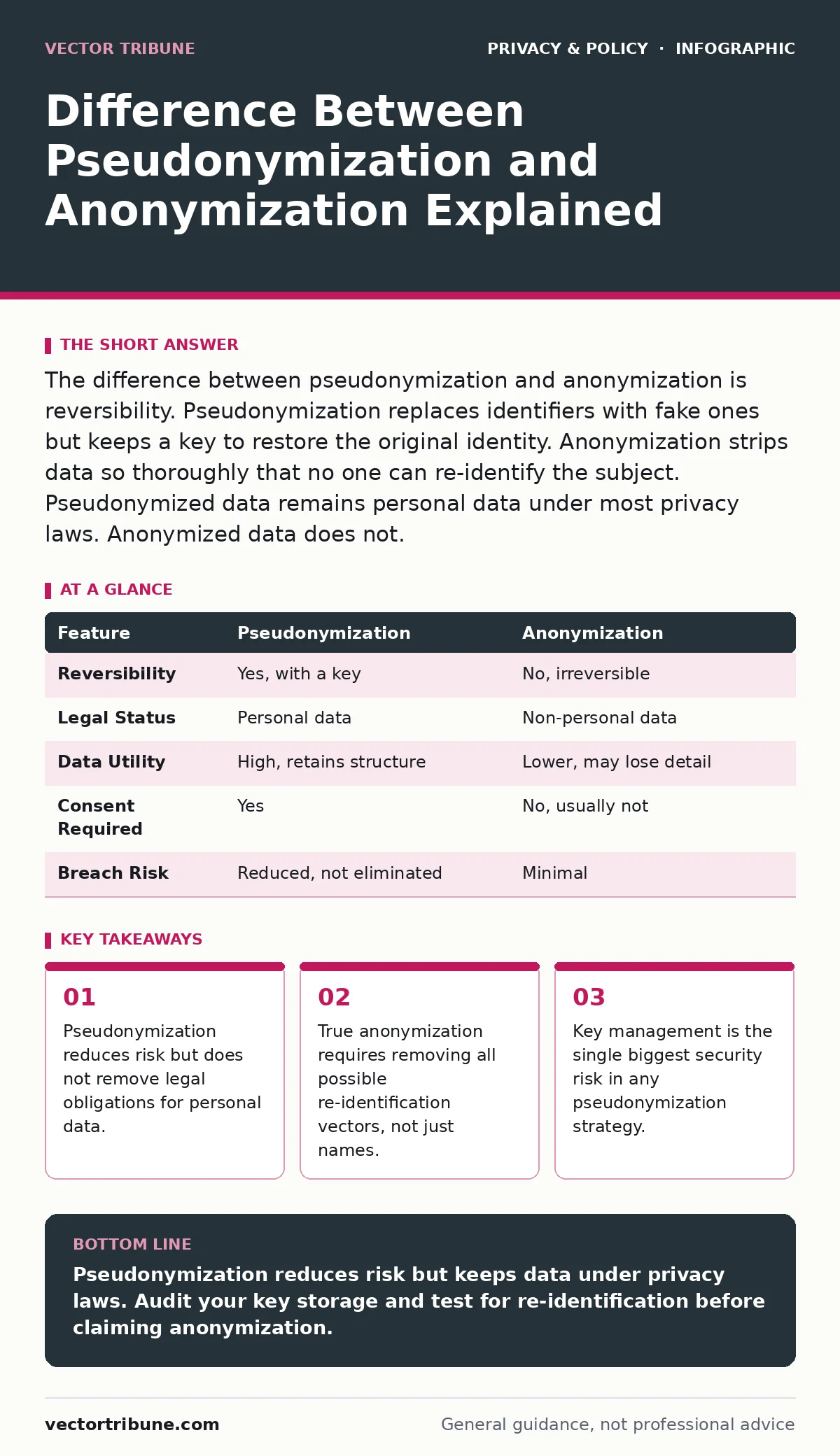
The difference between pseudonymization and anonymization is reversibility. Pseudonymization replaces identifiers with fake ones but keeps a key to restore the original identity. Anonymization strips data so thoroughly that no one can re-identify the subject. Pseudonymized data remains personal data under most privacy laws. Anonymized data does not.
What is the difference between pseudonymization and anonymization?
The difference between pseudonymization and anonymization lies in whether the original identity can be restored. Pseudonymization substitutes identifying fields with artificial identifiers, such as random tokens. This process keeps the data usable for analysis while hiding the direct link to a person. The link remains recoverable if you possess the separate key. Anonymization destroys that link entirely. Once data is truly anonymized, no amount of computing power or external information can reconnect it to a specific individual. This distinction determines your legal exposure.
Does pseudonymization make data anonymous?
No, pseudonymization does not make data anonymous. It creates a layer of indirection. You replace a direct identifier, like a social security number, with a pseudonym, like "User-789". The data remains personal data because the pseudonym can be mapped back to the person. Legal frameworks treat pseudonymized data with the same strictness as raw personal data. You must still obtain consent, honor deletion requests, and report breaches. The only change is the reduced risk of exposure if an attacker steals the database without the key.
How does true anonymization work in practice?
True anonymization requires removing or distorting data until re-identification is impossible. Simple methods like removing names fail because other fields often combine to identify someone. You must apply techniques like k-anonymity, which ensures every record is indistinguishable from at least k-1 others. Differential privacy adds mathematical noise to query results, protecting individuals while preserving statistical accuracy. Generalization replaces exact values with ranges, such as changing age 32 to "30-40". These methods degrade data utility. You trade precision for privacy.
Why is key management the hidden cost?
The key that maps pseudonyms to identities is your most valuable asset. If you lose it, the data becomes useless for its intended purpose. If an attacker steals it, the pseudonymization fails completely. This creates a high-stakes custody problem. You must store keys separately from the pseudonymized data. Access to keys should be logged, restricted, and rotated. Many organizations fail here by storing keys in the same database or using weak encryption for the key store. This single point of failure undermines the entire privacy strategy.
| Feature | Pseudonymization | Anonymization |
|---|---|---|
| Reversibility | Yes, with a key | No, irreversible |
| Legal Status | Personal data | Non-personal data |
| Data Utility | High, retains structure | Lower, may lose detail |
| Consent Required | Yes | No, usually not |
| Breach Risk | Reduced, not eliminated | Minimal |
When does pseudonymization fail to protect users?
Pseudonymization fails when the pseudonym itself becomes an identifier. Suppose you use a user’s email address hash as a pseudonym. If an attacker obtains a list of email hashes from another breach, they can cross-reference them. This is a linkage attack. It reveals the identity without ever seeing the raw email. Static pseudonyms are dangerous because they persist across datasets. Dynamic pseudonyms, which change frequently, are safer but harder to implement in systems that require consistent user tracking.
How do privacy laws for small businesses treat this data?
Most modern regulations, including GDPR and CCPA, classify pseudonymized data as personal data. This means you cannot claim exemption from compliance simply because you replaced names with IDs. You must still provide transparency, allow data subject requests, and implement appropriate security measures. The burden of proof for anonymization is high. Regulators often challenge organizations that claim data is anonymous when residual linkage risks exist. Pseudonymization is a security measure, not a legal loophole.
What is the impact on data utility and analytics?
Anonymization often destroys the value of data for machine learning or detailed analysis. Removing or generalizing fields can break correlations that models rely on. Pseudonymization preserves the structure of the data, allowing for long-term user behavior analysis. This is why many companies prefer pseudonymization despite the regulatory burden. It balances utility with risk reduction. However, you must ensure that the pseudonymization scheme does not leak information through patterns. Sequential IDs or predictable tokens can reveal user volume or activity frequency.
How does this relate to browser cookies?
Browser cookies often act as pseudonyms. A session ID links a user’s actions across pages. If that ID is tied to a login, it is a direct identifier. If it is a random string with no account link, it is a pseudonym. Third-party tracking cookies aggregate these pseudonyms across sites, creating a detailed profile. This profile can often be re-identified by combining it with other public data. Regulations increasingly target this practice. Blocking or restricting cookies is a form of preventing unauthorized pseudonymization.
Can you reverse anonymization later?
No, you cannot reverse true anonymization. The process is designed to be one-way. If you need to link data back to a user later, you have not anonymized it; you have pseudonymized it. This is a common mistake in data engineering. Teams often label data as "anonymous" because they have forgotten the key, not because the link is destroyed. If the key exists anywhere, even in a backup or a developer’s notes, the data is pseudonymized. You must document the destruction of the key to claim anonymization.
What about end-to-end encryption in this context?
End-to-end encryption protects data in transit and at rest, but it does not anonymize it. The sender and receiver are known to the service provider, even if the content is hidden. Encryption is a confidentiality measure, not a privacy measure in the sense of identity removal. Pseudonymization often sits alongside encryption. You encrypt the database and pseudonymize the fields within it. This adds layers of defense. An attacker must break the encryption and steal the key to re-identify users.
How do children's privacy laws affect pseudonymization?
Children's privacy laws, such as COPPA in the US, impose stricter controls on data collection. Pseudonymization does not exempt you from parental consent requirements. You must still verify age and obtain permission. However, pseudonymization can reduce the harm of a breach involving children’s data. It prevents immediate exposure of names and locations. It is a safety net, not a permission slip. Always default to collecting the minimum data necessary. Pseudonymize what you must keep, and delete what you do not need.
Key takeaways
- Pseudonymization reduces risk but does not remove legal obligations for personal data.
- True anonymization requires removing all possible re-identification vectors, not just names.
- Key management is the single biggest security risk in any pseudonymization strategy.
Pseudonymization reduces risk but keeps data under privacy laws. Audit your key storage and test for re-identification before claiming anonymization.
Frequently asked questions
Is hashing a password considered pseudonymization?
No, hashing a password is a security measure for authentication. Pseudonymization applies to data fields used for identification or analysis, not secrets used for access control.
Can I use pseudonymized data for marketing without consent?
Generally, no. Pseudonymized data is still personal data. You need a lawful basis, such as consent or legitimate interest, to process it for marketing.
How often should I rotate pseudonymization keys?
Rotate keys regularly, especially if the data is high-risk. The frequency depends on your threat model, but annual rotation is a common baseline for sensitive data.
Does deleting the key make pseudonymized data anonymous?
Only if no other copy of the key exists. If backups, logs, or employees retain the key, the data remains pseudonymized and subject to privacy laws.
How this guide was produced: written by the Vector Tribune editorial team with AI assistance, checked against the public references listed below, and reviewed when the facts change. See our editorial policy or report an error.