
Children’s Privacy Laws: Answers to Your Most Pressing Questions
Compliance requires more than age gates; it demands a fundamental redesign of data collection architectures to prevent tracking before consent occurs.
Children’s privacy laws restrict data collection from minors, often banning targeted advertising and requiring parental consent. Developers must implement age verification, minimize data retention, and design systems that default to high privacy settings. Compliance varies by jurisdiction but generally prohibits profiling based on behavioral tracking.
What constitutes a child under privacy regulations?
Regulations typically define a child as an individual under the age of thirteen in the United States, while other jurisdictions may set the threshold at sixteen or eighteen. This discrepancy creates a compliance burden for global services, as you must adhere to the strictest standard applicable to your user base. You cannot assume a user is an adult based on self-reported age without verification mechanisms. The definition drives the entire compliance framework, dictating what data you can collect and how you process it.
Is parental consent required for all data collection?
Yes, verifiable parental consent is mandatory before collecting, using, or disclosing personal information from children under the statutory age limit. This consent must be informed, meaning parents receive clear notice of what data is collected and why. Simple acknowledgment of terms of service is insufficient; you must implement a mechanism that confirms the consenting party is indeed the parent or guardian. This requirement applies even if the data is used for internal analytics or service improvement.
How do I verify a user’s age without collecting excessive data?
Age verification presents a significant technical challenge because collecting identity documents creates new privacy risks and potential liability. You must balance the need for accuracy with the principle of data minimization, which dictates collecting only what is strictly necessary. Some organizations use third-party verification services that return a simple boolean result indicating whether the user is above or below the age threshold, without storing the underlying identity data. This approach reduces the risk profile but adds latency to the onboarding process.
Can I use cookies or tracking technologies on sites visited by children?
Most children’s privacy laws prohibit the use of third-party tracking cookies, pixels, or similar technologies for behavioral advertising or profiling. You must configure your infrastructure to block these trackers automatically when a user is identified as a minor. This restriction extends to analytics cookies that can be used to build a profile of a child’s browsing habits over time. Even first-party cookies used for personalization may be restricted if they contribute to a profile used for advertising. For deeper technical details on managing these identifiers, refer to the guide on browser cookies.
What types of data are considered personal information?
Personal information includes not only names and addresses but also persistent identifiers, geolocation data, photos, audio recordings, and device identifiers. This broad definition captures data that might seem innocuous in isolation but can be combined to identify a specific child. For example, a combination of IP address, device type, and timestamp can often pinpoint a user’s location and routine. You must treat all such data with the highest level of protection and delete it when it is no longer necessary for the service.
See also: Consent Management Mistakes That Break Your Legal Compliance · Tracker Blockers: How They Work and What They Break
Are there exceptions to parental consent requirements?
Limited exceptions exist for data collected solely to support the internal operations of the service, such as frequency capping or authentication. These exceptions do not allow you to share the data with third parties or use it for behavioral advertising. You must clearly document which data falls under these operational exceptions and ensure it is not commingled with data used for marketing or profiling. Relying on these exceptions without strict internal controls can lead to severe penalties and loss of user trust.
How does data minimization apply to children’s services?
Data minimization requires you to collect only the data strictly necessary to provide the core service functionality. For children’s apps and websites, this means avoiding optional fields, disabling optional data collection features by default, and implementing automatic deletion schedules. You should design your database schemas to exclude fields that do not have a direct, immediate operational purpose. This principle reduces the attack surface in case of a breach and simplifies compliance audits.
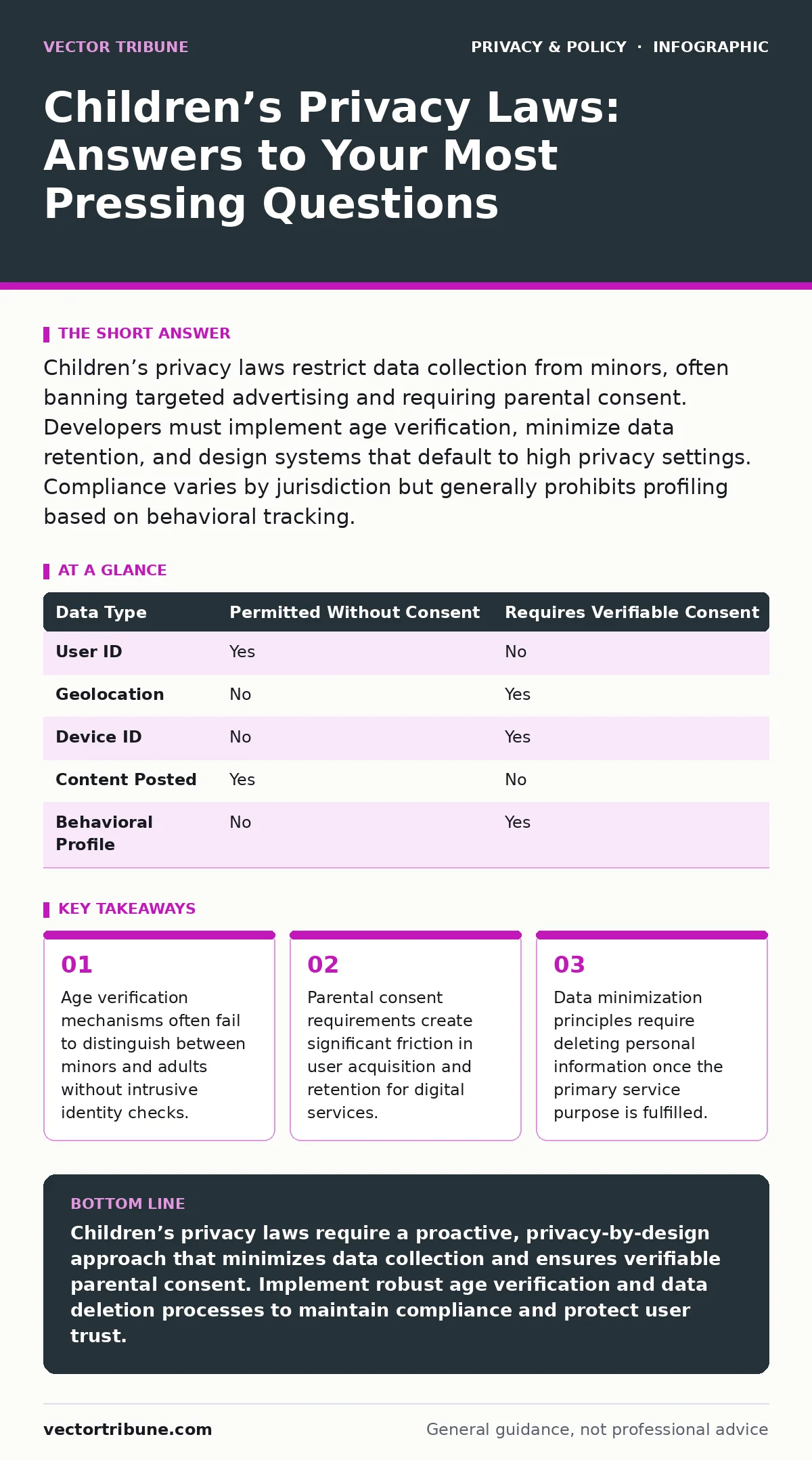
| Data Type | Permitted Without Consent | Requires Verifiable Consent |
|---|---|---|
| User ID | Yes | No |
| Geolocation | No | Yes |
| Device ID | No | Yes |
| Content Posted | Yes | No |
| Behavioral Profile | No | Yes |
What are the consequences of non-compliance?
Non-compliance can result in substantial fines, mandatory audits, and orders to delete collected data. Regulators may also require you to cease operations in specific jurisdictions until compliance is achieved. Beyond legal penalties, non-compliance damages brand reputation and erodes trust among parents and users. The cost of remediation often exceeds the initial investment in building privacy-by-design systems. For a broader view of regulatory obligations, see the guide on privacy laws for small businesses.
How do international laws complicate compliance?
Different jurisdictions have varying definitions of childhood and different requirements for consent and data handling. The European Union’s GDPR, for instance, sets the age of consent at sixteen, though member states may lower this to thirteen. This fragmentation requires you to implement geo-aware compliance logic that adjusts data handling practices based on the user’s location. You must also consider data transfer restrictions, which may prevent you from storing data from certain jurisdictions on servers located elsewhere.
What role does parental control play in technical design?
Technical design must facilitate parental oversight by providing clear, accessible mechanisms for parents to review, delete, or modify their child’s data. This includes dashboards where parents can see what data has been collected and request its removal. You should also provide options for parents to restrict certain features or data collection types. Designing these interfaces with clarity and ease of use is critical for maintaining compliance and trust. For strategies to manage family digital safety, consult the guide on password managers for families.
How do I handle data deletion requests?
You must have a robust process for responding to deletion requests from parents or children, typically within a defined timeframe. This process should ensure that all copies of the data, including backups and third-party shares, are permanently erased. Automated scripts can help identify and delete data across your infrastructure, but you must verify their effectiveness regularly. Failure to delete data upon request is a common violation and can lead to significant penalties.
What is the impact on product development cycles?
Privacy compliance requires integrating privacy checks into every stage of the development lifecycle, from design to deployment. This integration can slow down feature releases but prevents costly retrofits and legal issues later. Developers must be trained to recognize privacy risks and implement privacy-enhancing technologies by default. The initial investment in privacy infrastructure pays off by reducing long-term liability and building user trust. For more on securing digital environments, see the guide on children's online privacy risks.
Key takeaways
- Age verification mechanisms often fail to distinguish between minors and adults without intrusive identity checks.
- Parental consent requirements create significant friction in user acquisition and retention for digital services.
- Data minimization principles require deleting personal information once the primary service purpose is fulfilled.
Children’s privacy laws require a proactive, privacy-by-design approach that minimizes data collection and ensures verifiable parental consent. Implement robust age verification and data deletion processes to maintain compliance and protect user trust.
Frequently asked questions
Do I need parental consent if the app is free?
Yes, parental consent is required regardless of whether the service is free or paid, as the restriction applies to the collection of personal data from minors.
Can I use aggregated data for analytics?
Aggregated data that cannot be linked back to an individual child is generally permissible, provided it is truly anonymized and not used for profiling.
What if a child lies about their age?
You must implement reasonable verification measures; if you have reason to believe a user is a minor, you must treat them as such and seek parental consent.
Does this apply to educational apps?
Yes, educational apps are subject to the same privacy laws, though some jurisdictions have specific provisions for educational contexts that may allow limited data sharing with schools.
How this guide was produced: written by the Vector Tribune editorial team with AI assistance, checked against the public references listed below, and reviewed when the facts change. See our editorial policy or report an error.