
Privacy by Design Framework: Implementation and Core Principles
Privacy by Design embeds data protection into system architecture before code is written, shifting compliance from a final audit to a continuous engineering constraint.
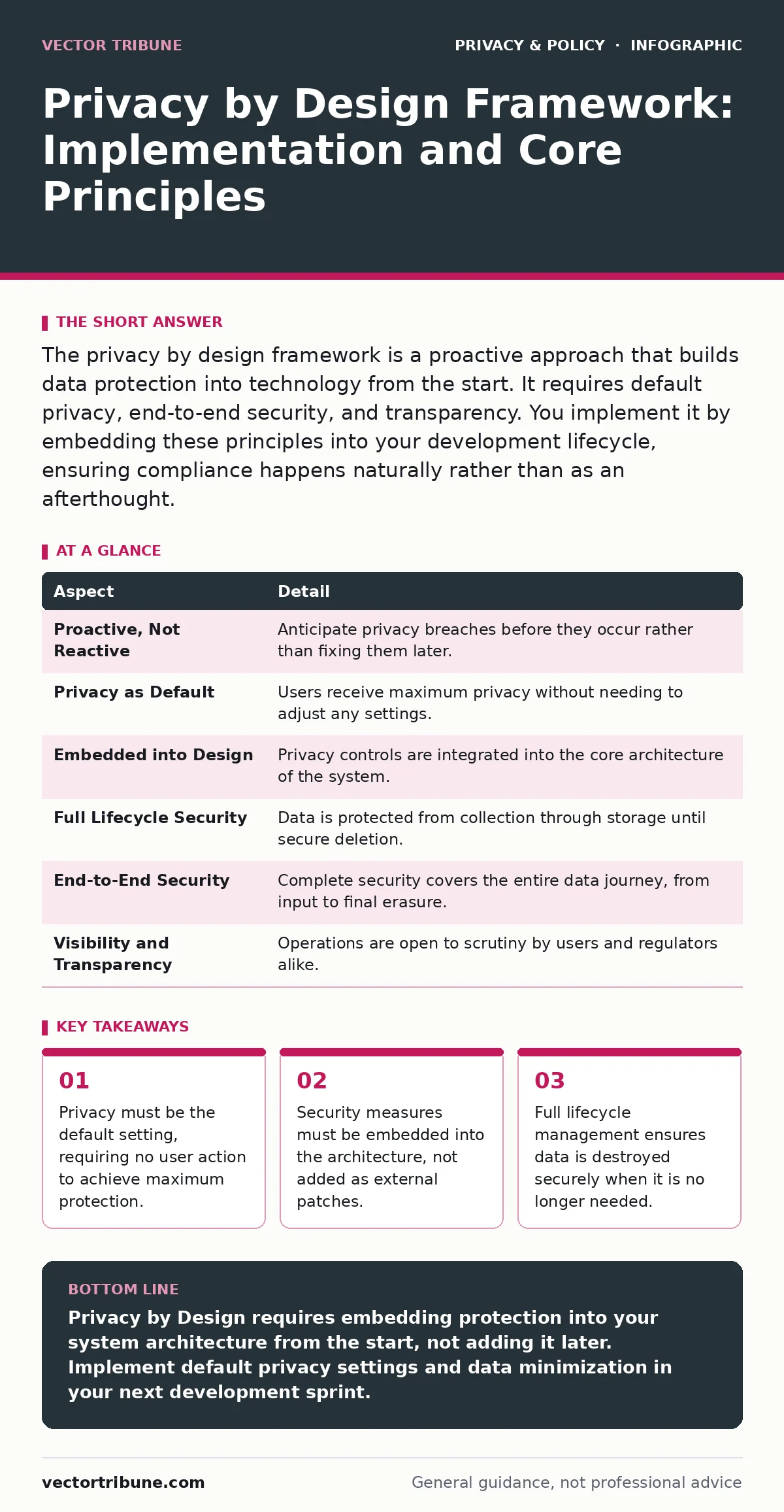
The privacy by design framework is a proactive approach that builds data protection into technology from the start. It requires default privacy, end-to-end security, and transparency. You implement it by embedding these principles into your development lifecycle, ensuring compliance happens naturally rather than as an afterthought.
The Foundation of Privacy by Design
Imagine a house built with locks on every door from the foundation up. You do not add locks after the walls are dry. You do not hope the residents remember to bolt the windows. The security is inherent to the structure. Privacy by Design Framework operates on this same architectural principle. It treats privacy not as a legal checkbox but as a core engineering requirement.
This framework shifts the burden of protection from the user to the system. Users should not need to configure complex settings to stay safe. The system must protect them automatically. This approach reduces human error and simplifies the user experience. You build trust by making privacy the easiest path.
| Aspect | Detail |
|---|---|
| Proactive, Not Reactive | Anticipate privacy breaches before they occur rather than fixing them later. |
| Privacy as Default | Users receive maximum privacy without needing to adjust any settings. |
| Embedded into Design | Privacy controls are integrated into the core architecture of the system. |
| Full Lifecycle Security | Data is protected from collection through storage until secure deletion. |
| End-to-End Security | Complete security covers the entire data journey, from input to final erasure. |
| Visibility and Transparency | Operations are open to scrutiny by users and regulators alike. |
How the Framework Works in Practice
The privacy by design framework relies on seven foundational principles. These principles guide every stage of the software development lifecycle. You apply them during requirement gathering, design, coding, and testing. Ignoring any single principle creates a vulnerability that can be exploited.
The first principle demands proactive measures. You anticipate potential privacy harms and address them early. Suppose your application collects user location data. You ask why you need it before you write the code. If you do not strictly need real-time tracking, you design the system to request only approximate location. This reduces the risk of exposure if the database is compromised.
The second principle ensures privacy is the default. Users should not have to opt-in to basic protections. If a social media app shares user data by default, it violates this principle. The default setting must be the most private option available. Users can choose to share more if they wish, but the system starts with maximum protection. This reduces the cognitive load on users and prevents accidental data leakage.
Who Must Implement These Standards
This framework affects every organization that processes personal data. It is not limited to large technology companies. Small businesses that collect customer emails or employee records must also apply these principles. The scope includes software developers, product managers, and legal teams.
Developers bear the primary responsibility for implementation. You write the code that enforces privacy defaults. You choose the encryption standards that protect data in transit and at rest. Product managers define the features that respect user autonomy. Legal teams ensure the design meets regulatory requirements. All roles must collaborate to embed privacy into the product culture.
You cannot delegate privacy to a single department. It requires cross-functional integration. When development teams view privacy as an external constraint, they often cut corners. When they view it as a quality metric, they build better software. This mindset shift is the hardest part of implementation but yields the highest long-term returns.
Implementing Technical Controls
Technical controls make the framework actionable. You must implement data minimization strategies. Collect only the data you strictly need for the stated purpose. If a login form asks for a phone number but does not use it for two-factor authentication, you are violating data minimization. Remove that field. Less data means less risk.
Encryption is a mandatory control. You must encrypt data at rest and in transit. This protects against unauthorized access even if storage systems are breached. Key management is critical. You must store encryption keys separately from the encrypted data. If an attacker steals the database, they cannot read the contents without the keys.
Access controls limit who can view or modify data. You implement the principle of least privilege. Users and systems should only have access to the data they need to perform their specific tasks. Regular audits ensure these controls remain effective. You review permissions periodically to remove access for former employees or deprecated services.
Common Misconceptions About Privacy by Design
Many teams misunderstand the scope of privacy by design. They treat it as a one-time compliance exercise. They create a privacy policy and assume they are done. This is incorrect. Privacy is a continuous process. You must review and update controls as the application evolves. New features often introduce new privacy risks that require fresh analysis.
Another mistake is equating privacy with security. Security protects data from unauthorized access. Privacy governs how data is collected, used, and shared. A system can be secure but violate privacy if it collects unnecessary data. You must address both aspects. Secure transmission does not justify collecting data you do not need.
Teams often ignore the user experience impact. They assume privacy controls will frustrate users. This is rarely true. Simple, default privacy settings often improve trust and adoption. Complex opt-out mechanisms confuse users and lead to accidental data sharing. Clear, simple choices empower users and reduce support tickets. You design for clarity, not complexity.
See also: Email Aliases Checklist: Protect Identity and Filter Spam
Integrating With Related Privacy Strategies
Privacy by design works best when combined with other privacy tools. You should align your backend architecture with frontend protections. For instance, ensure your application respects browser cookies settings. If a user disables tracking cookies, your system must not use alternative tracking mechanisms that circumvent this choice.
Consider how your application interacts with device-level settings. Users who adjust smartphone privacy settings expect applications to honor those choices. If a user denies location access, your app must function without it or clearly explain why it is needed. Respecting these boundaries builds user confidence.
Data protection extends beyond your application. Encourage users to adopt end-to-end encryption for sensitive communications. While you cannot force this, you can design interfaces that make encrypted communication easy. This layered approach ensures privacy remains intact even if one layer fails.
Lifecycle Management and Data Retention
Data retention policies are a core component of the framework. You must define how long you keep data. Keeping data longer than necessary increases liability. You automate data deletion processes. When a user deletes their account, all associated data must be erased from primary and backup systems.
Backup systems often retain data longer than intended. You must ensure your backup restoration policies exclude deleted user data. This requires careful coordination between development and operations teams. Regular audits verify that deletion processes work as expected. You test these processes periodically to ensure they function during actual deletion events.
Transparency is required throughout this process. Users must know what data you hold and why. You provide clear mechanisms for users to request data exports or deletions. This aligns with global privacy regulations and user expectations. Openness about data handling reduces legal risk and improves brand reputation.
What People Usually Get Wrong
Teams often implement privacy features as add-ons. They build the core functionality first and then layer privacy controls on top. This creates technical debt. Refactoring code to support privacy defaults is expensive and error-prone. You avoid this by including privacy requirements in the initial design documents.
Another error is assuming privacy is static. User expectations and legal requirements evolve. You must revisit your privacy architecture regularly. New regulations may require different data handling practices. New attack vectors may necessitate stronger controls. Continuous improvement is mandatory.
Finally, teams often neglect vendor management. Third-party services process your users' data. You must ensure these vendors adhere to similar privacy standards. Conduct due diligence before integrating external services. Review their privacy policies and security practices. You are responsible for how your vendors handle user data.
Key takeaways
- Privacy must be the default setting, requiring no user action to achieve maximum protection.
- Security measures must be embedded into the architecture, not added as external patches.
- Full lifecycle management ensures data is destroyed securely when it is no longer needed.
Privacy by Design requires embedding protection into your system architecture from the start, not adding it later. Implement default privacy settings and data minimization in your next development sprint.
Frequently asked questions
Does privacy by design replace the need for a privacy policy?
No. The framework guides technical implementation, while the policy communicates legal rights and practices to users. Both are necessary for full compliance and transparency.
How do I handle legacy systems that do not support privacy by design?
You must prioritize refactoring critical components. Start with data minimization and access controls. Gradually update the architecture to support default privacy settings and secure data deletion.
Can small teams implement privacy by design effectively?
Yes. Small teams can adopt these principles by focusing on data minimization and default settings. You do not need extensive resources to start collecting less data and encrypting what you keep.
What is the difference between privacy and security in this framework?
Security protects data from unauthorized access, while privacy governs the ethical collection and use of data. You need strong security to maintain privacy, but security alone does not ensure privacy compliance.
How this guide was produced: written by the Vector Tribune editorial team with AI assistance, checked against the public references listed below, and reviewed when the facts change. See our editorial policy or report an error.