
Linux Kernel Privilege Escalation Explained Simply
Kernel privilege escalation allows low-level code to bypass system boundaries and gain full control over your hardware and data.
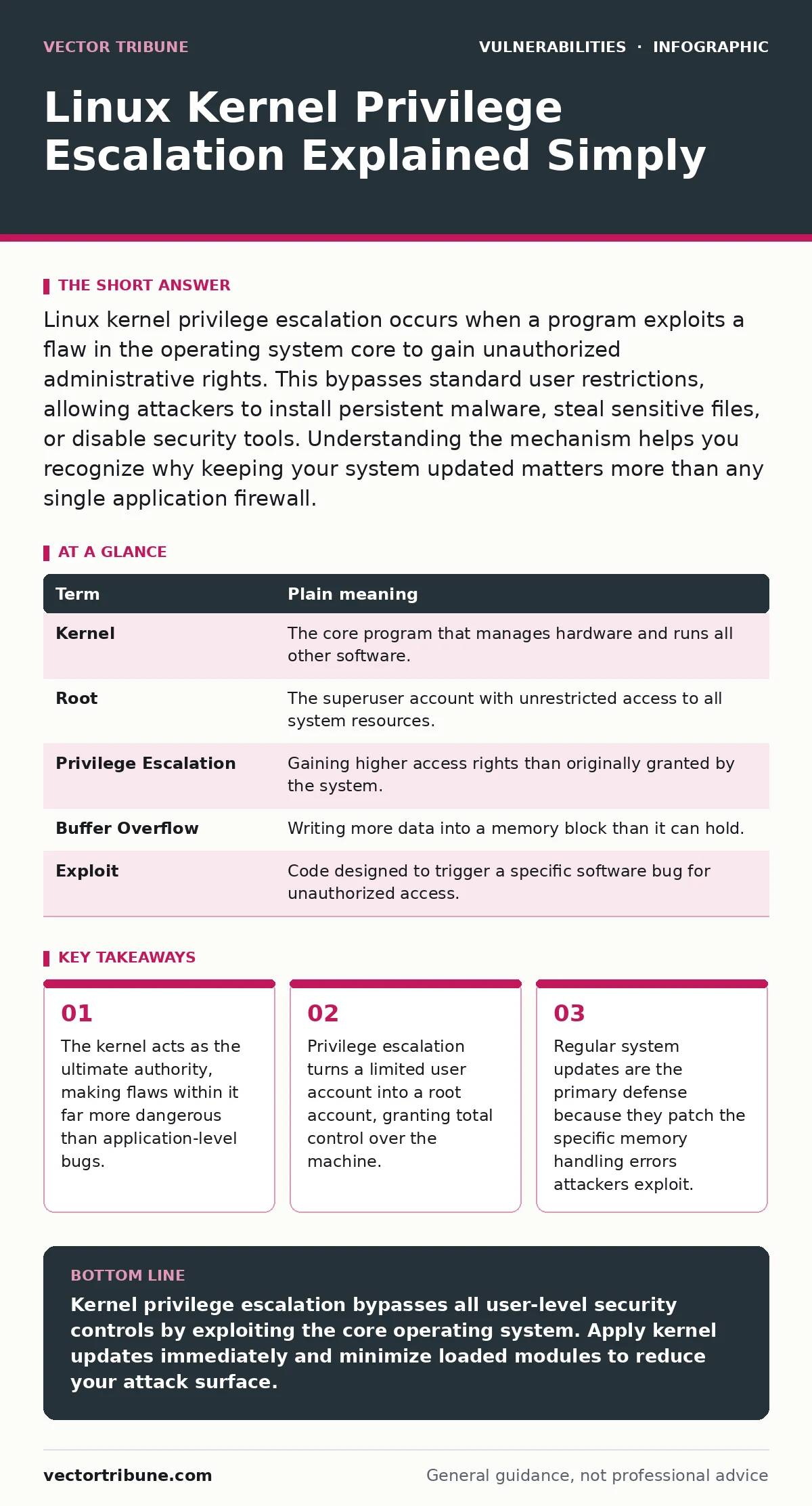
Linux kernel privilege escalation occurs when a program exploits a flaw in the operating system core to gain unauthorized administrative rights. This bypasses standard user restrictions, allowing attackers to install persistent malware, steal sensitive files, or disable security tools. Understanding the mechanism helps you recognize why keeping your system updated matters more than any single application firewall.
The Building Security Analogy
Imagine a high-security building where you are a visitor. You have a badge that only opens the main lobby doors. The security guard at the front desk represents the operating system kernel. The guard checks your badge before letting you into any restricted area. If you try to enter the server room, the guard stops you. Privilege escalation is like finding a hidden maintenance tunnel behind the guard booth that leads directly into the server room. You bypass the guard entirely, ignoring the rules of your badge.
Key Terms and Concepts
| Term | Plain meaning |
|---|---|
| Kernel | The core program that manages hardware and runs all other software. |
| Root | The superuser account with unrestricted access to all system resources. |
| Privilege Escalation | Gaining higher access rights than originally granted by the system. |
| Buffer Overflow | Writing more data into a memory block than it can hold. |
| Exploit | Code designed to trigger a specific software bug for unauthorized access. |
Why Kernel Flaws Matter
Most security breaches start at the application layer. A web browser might have a bug, but the kernel isolates it. If the kernel itself has a flaw, that isolation breaks. An attacker who controls the kernel controls the hardware. They can read every file, intercept network traffic, and hide their presence from standard monitoring tools. This is why kernel vulnerabilities are considered high-severity issues. They do not just compromise one program; they compromise the entire machine.
The Mechanism of Attack
Attackers often use buffer overflows to achieve this. Imagine a bucket that holds exactly 1 liter of water. If you pour 2 liters, the excess spills over. In computer memory, that overflow spills into adjacent memory spaces. If an attacker carefully crafts the overflow, they can overwrite the return address of a function. This tricks the processor into executing malicious code instead of the intended instruction. Once that code runs with kernel privileges, the attacker becomes root.
Unexpected Consequences for Users
Many users believe that using a standard account is enough protection. It is not if the kernel is vulnerable. Even if you never run suspicious software, a compromised application can trigger a kernel bug. This means your user-level protections are irrelevant. The hidden cost of ignoring kernel updates is that your entire security posture collapses. You might have strong passwords and firewalls, but a kernel exploit renders them useless. The attacker operates below the level where those controls function.
Simple Safety Habits
- Apply system updates immediately. Kernel patches fix the specific memory errors that allow escalation. Delaying updates leaves the maintenance tunnel open.
- Use memory-safe programming languages for new kernel modules. These languages prevent buffer overflows by design. This reduces the attack surface significantly.
- Limit kernel loadable modules. Only allow modules that are strictly necessary. Fewer modules mean fewer potential entry points for an attacker.
The Role of Disclosure
When a flaw is found, vendors rely on vulnerability disclosure policies to patch it quickly. These policies ensure that researchers share details with the vendor before publishing them publicly. This gives administrators time to apply fixes before attackers can write exploits. Understanding these policies helps you prioritize patches. If a vendor has a slow disclosure process, you should monitor for emergency patch change management opportunities.
Beyond Basic Updates
While updates are primary, deeper defenses exist. Memory-safe programming languages are increasingly used in kernel development to eliminate entire classes of bugs. You cannot always choose the kernel code, but you can choose environments that prioritize these standards. Additionally, understanding EPSS percentiles helps you prioritize which patches matter most. High percentile scores indicate a higher likelihood of exploitation in the wild.
Dependency Risks
Kernel updates often pull in new libraries. Be aware of dependency confusion attacks, where attackers trick systems into loading malicious packages. While rare at the kernel level, supply chain integrity matters. Verify the source of every package. Server-side request forgery (SSRF) is less relevant here, but ensuring your update servers are secure prevents tampering with the patches themselves.
Key takeaways
- The kernel acts as the ultimate authority, making flaws within it far more dangerous than application-level bugs.
- Privilege escalation turns a limited user account into a root account, granting total control over the machine.
- Regular system updates are the primary defense because they patch the specific memory handling errors attackers exploit.
Kernel privilege escalation bypasses all user-level security controls by exploiting the core operating system. Apply kernel updates immediately and minimize loaded modules to reduce your attack surface.
Frequently asked questions
How do I know if my kernel is vulnerable?
Check your current kernel version against official security advisories. These documents list specific version numbers that contain known flaws.
Can antivirus software stop kernel privilege escalation?
Antivirus tools often run at the user level. A kernel exploit can disable or bypass these tools before they can react.
Is privilege escalation only possible with root access?
No. The goal is to gain root access. Attackers start with low-privilege accounts and use bugs to escalate their rights.
Do Linux distributions handle this automatically?
Most distributions offer automatic update options. Enable them for kernel packages to ensure you receive security patches without manual intervention.
How this guide was produced: written by the Vector Tribune editorial team with AI assistance, checked against the public references listed below, and reviewed when the facts change. See our editorial policy or report an error.