
Buffer Overflow Prevention Checklist for Secure Code
Modern compilers hide many overflow errors, but unchecked bounds in legacy C code still allow attackers to hijack program execution and gain full system control.
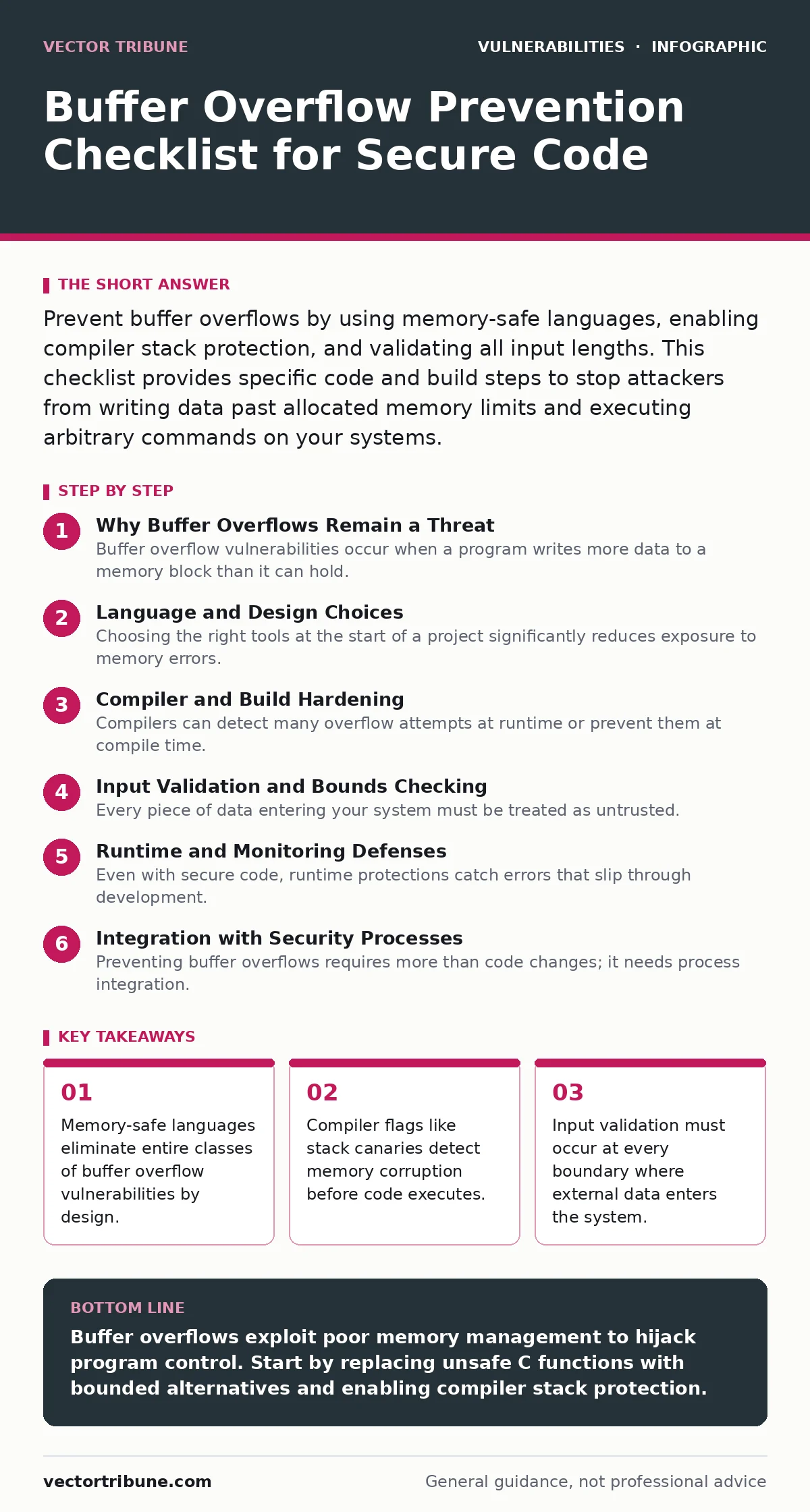
Prevent buffer overflows by using memory-safe languages, enabling compiler stack protection, and validating all input lengths. This checklist provides specific code and build steps to stop attackers from writing data past allocated memory limits and executing arbitrary commands on your systems.
Why Buffer Overflows Remain a Threat
Buffer overflow vulnerabilities occur when a program writes more data to a memory block than it can hold. This excess data spills into adjacent memory locations, potentially overwriting return addresses or function pointers. Attackers exploit this behavior to redirect program execution to their own malicious code. While modern systems have improved defenses, legacy code written in C or C++ remains vulnerable. Developers must understand that memory management errors are not just bugs; they are security failures that grant unauthorized control over the process.
Language and Design Choices
Choosing the right tools at the start of a project significantly reduces exposure to memory errors. You cannot patch away fundamental design flaws in how a language handles memory.
- Use memory-safe languages: Languages like Rust or Go manage memory automatically, preventing out-of-bounds writes by design.
- Audit legacy C/C++ code: Identify functions that handle raw pointers or manual memory allocation, as these are high-risk areas.
- Prefer safe string functions: Replace unsafe functions like
strcpywith bounded alternatives likestrncpyto enforce length limits.
Compiler and Build Hardening
Compilers can detect many overflow attempts at runtime or prevent them at compile time. Enabling these features adds a layer of defense without changing application logic.
- Enable stack canaries: These values detect stack smashing before the program returns to an attacker-controlled address.
- Activate Address Space Layout Randomization (ASLR): This randomizes memory locations, making it harder for attackers to predict where to inject code.
- Use Data Execution Prevention (DEP): This marks memory regions as non-executable, stopping injected code from running even if it is placed in memory.
Input Validation and Bounds Checking
Every piece of data entering your system must be treated as untrusted. Validation must happen before the data is processed or stored in memory buffers.
- Validate input length explicitly: Check the size of incoming data against the buffer capacity before any copy operation occurs.
- Enforce type constraints: Ensure numeric inputs fall within expected ranges to prevent integer overflows that lead to incorrect buffer sizing.
- Sanitize external data: Strip or escape special characters that might be used to manipulate memory structures or parsing logic.
Runtime and Monitoring Defenses
Even with secure code, runtime protections catch errors that slip through development. These mechanisms provide a safety net for unexpected behavior.
- Implement heap protection: Use allocator libraries that check for heap corruption, which is harder to detect than stack overflows.
- Monitor for abnormal memory access: Log and alert on patterns that suggest memory corruption or unauthorized access attempts.
- Regularly update libraries: Keep dependencies current to benefit from security patches that address known overflow issues.
See also: Secure Software Development for Small Teams Without Heavy Infrastructure
Integration with Security Processes
Preventing buffer overflows requires more than code changes; it needs process integration. Your security efforts must align with development workflows.
- Include static analysis in CI/CD: Use tools that scan code for unsafe memory operations before merging changes.
- Conduct regular code reviews: Have senior developers review memory management logic, especially in critical components.
- Maintain an IT asset inventory: Knowing all software components helps prioritize patching and reduces the attack surface for exploitation.
Common Misconceptions and Edge Cases
Some developers believe certain practices are safe when they are not. Understanding these pitfalls prevents false confidence in your security posture.
- Assume trusted input is safe: Data from internal services or databases can still be malformed or malicious if upstream systems are compromised.
- Ignore integer overflow: An integer overflow can cause a buffer size calculation to wrap around, leading to a small allocation for large data.
- Overlook format string vulnerabilities: These can be used to read or write arbitrary memory, often leading to similar outcomes as buffer overflows.
Review your remote code execution vulnerabilities guide to see how buffer overflows often serve as the initial step in achieving full system compromise. Understanding the connection between memory corruption and code execution helps prioritize remediation efforts effectively.
Key takeaways
- Memory-safe languages eliminate entire classes of buffer overflow vulnerabilities by design.
- Compiler flags like stack canaries detect memory corruption before code executes.
- Input validation must occur at every boundary where external data enters the system.
Buffer overflows exploit poor memory management to hijack program control. Start by replacing unsafe C functions with bounded alternatives and enabling compiler stack protection.
Frequently asked questions
How do I detect buffer overflows in existing code?
Use static analysis tools during builds and dynamic analysis during testing to identify out-of-bounds memory writes.
Are memory-safe languages immune to all security issues?
No, they prevent memory corruption but can still suffer from logic errors, injection flaws, or configuration mistakes.
Can a buffer overflow occur without user input?
Yes, internal data processing, file reads, or network messages from trusted sources can trigger overflows if not validated.
What is the difference between stack and heap overflows?
Stack overflows occur in function call memory, while heap overflows happen in dynamically allocated memory, both allowing code execution.
How this guide was produced: written by the Vector Tribune editorial team with AI assistance, checked against the public references listed below, and reviewed when the facts change. See our editorial policy or report an error.