Attack Surface Management Mistakes and How to Fix Them
Most organizations manage their known assets while ignoring the shadow infrastructure that attackers exploit first, creating a blind spot that renders traditional security controls ineffective against external threats.
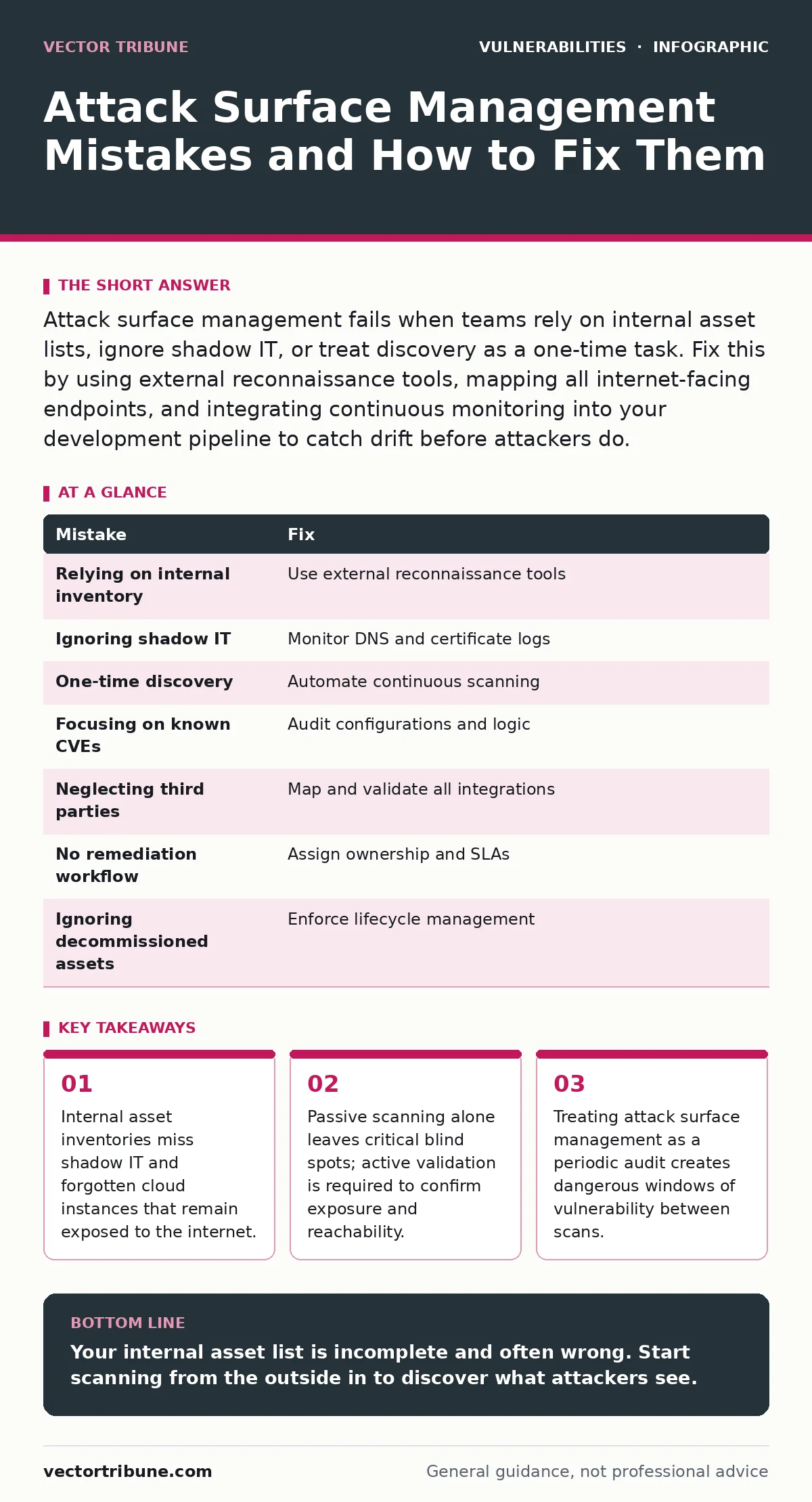
Attack surface management fails when teams rely on internal asset lists, ignore shadow IT, or treat discovery as a one-time task. Fix this by using external reconnaissance tools, mapping all internet-facing endpoints, and integrating continuous monitoring into your development pipeline to catch drift before attackers do.
Mistake 1: Relying on Internal Asset Inventory Tools
Internal configuration management databases and IT asset inventory systems track what you intend to exist. They do not track what actually exists on the internet. Developers often provision resources for testing and forget to decommission them. These forgotten assets become entry points for attackers who scan for common misconfigurations.
Why it hurts:
Your security team protects the assets they know about. Attackers exploit the assets they find. This mismatch creates a persistent blind spot. A forgotten staging server with default credentials or an exposed database port can lead to unauthenticated remote code execution. The internal record shows zero risk, while the external reality shows critical exposure.
The fix:
Use external reconnaissance tools that scan from the perspective of an attacker. These tools discover DNS records, open ports, and exposed services without relying on internal logs. Compare this external view against your internal inventory. Flag any asset that exists externally but not internally for immediate review or decommissioning.
Mistake 2: Ignoring Shadow IT and Developer-Deployed Resources
Development teams frequently provision cloud resources directly to meet deadlines. These resources often bypass standard security reviews and change management processes. They may include public storage buckets, test environments, or third-party integrations that are not recorded in the central asset register.
Why it hurts:
Shadow IT assets lack the security controls applied to production systems. They often use default configurations that are vulnerable to common exploits. Because they are not monitored, they remain exposed indefinitely. An attacker can use a misconfigured storage bucket to upload malicious scripts, leading to remote code execution vulnerabilities on connected systems.
The fix:
Implement continuous discovery tools that monitor your domain name system and certificate transparency logs. These tools detect new subdomains and services automatically. Integrate these findings into your security operations center dashboards. Establish a process for developers to register new assets quickly, reducing the incentive to bypass security controls.
Mistake 3: Treating Discovery as a One-Time Event
Many organizations perform a comprehensive attack surface assessment during a quarterly audit. They assume the surface remains static between assessments. In reality, the attack surface changes daily. New dependencies are added, configurations drift, and deprecated services are left running.
Why it hurts:
A static snapshot becomes outdated immediately. An asset that was secure during the last audit may be misconfigured today. Attackers exploit this temporal gap. They scan for new exposures that appeared after the last review. Your team operates on stale data, missing critical changes that increase risk.
The fix:
Automate continuous monitoring. Schedule daily or hourly scans of your external attack surface. Use APIs to push findings directly into your ticketing system. Treat new exposures as high-priority incidents. This ensures that changes are detected and addressed within hours, not months.
Mistake 4: Focusing Only on Known Vulnerabilities
Teams often prioritize patching known common vulnerabilities and exposures. They assume that if a service has no known patches, it is secure. This ignores zero-day vulnerabilities and misconfigurations that do not have public identifiers. It also ignores the risk of complex interaction between components.
Why it hurts:
Attackers do not wait for patches. They exploit logic flaws, authentication bypasses, and configuration errors that have no CVE identifier. A system may be fully patched but still vulnerable to server-side request forgery (SSRF) due to improper input validation. Focusing only on known issues leaves these logic-based flaws unaddressed.
The fix:
Combine vulnerability scanning with configuration auditing. Check for default credentials, unnecessary open ports, and weak encryption protocols. Review application logic for common anti-patterns. Use threat modeling to identify potential attack paths that do not rely on known software bugs.
Mistake 5: Neglecting Third-Party Dependencies
Modern applications rely on numerous external libraries and services. Teams often assume that vendors manage their own attack surfaces. They do not verify that third-party components are secure or properly configured. This includes content delivery networks, analytics scripts, and API providers.
Why it hurts:
A vulnerability in a third-party service can compromise your entire application. If a vendor suffers a dependency confusion attack, your application may execute malicious code. You are responsible for the security of your user data, regardless of where it is processed. Ignoring third-party risk expands your attack surface beyond your direct control.
The fix:
Map all third-party integrations. Assess the security posture of each vendor. Require them to provide regular security reports. Implement strict input validation and output encoding for all data exchanged with third parties. Use subresource integrity hashes to ensure that external scripts have not been tampered with.
See also: Alert Triage: How to Cut Noise and Find Real Threats · Implement IT Asset Inventory: A Step-by-Step Technical Guide
Mistake 6: Lacking a Clear Remediation Workflow
Discovering vulnerabilities is useless without a process to fix them. Many teams generate reports that sit unread in email inboxes. There is no clear owner for each finding. Prioritization is ad-hoc, leading to critical issues being delayed while minor ones are addressed first.
Why it hurts:
Unresolved findings accumulate over time. The attack surface grows as new vulnerabilities are discovered but not fixed. Security fatigue sets in when teams are overwhelmed by untriaged alerts. Critical exposures remain open because there is no accountability. This delays mitigation until an attacker exploits the flaw.
The fix:
Assign ownership for each asset and vulnerability. Define service level agreements for remediation based on risk severity. Integrate findings into your existing project management tools. Track remediation progress in real-time. Celebrate quick fixes to build momentum and demonstrate the value of continuous management.
Mistake 7: Ignoring Decommissioned Assets
Organizations often forget to remove old domains, subdomains, or services when they are no longer in use. These assets may still be accessible on the internet. They often lack maintenance and security updates. They become low-hanging fruit for attackers.
Why it hurts:
Decommissioned assets are rarely monitored. They may redirect to active systems, allowing attackers to bypass security controls. They may host outdated software with known memory-safe programming languages vulnerabilities that have been patched elsewhere. An attacker can use these forgotten endpoints to pivot into your core infrastructure.
The fix:
Maintain a lifecycle process for all assets. Define clear criteria for decommissioning. Verify that DNS records are removed and services are shut down. Audit for orphaned assets quarterly. Ensure that legal and compliance teams are involved in the disposal of data associated with decommissioned systems.
| Mistake | Fix |
|---|---|
| Relying on internal inventory | Use external reconnaissance tools |
| Ignoring shadow IT | Monitor DNS and certificate logs |
| One-time discovery | Automate continuous scanning |
| Focusing on known CVEs | Audit configurations and logic |
| Neglecting third parties | Map and validate all integrations |
| No remediation workflow | Assign ownership and SLAs |
| Ignoring decommissioned assets | Enforce lifecycle management |
Key takeaways
- Internal asset inventories miss shadow IT and forgotten cloud instances that remain exposed to the internet.
- Passive scanning alone leaves critical blind spots; active validation is required to confirm exposure and reachability.
- Treating attack surface management as a periodic audit creates dangerous windows of vulnerability between scans.
Your internal asset list is incomplete and often wrong. Start scanning from the outside in to discover what attackers see.
Frequently asked questions
How often should I scan my attack surface?
Scan continuously or at least daily. The attack surface changes rapidly with new deployments and configuration drift. Frequent scanning ensures you detect exposures before attackers do.
Can I use open-source tools for attack surface management?
Yes, many open-source tools provide basic discovery capabilities. However, they often require significant manual effort to correlate findings and manage false positives. Commercial solutions offer better integration and automation for large environments.
How do I prioritize which vulnerabilities to fix first?
Prioritize based on exploitability and impact. Focus on internet-facing assets with known exploits. Consider the context of the vulnerability, such as whether it requires authentication or user interaction. Use threat intelligence to gauge active exploitation in the wild.
What is the difference between ASM and vulnerability management?
Vulnerability management focuses on known weaknesses in known assets. Attack surface management focuses on discovering all assets, known and unknown, and assessing their exposure. ASM provides the context that vulnerability management lacks.
How this guide was produced: written by the Vector Tribune editorial team with AI assistance, checked against the public references listed below, and reviewed when the facts change. See our editorial policy or report an error.