Types of Threat Intelligence and How They Protect Your Systems
Tactical threat intelligence feeds your defensive tools, while strategic types guide long-term security budgeting and architectural decisions.
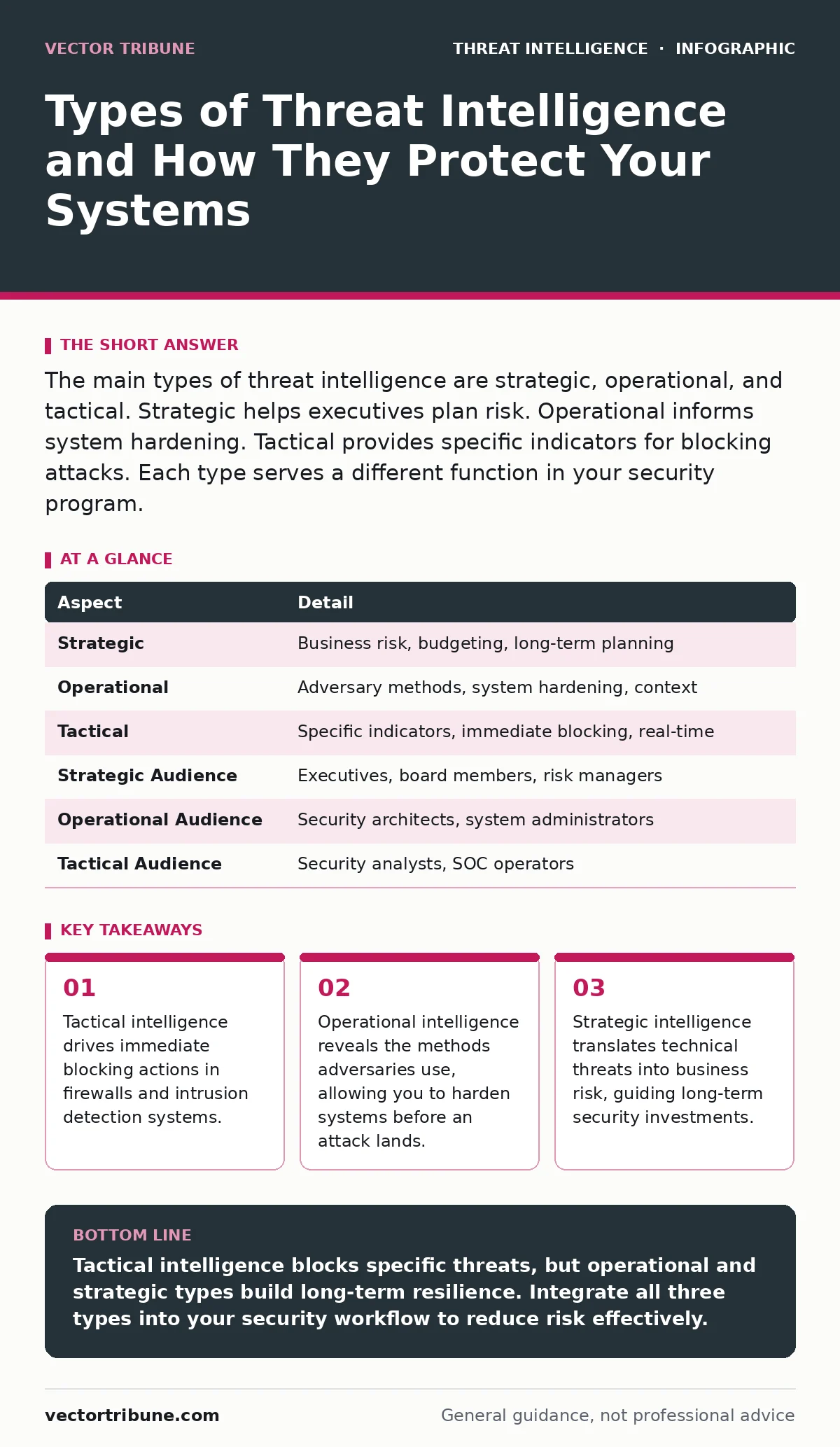
The main types of threat intelligence are strategic, operational, and tactical. Strategic helps executives plan risk. Operational informs system hardening. Tactical provides specific indicators for blocking attacks. Each type serves a different function in your security program.
The Foundation of Defensive Posture
Imagine a ship navigating stormy waters. The captain needs weather forecasts to choose a route. The engineers need to know how much stress the hull can take. The radar operators need real-time data on nearby vessels. Threat intelligence works the same way. Different teams need different data to keep the organization safe. You must match the intelligence type to the consumer’s specific needs.
Strategic intelligence supports high-level decision-making. It translates technical threats into business risk. Executives use this data to allocate budgets and prioritize security initiatives. Operational intelligence focuses on the context of threats. It describes how adversaries operate and what systems they target. Security architects use this to improve network design and patch management. Tactical intelligence provides specific, actionable data. It includes indicators of compromise such as malicious IP addresses. Security operations teams use this to block active attacks.
| Aspect | Detail |
|---|---|
| Strategic | Business risk, budgeting, long-term planning |
| Operational | Adversary methods, system hardening, context |
| Tactical | Specific indicators, immediate blocking, real-time |
| Strategic Audience | Executives, board members, risk managers |
| Operational Audience | Security architects, system administrators |
| Tactical Audience | Security analysts, SOC operators |
How Tactical Threat Intelligence Works
Tactical threat intelligence is the most immediate form of data. It consists of specific indicators of compromise. These include file hashes, domain names, and IP addresses. You ingest this data into your security tools. Firewalls block known malicious IP addresses. Antivirus software scans for known bad file hashes. Email filters discard messages from compromised domains. This process happens automatically and at scale.
The mechanism relies on correlation. Your tools compare incoming traffic against a list of known bad indicators. If a match occurs, the tool takes action. This might be blocking a connection or quarantining a file. The speed of this process matters. Adversaries change their infrastructure frequently. An IP address used for an attack today might be clean tomorrow. You must update your indicators regularly to stay effective.
This type of intelligence has a short shelf life. Indicators become obsolete quickly. Adversaries rotate their resources to avoid detection. You need a steady stream of new data. Static lists fail within days or weeks. Automation is necessary to handle the volume. Manual updating is impossible at scale. You rely on feeds from trusted sources. These sources aggregate data from many collectors.
Who Consumes Each Type
Not every team needs every type of intelligence. Forcing tactical data on executives causes noise. They cannot act on specific IP addresses. They need to understand the financial impact of a breach. Forcing strategic data on analysts causes delay. They cannot block an attack using a high-level trend report. They need specific indicators to stop the intrusion.
Security operations centers consume tactical intelligence. They monitor alerts and block threats in real time. This work is fast-paced and reactive. You need accurate data to avoid blocking legitimate traffic. False positives disrupt business operations. System administrators use operational intelligence. They configure servers and applications to resist attacks. They patch vulnerabilities that adversaries exploit. This work is proactive and structural.
Executives use strategic intelligence. They decide which risks to accept and which to mitigate. They look at industry trends and adversary goals. This work is slow and deliberate. It shapes the security program for years. Each group needs data formatted for their workflow. A dashboard for an analyst looks different from a report for a board member. You must tailor the output to the consumer.
Types of Threat Intelligence in Practice
The search query "types of threat intelligence" often seeks a simple list. The reality involves three distinct categories. Strategic intelligence answers "why" an adversary acts. It covers motives and capabilities. Operational intelligence answers "how" an adversary operates. It covers tactics, techniques and procedures (TTPs). Tactical intelligence answers "what" the adversary uses. It covers specific tools and indicators.
You must integrate all three types. Relying only on tactical data leaves you blind to new methods. Adversaries change their tools but keep their methods. If you only block specific IPs, you miss the pattern. Relying only on strategic data leaves you vulnerable to daily attacks. You need specific indicators to stop active intrusions. A balanced program uses all three layers.
What People Usually Get Wrong
Many organizations confuse volume with value. They subscribe to massive feeds of indicators. They assume more data means better security. This creates alert fatigue. Analysts drown in false positives. They miss real threats in the noise. You need quality over quantity. Curated feeds outperform raw data dumps.
Another common error is treating intelligence as a product. It is a process. You must validate indicators before using them. Some feeds contain outdated or incorrect data. Blind trust leads to blocking legitimate services. You must tune your tools to your environment. Context matters more than the indicator itself.
See also: Tactics Techniques and Procedures: How to Map Adversary Behavior · Tactics vs Techniques vs Procedures: The Difference in Cybersecurity
The Hidden Cost of Automation
Automation is necessary for tactical intelligence. You cannot process thousands of indicators manually. But automation has hidden costs. You rely on the accuracy of your feeds. If the feed is wrong, you block the wrong traffic. You must maintain trust in your sources.
Automation also reduces human oversight. Analysts stop thinking critically about the data. They assume the tool knows best. This creates a skill gap. You need people who understand the underlying methods. They must review the automation logic periodically. You must balance speed with accuracy.
Integrating with Defensive Operations
Tactical intelligence feeds into your security operations. It drives alert triage for your analysts. You must integrate it with your workflows. This requires coordination between teams. The intelligence team provides the data. The operations team uses the data. They must share feedback loops.
If analysts see false positives, they report them. The intelligence team validates the indicator. They remove bad data from the feed. This improves quality over time. You must build this feedback mechanism. It is not optional. It is required for sustainable operations.
You can enhance this with digital forensics and incident response. When an attack occurs, you investigate the impact. You collect new indicators from the breach. You add these to your tactical feed. This closes the loop. You learn from every incident.
Beyond Simple Indicators
Tactical intelligence is not just about blocking. It is about understanding the attack chain. You must look at command and control traffic. This reveals how the adversary communicates. You can disrupt their control plane. This is more effective than blocking individual IPs.
You should also consider red teaming exercises. These simulate adversary behavior. They test your detection capabilities. They reveal gaps in your tactical defenses. You learn what you miss. You improve your indicators and rules. This proactive approach strengthens your posture.
Packet capture analysis helps verify your data. You examine the raw traffic. You confirm the presence of malicious indicators. You understand the protocol details. This deep dive improves your detection logic. You move from simple matching to behavioral analysis.
Key takeaways
- Tactical intelligence drives immediate blocking actions in firewalls and intrusion detection systems.
- Operational intelligence reveals the methods adversaries use, allowing you to harden systems before an attack lands.
- Strategic intelligence translates technical threats into business risk, guiding long-term security investments.
Tactical intelligence blocks specific threats, but operational and strategic types build long-term resilience. Integrate all three types into your security workflow to reduce risk effectively.
Frequently asked questions
What is the difference between tactical and operational intelligence?
Tactical intelligence provides specific indicators like IP addresses for immediate blocking. Operational intelligence describes adversary methods and techniques for system hardening.
How do I validate threat intelligence feeds?
Check the source reputation and cross-reference indicators with other trusted data. Monitor for false positives and adjust your tools accordingly.
Can I rely solely on automated blocking?
No. Automation requires accurate data and human oversight. Blind automation leads to false positives and missed threats due to lack of context.
Who should read tactical threat intelligence reports?
Security operations center analysts and incident responders use tactical intelligence. They need specific indicators to block active attacks in real time.
How this guide was produced: written by the Vector Tribune editorial team with AI assistance, checked against the public references listed below, and reviewed when the facts change. See our editorial policy or report an error.