How ISO 27001 Works: The Mechanics of Certification and Control
ISO 27001 does not dictate specific tools but forces an organization to prove that its risks are identified, treated, and continuously monitored by an external auditor.
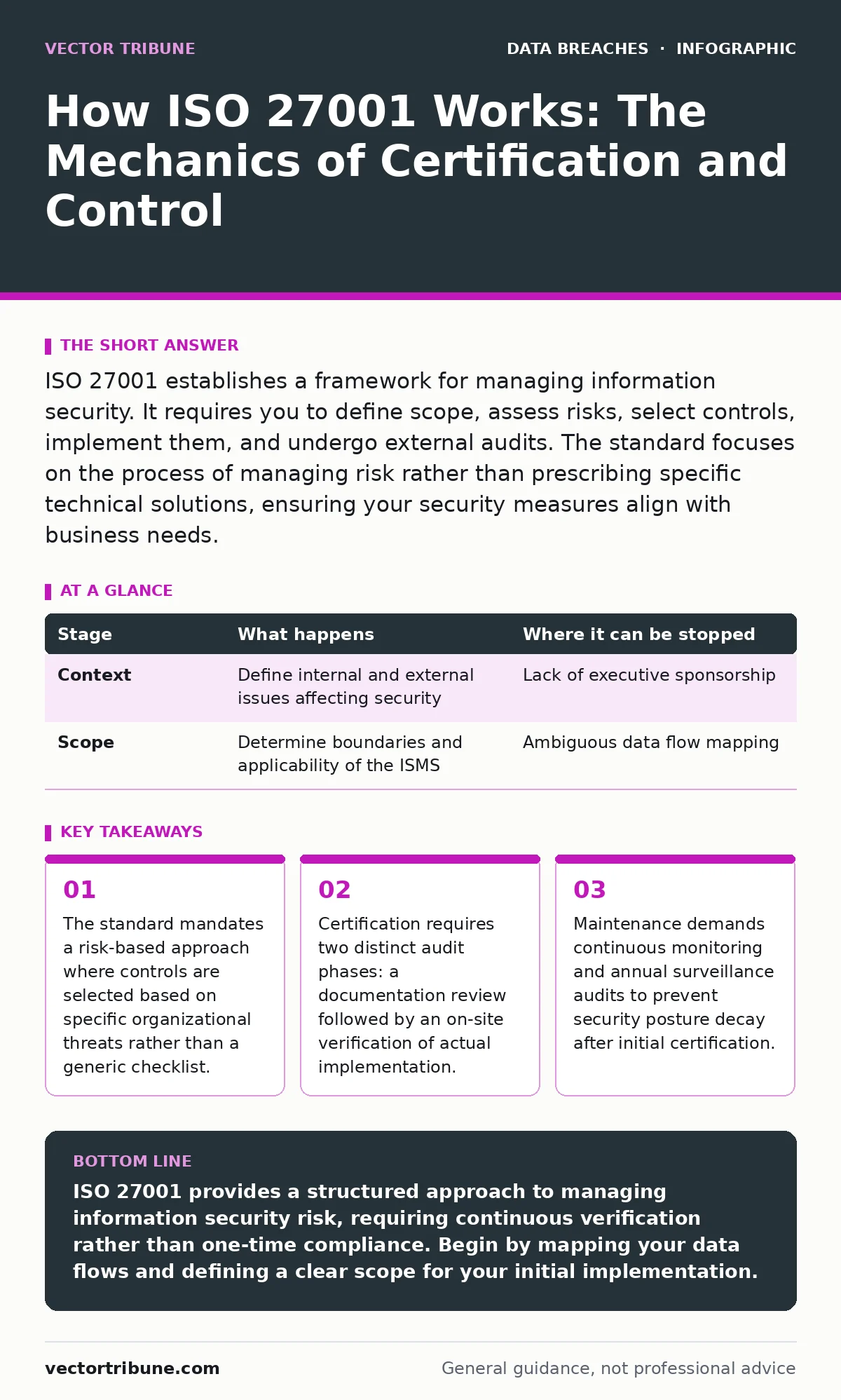
ISO 27001 establishes a framework for managing information security. It requires you to define scope, assess risks, select controls, implement them, and undergo external audits. The standard focuses on the process of managing risk rather than prescribing specific technical solutions, ensuring your security measures align with business needs.
Defining the Boundary of Protection
You cannot secure what you cannot define. The first step in adopting ISO 27001 is establishing the scope of your Information Security Management System (ISMS). This boundary determines which assets, locations, people, and organizational units are subject to the standard’s requirements. If you leave the scope too broad, you dilute resources and create unmanageable complexity. If you make it too narrow, you create gaps where sensitive data resides outside your protection umbrella.
This stage forces you to map your data flows and identify where information enters, processes, and exits your organization. You must document this boundary clearly because auditors will test specifically against it. A common error is including third-party vendors in the scope without proper contractual controls, which leads to failures during the assessment of third-party data breaches. Your scope statement becomes the contract between your security team and the rest of the organization regarding what is protected and what is excluded.
Identifying What Could Go Wrong
Risk assessment is the engine of the standard. You must identify assets, determine their value, and evaluate the threats and vulnerabilities that could compromise them. This is not a theoretical exercise; it requires concrete evidence of how data moves and who accesses it. You assign likelihood and impact scores to each risk scenario to prioritize your efforts.
The output of this stage is a risk treatment plan. You decide whether to accept, avoid, transfer, or mitigate each identified risk. Mitigation involves selecting controls from Annex A of the standard or creating custom controls. You must justify why a specific control is necessary for a specific risk. This linkage is critical because auditors will trace every control back to a documented risk. Without this traceability, your security measures appear arbitrary and unmanaged.
Stage 1: Context and Scope
| Stage | What happens | Where it can be stopped |
|---|---|---|
| Context | Define internal and external issues affecting security | Lack of executive sponsorship |
| Scope | Determine boundaries and applicability of the ISMS | Ambiguous data flow mapping |
Implementing the Control Framework
You now move from planning to action. The standard provides a catalog of controls in Annex A, covering areas like access control, cryptography, and physical security. You do not implement all of them. You implement only those required by your risk treatment plan. This tailored approach is a key differentiator from compliance checklists that demand uniform adoption.
Implementation requires policy creation, technical configuration, and user training. You must document how each control operates. For example, if you select a control for access review, you must document the frequency, the method, and the responsible party. You also need to address human factors, such as misdirected emails, through training and technical safeguards like data loss prevention tools. The goal is to make security behaviors repeatable and auditable.
Stage 2: Risk Assessment and Treatment
| Stage | What happens | Where it can be stopped |
|---|---|---|
| Risk ID | Identify assets, threats, and vulnerabilities | Incomplete asset inventory |
| Treatment | Select and justify controls for each risk | Failure to link controls to risks |
Verifying and Auditing the System
You must prove that your controls work. This involves internal audits and management reviews. Internal audits are systematic checks to ensure your ISMS conforms to your own policies and the standard. Management reviews involve senior leadership assessing the suitability, adequacy, and effectiveness of the system. These reviews use metrics and incident data to drive decisions.
External certification audits follow two stages. The stage one audit reviews your documentation to ensure it meets the standard’s requirements. The stage two audit verifies implementation. Auditors interview staff, observe processes, and test controls. They look for evidence that controls are operating as intended. For instance, they may check if security bulletins are reviewed and applied within a defined timeframe. Failure in either stage results in non-certification.
Stage 3: Implementation and Operation
| Stage | What happens | Where it can be stopped |
|---|---|---|
| Policy | Create security policies and procedures | Policies ignored in practice |
| Control | Deploy technical and physical safeguards | Insufficient resources or budget |
Maintaining Continuous Improvement
Certification is not a final destination. You must monitor and measure your security performance continuously. This includes tracking incidents, measuring control effectiveness, and updating your risk assessment. The standard requires you to identify opportunities for improvement and act on them. This is the Plan-Do-Check-Act cycle in motion.
You must also address non-conformities identified during audits or incidents. Corrective actions must eliminate the root cause, not just the symptom. For example, if an insider data theft occurs due to lack of monitoring, simply firing the employee is insufficient. You must implement technical controls to detect similar behavior in the future. Regular surveillance audits maintain your certification and ensure your system evolves with new threats.
Stage 4: Performance Evaluation and Improvement
| Stage | What happens | Where it can be stopped |
|---|---|---|
| Internal Audit | Check compliance with policies and standard | Lack of auditor competence |
| Management Review | Leadership assesses system effectiveness | Absence of measurable metrics |
| Certification | External audit for certification | Failure to correct non-conformities |
See also: Misdirected Email Response: Containment and Recovery Steps
Navigating Common Pitfalls
Many organizations treat ISO 27001 as a paperwork exercise. This approach fails because auditors now test the operational reality of controls. If your documentation says you monitor logs, but your tools are not configured to alert on anomalies, you will fail. The standard requires effectiveness, not just existence.
Another pitfall is ignoring the human element. Technical controls alone cannot stop all threats. You must integrate security into daily workflows. For instance, addressing oversharing on social media requires both policy and technical restrictions on data access. Similarly, securing lost and stolen devices requires mobile device management solutions that enforce encryption and remote wipe capabilities. Security is a combination of technology, process, and people.
Understanding the Trade-offs
Adopting ISO 27001 requires significant investment in time and resources. You must balance security requirements with business agility. Over-engineering controls can slow down development and operations. Under-engineering leaves you vulnerable. The standard provides a framework for finding this balance through risk-based decision-making.
You must also manage the cultural shift. Security becomes everyone’s responsibility, not just the IT department’s. This requires clear communication and training. By embedding security into your business processes, you reduce friction and improve adoption. The result is a more resilient organization that can withstand evolving threats.
Key takeaways
- The standard mandates a risk-based approach where controls are selected based on specific organizational threats rather than a generic checklist.
- Certification requires two distinct audit phases: a documentation review followed by an on-site verification of actual implementation.
- Maintenance demands continuous monitoring and annual surveillance audits to prevent security posture decay after initial certification.
ISO 27001 provides a structured approach to managing information security risk, requiring continuous verification rather than one-time compliance. Begin by mapping your data flows and defining a clear scope for your initial implementation.
Frequently asked questions
Does ISO 27001 require specific security tools?
No, the standard is technology-agnostic. It requires you to implement controls that address your specific risks, regardless of the tools used.
How long does it take to get certified?
The timeline varies based on scope and complexity. Small organizations may take six to twelve months, while larger enterprises may take longer.
What happens if I fail the audit?
You receive non-conformities that must be corrected within a specified timeframe. Failure to correct them results in non-certification or decertification.
Is ISO 27001 only for large companies?
No, the standard is scalable. Small and medium-sized businesses can adopt it by tailoring the scope and controls to their size and risk profile.
How this guide was produced: written by the Vector Tribune editorial team with AI assistance, checked against the public references listed below, and reviewed when the facts change. See our editorial policy or report an error.